7 Steps to a Winning Database Reactivation Campaign for Home Services
Picture this: you're an HVAC or plumbing owner spending roughly $500 a month on ads chasing cold leads, while hundreds of past customers sit quietly in your…
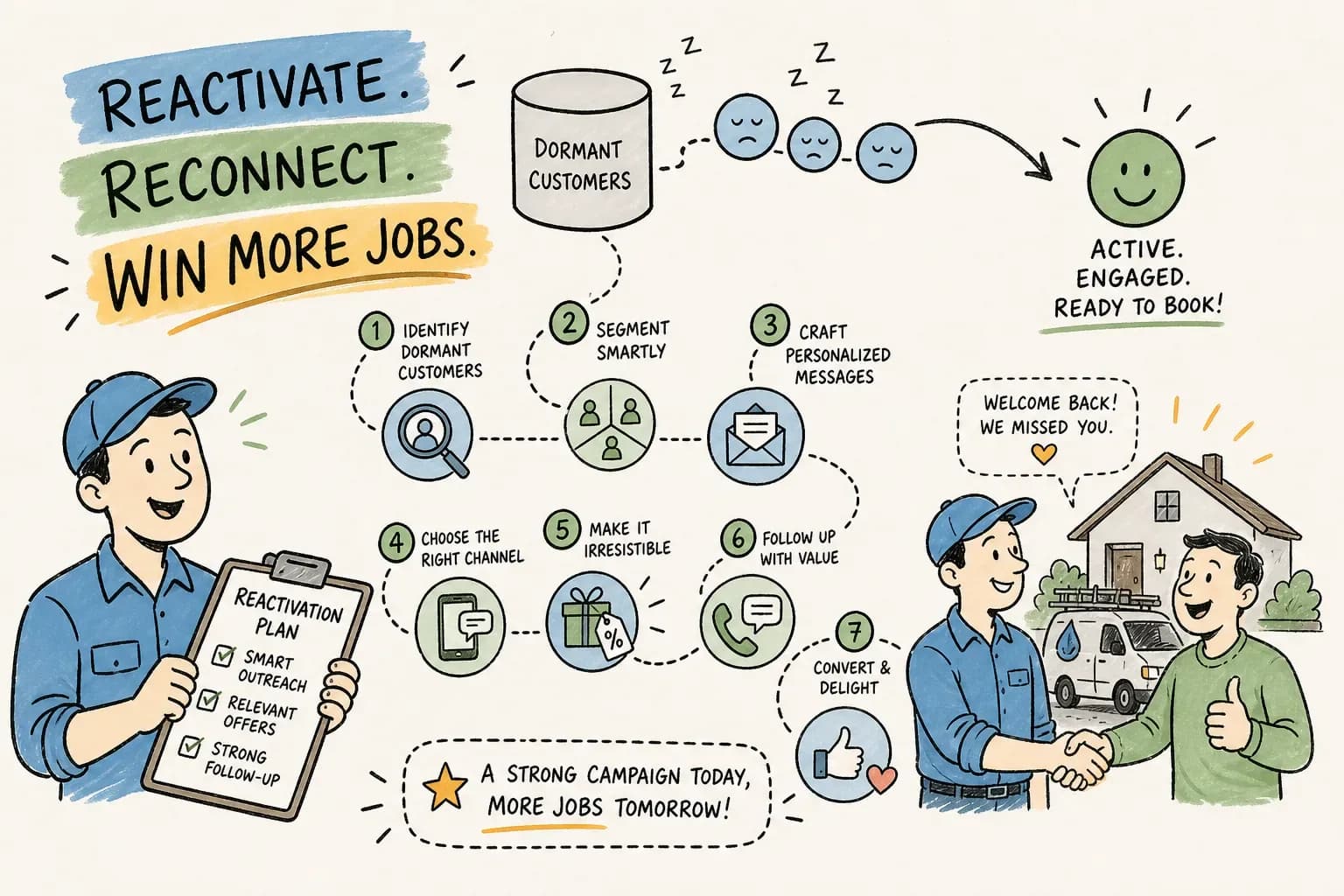
Picture this: you're an HVAC or plumbing owner spending roughly $500 a month on ads chasing cold leads, while hundreds of past customers sit quietly in your QuickBooks, untouched, uncontacted, and completely forgotten. Those customers already trust you. They've already let you into their home. And many of them will need service again within the next 12 to 24 months, whether they hear from you or not.
That old customer list is the most underused revenue asset in your shop. A well-executed database reactivation campaign can change that fast. Maximus, an AI-powered platform built specifically for home services businesses, ran a single dormant customer reactivation effort for one HVAC shop and recovered over $31,000 from contacts sitting idle in QuickBooks. No cold ads. No new leads purchased. Just a systematic approach to an existing list. This guide walks you through that exact sequence, step by step, so you can plan and launch one yourself.
Why your old customer list is more valuable than you realize
Most home services owners obsess over new lead cost while ignoring customers who already know and trust the business. The math is straightforward. If an average HVAC visit runs in the $400 to $800 range and you have 500 dormant contacts, even a 3% reactivation rate produces 15 booked jobs. That's $6,000 to $12,000 in revenue from a list you already own, with a cost per booked job that can run as low as $10, compared to $168 to $233 per booked job through paid local ads.
Timing a reactivation marketing strategy also matters more than most owners expect. Contacts who went quiet 3 months ago tend to respond at higher rates than those who've been dormant closer to 6 months, where response typically falls into the 4 to 8% range. Wait until 24 months and that rate drops to 2 to 4%. The decay is real, and it means a quarterly cadence generally outperforms a single annual blast for maintaining both deliverability and response rates. Running a re-engagement campaign before peak season, ideally 4 to 8 weeks ahead of sustained hot or cold weather, is where home services businesses consistently see the strongest return.
Not every dormant contact is the same. Customers who went quiet after three prior visits behave very differently from a lead who requested an estimate and never booked. A maintenance plan prospect who went cold needs a different message than someone who spent $800 on a repair two years ago. Treating these as separate buckets, rather than one big list, is what separates a real win-back campaign from a spray-and-pray blast.
Steps 1 and 2: Clean your data before you send anything
Bad data is not just a nuisance. Sending to hard bounces, duplicates, and stale records damages your sender reputation, which hurts the deliverability of every future email you send. Before anything goes out, run through this pre-send checklist: remove hard bounces permanently, suppress anyone who has opted out or is on a do-not-contact list, deduplicate against your master record, and scrub obviously stale entries. Then send a small test batch first so bounce signals surface before you scale the full campaign.
After the list is clean, segment what's left by recency. A useful four-tier structure is 0 to 90 days, 91 to 180 days, 181 to 365 days, and 12-plus months. The first two buckets get priority because response rates are meaningfully higher in those windows. Within each tier, sort by customer value, specifically job size and number of prior visits, so your highest-value lapsed customers receive the first and most personalized outreach. This segmentation step is what turns a reactivation effort into a targeted campaign rather than a random blast.
One compliance note that can't be skipped: a contact being dormant does not create new consent for SMS outreach. Under current TCPA rules, you need documented prior express written consent before sending marketing texts. For email, CAN-SPAM allows reactivation outreach to past customers as long as you include a valid postal address, a clear unsubscribe option, and honor opt-out requests within 10 business days. Check your list against those requirements before a single message goes out.
Steps 3 and 4: Pick your channels and build your database reactivation campaign cadence
Email is cheap, scalable, and effective at volume. For a well-segmented home services list, expect open rates in the 20 to 30% range and conversion to action around 2 to 5%. SMS is faster and more immediate: read rates run 90 to 98%, response rates 20 to 45%, and conversion can reach 21 to 30% in strong segments. Neither channel alone beats a multi-channel sequence. The most effective approach for home services is to lead with email, follow up with SMS for non-responders, and use a personal phone call or voicemail drop for high-value segments who haven't responded after two touches.
Setting the right cadence
Run 3 to 5 touches over 4 to 8 weeks. Send touch one, wait 5 to 7 days, send touch two in a different channel, wait another 5 to 7 days, then deliver a final follow-up with a hard expiry on the offer. After that, suppress non-responders. Continuing to mail a contact who hasn't responded after three to five attempts burns your sender reputation and dilutes list quality. Suppressing non-responders protects deliverability for future campaigns and keeps your focus on the contacts who are actually ready to book.
Building a reactivation email campaign sequence
Map each email to a specific job in the sequence before you write a word of copy. Touch one reintroduces context ("We serviced your unit in March 2024"). Touch two adds urgency or a specific offer. Touch three delivers the deadline. Knowing the purpose of each email before drafting it prevents the sequence from feeling like a pile of similar messages and keeps unsubscribes low.
Steps 5 and 6: Write the messages and build the offer
Subject lines for a lapsed customer winback campaign perform best when they're short, specific, and connected to the customer's actual history with your business. Question-based lines and very short subjects often outperform generic "we miss you" copy, particularly when they tie a personal context to a real need. For home services, a subject like "Still need your AC looked at?" or "Your last service was 14 months ago" works better than a generic seasonal promotion. In the body, lead with the customer's history rather than a promotion. "We serviced your unit in March 2024" is more compelling than "Check out our summer special." Get to the ask within 3 to 4 sentences and don't bury the call to action.
Offer structure matters as much as channel and copy. For customers who drifted passively, a maintenance reminder with a clear scheduling link often converts without any discount at all. For customers who have been gone longer or are price-sensitive, a specific dollar-off offer with a deadline works best. Fixed dollar amounts tend to outperform percentage discounts, and time-limited offers outperform open-ended ones. A real example that performs well: "$50 off your next service, valid through the end of the month." For leads who never converted from an estimate, lower the barrier with a free diagnostic or no-commitment inspection instead of leading with a discount.
Tailoring the offer to the segment is what separates campaigns that convert from ones that get ignored. A three-time customer who hasn't booked in 18 months needs a reminder and an easy path back. A lead who got a quote and went quiet needs a reason to act on something they already considered. Keep those two groups in separate sequences with separate messaging.
Step 7: Measure results and know when to stop
Track four numbers: open rate, response rate, conversion to booked job, and cost per booked job. A healthy lapsed customer reactivation campaign should land in the 20 to 30% open rate range for email, with 2 to 5% conversion to action. For SMS, a response rate above 10% is a conservative floor that signals a warm enough segment to continue working, though strong segments often run considerably higher. The number that matters most is revenue recovered divided by campaign cost. If cost per booked job exceeds what a cold lead would cost through paid channels, revisit the segmentation or the offer before you scale.
Set a clear suppression threshold before you launch. If a contact doesn't respond after 3 to 5 touches over 4 to 8 weeks, move them to a suppression list and revisit them on an annual basis. The goal is not to win back everyone; it is to efficiently identify and activate the 3 to 8% who are ready to book right now. Continuing to mail unresponsive contacts costs deliverability and dilutes the list quality you've worked to build.
What the campaign looks like when AI runs it for you
Every step in this guide requires real work: pulling the list, cleaning the data, segmenting by recency and value, writing the sequences, loading them into a platform, monitoring results, and suppressing non-responders. Done manually, a first database reactivation campaign typically takes 8 to 12 hours to set up and another 3 to 4 hours per follow-up cycle, assuming a small team with basic tooling in place. That's a meaningful time commitment for an owner who is already doing ride-alongs and working 60-hour weeks.
Maximus removes that manual layer entirely. It connects directly to QuickBooks, pulls customer history by last transaction date, and builds the segmented lists automatically. It then executes the outreach sequence, including email and follow-up touches, without the owner building a spreadsheet or writing a single message by hand. That's how Temperature Pros Orlando recovered over $31,000 from a single campaign. The owner didn't manage any piece of the execution. The campaign ran, the contacts responded, and the jobs were booked.
The bigger shift AI creates is consistency, not just speed. A manual reactivation campaign is a one-time event. An automated system turns it into a continuous process, where new dormant contacts are identified as they hit the time threshold, added to the sequence automatically, and worked through the same proven cadence. The owner sees a summary each morning in the 7am briefing and acts on the jobs that booked, rather than managing the outreach that generated them.
The best leads you can call are the ones who already know you
Past customers require no introduction, no trust-building, and no proof of quality. They've already experienced your work. A systematic lead revival campaign is not a marketing trick; it is a disciplined way to recover revenue already sitting inside your business, in your QuickBooks history, in your service records, and in your estimate log.
The seven steps in this guide work whether you run the campaign manually or automate it: clean the data, segment by recency and value, choose a multi-channel sequence, write specific offers, set a clear cadence, measure against real KPIs, and suppress non-responders. The biggest risk is not running the campaign imperfectly. It is never running it at all while spending on cold traffic.
Start your database reactivation campaign by opening your QuickBooks history right now and counting the contacts who haven't booked in the past 12 months. Then ask what a 3% reactivation rate would mean for this quarter's revenue. If you want to see how Maximus automates this entire process for home services businesses, without adding headcount or building spreadsheets, schedule a demo and see it built around your actual list.