AI Office Manager for HVAC: The Real Cost Comparison
Many HVAC owners who feel buried in office work reach for the same solution: hire someone.
AI Office Manager for HVAC: The Real Cost Comparison
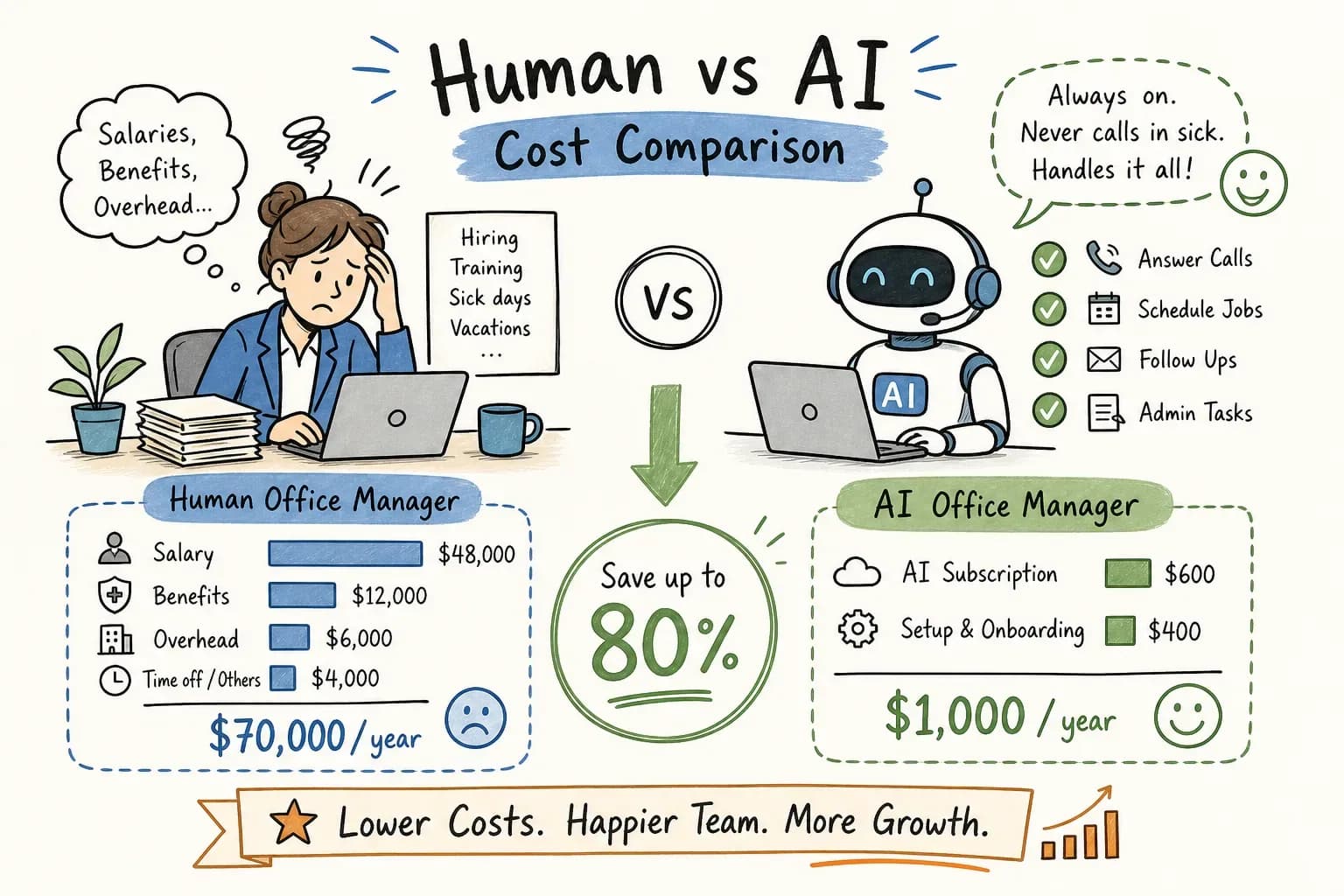
Many HVAC owners who feel buried in office work reach for the same solution: hire someone. They post a job, spend several weeks finding the right person, spend several more months getting them trained, and then discover the chaos didn't stop. It just got more expensive. The smarter move is running the actual comparison, what does a full-time office manager cost your business, and what does an AI office manager for HVAC handle for a fraction of that number? The answer is more lopsided than most owners expect.
That comparison is exactly what pushed us to build Maximus inside Temperature Pros Orlando, our own HVAC company. The numbers were hard to ignore. This article lays out what each option actually costs and what each one actually does, so you can make a decision based on math rather than intuition.
What a Full-Time Office Manager Actually Costs Your HVAC Business
Salary is just the starting number
The national average base salary for an office manager at a small HVAC company sits around $51,500 in 2026, with small shops often landing in the $40,000 to $42,000 range for less experienced hires (based on ZipRecruiter 2026 benchmarks). That number feels manageable until you add what's sitting underneath it. Employer payroll taxes, health insurance, dental and vision, workers' comp, PTO, and the recruiting and training costs you absorb during the first few months push the total loaded cost to $60,000 on the low end and $77,000 or more for experienced managers.
The number most owners think they're paying and the number they're actually paying are rarely the same. Budget $40,000 in salary, and you're spending closer to $56,000 to $60,000 by the time you account for everything else. That gap matters when you're comparing options.
The hours a full-time employee still can't cover
A full-time office manager works roughly 40 hours a week. HVAC calls don't respect that schedule. After-hours calls, weekend emergencies, and the Monday morning voicemail backlog are exactly where revenue disappears. Based on home services industry benchmarks, the average call answer rate for businesses without an automated system sits at 60 to 75%, meaning up to 40% of inbound calls never reach a human.
After 5 PM, that number gets worse. Field service industry studies put the after-hours unanswered rate for HVAC calls at 67% or higher, with figures exceeding 90% on weekends at smaller shops. An unanswered call at 7 PM during a heat wave isn't a missed message. It's a job that went to a competitor, and the average emergency call in this industry carries a ticket value of $1,400 to $1,847, based on ServiceTitan job-value data.
AI Office Manager for HVAC: What Automation Handles That a Human Employee Can't
Around-the-clock call answering and job booking
A virtual receptionist built for HVAC answers inbound calls in seconds, captures job details, books appointments directly into your scheduling system, and routes real emergencies to on-call staff automatically. Dramatically fewer missed calls, dramatically less voicemail. The performance gap between this and manual answering is significant: AI-driven call answering achieves a 95 to 100% answer rate versus the manual baseline of 60 to 75%, and lead-to-booking ratios of 68% compared to the industry manual average of 25%, according to published platform benchmarks.
That difference compounds fast. If your shop gets 10 after-hours calls a week and converts 25% manually, you're booking 2.5 jobs. At a 68% booking rate with automated answering, that's nearly 7 jobs from the same call volume. Same phone, same leads, meaningfully different revenue.
Invoice chasing and dormant customer reactivation
This is where most owners are sitting on money they don't realize is there. The average HVAC company writes off 2.1% of annual revenue in bad debt when invoices go unpursued, $21,000 in losses for every $1 million in revenue. A capable AI office platform monitors aging accounts receivable and sends follow-up messages on invoices past 30 and 60 days automatically, without anyone having to remember to do it.
The same system can pull dormant customer records directly from QuickBooks and run a reactivation sequence without any manual list-building. At Temperature Pros Orlando, Maximus collected $12,400 in aging AR within 90 days and recovered $31,000 from a single reactivation campaign. Those are real figures from our own operation, not projected revenue or theoretical upside. Industry benchmarks show that well-segmented reactivation campaigns in home services typically convert 10 to 15% of dormant customers, and the data to run them is already in your QuickBooks history.
AI Office Manager for HVAC vs. Hiring: The Side-by-Side Comparison Most Vendors Won't Show You
Cost and deployment time
A full-time office manager costs $60,000 to $77,000 per year. Based on typical HR and vendor timelines, expect several weeks to a few months to hire, onboard, and get someone fully operational. A full-service AI office platform with integrations runs $1,000 to $3,000 per month, with some managed deployments going live in 48 to 72 hours, though full optimization can take longer depending on scope. It doesn't require PTO, leave for a better offer, or clock out at 5 PM. At the top end of that pricing range, you're still under $36,000 annually. For smaller shops that only need after-hours call answering to start, entry-level AI answering platforms begin at $49 to $200 per month.
The deployment gap is also worth noting. Traditional software implementations often run 90 days or more before they're production-ready. Modern AI virtual receptionists for home services can be answering live calls within 48 hours of setup in many cases, which means you're not waiting months to see results.
What each option actually covers
A well-organized human office manager handles scheduling, customer calls during business hours, and invoice follow-up. That's genuinely useful, and a person brings judgment to complex customer situations and nuanced pricing conversations that software doesn't replicate. That distinction matters, and it's worth being honest about it.
An AI-driven field service office assistant covers what a person can't sustain around the clock: 11 PM calls, automatic invoice follow-up, dormant customer outreach, review monitoring, and a daily briefing on overnight activity. It doesn't replace good judgment on hard situations. It clears the repetitive, high-volume work that's been consuming time your team doesn't have. For most $1M to $5M HVAC shops, that's where the real operational drag lives.
Why Your Existing Software is Already Sitting on The Answer
The integration gap most HVAC shops have
Most shops running Jobber, ServiceTitan, or Housecall Pro have more data in those platforms than they're using. Aging AR, dormant customer history, missed calls, underquoted jobs, all of it is sitting there. The problem isn't data. It's that nobody has time to act on it. A disconnected AI tool that doesn't read your field service management software adds work instead of removing it, because someone still has to manually move information between systems.
The integration matters as much as the feature list. An AI answering service that doesn't write to your scheduling board isn't solving the workflow problem, it's creating a new one. Think about what a broken version of that looks like in practice: a call gets answered, a job gets promised, and then someone has to re-enter that booking by hand the next morning because nothing connected.
How Maximus connects your stack without replacing it
Maximus was built to sit on top of the tools HVAC owners already use. It integrates with Jobber, ServiceTitan, Housecall Pro, and QuickBooks, pulling live data to flag aged invoices, identify dormant customers, and book jobs directly into the existing schedule. Every feature in the platform was developed and pressure-tested inside Temperature Pros Orlando, a real $1M to $5M HVAC operation, before it was made available to any other shop.
That context matters. Enterprise AI tools designed for 50-truck fleets solve different problems than a single owner-operator running 60-hour weeks. Maximus is specifically built for the $1M to $5M revenue range, which is why the integrations address the problems that actually show up at that size. Customers also get a monthly working session with the founder, who runs an active HVAC company and reviews system findings alongside you, a different kind of vendor relationship than submitting a support ticket and waiting three days for a reply.
How to Pilot This Without Disrupting Your Operation
Start with the one workflow that costs you the most
The standard advice on AI implementation is to start small and prove value before scaling. For most HVAC shops, after-hours call answering is the right starting point. It's the easiest workflow to implement, the fastest to show ROI, and it doesn't touch your existing daytime operation at all. Your office staff keeps doing what they do during business hours. The AI handles what happens when they're gone.
Within 30 days, you'll have real data on exactly how many calls you were missing and what that was costing you in booked jobs. That's a concrete number, not an estimate, and it becomes the foundation for deciding whether to expand coverage from there.
What to measure in the first 90 days
Set three specific metrics before you start: calls answered after hours, invoices flagged and collected past 30 days, dormant customer reactivations initiated. Track those numbers weekly. By day 90, you'll have enough data to decide whether to expand to full AI reception coverage, add invoice automation, or hold at the after-hours layer until you're confident in the returns.
The businesses that see real results from AI office automation treat it as an operational rollout with clear metrics, not a software purchase they forget about. The technology deploys fast. The discipline of measuring it is what separates shops that see ROI in 60 days from shops that cancel after 90 because they never tracked anything.
The Math is Clear Enough
The choice between hiring and automating isn't about replacing people. It's about deciding which problems a $60,000 salary should be solving and which ones an ai office manager hvac platform can handle for a fraction of the cost. The money you're losing to after-hours calls, aging invoices, and dormant customers sitting in your QuickBooks history isn't a people problem. It's a systems problem.
The right AI platform doesn't replace good judgment. It clears the daily grind so that time can go toward growing the business, or toward getting out of the business sooner. The numbers are what they are. The next step is running a 30-day pilot and seeing what they look like in your own shop.
If you want to see how Maximus works inside an actual HVAC operation before committing to anything, the founding cohort is open to shops in the $1M to $5M range. Many customers are live within 48 hours of setup. Expect measurable results within the first 30 to 90 days, depending on scope.
Frequently Asked Questions About AI Office Managers for HVAC
What does an AI office manager for HVAC actually do?
An AI office manager for HVAC handles inbound call answering, appointment booking, invoice follow-up, and dormant customer outreach, automatically and around the clock. It integrates with field service management tools like Jobber, ServiceTitan, and Housecall Pro to act on live data rather than requiring manual input.
How does AI office manager cost compare to hiring a full-time employee?
A full-time office manager typically costs $60,000 to $77,000 per year when you factor in loaded costs. A full-service AI office platform runs $1,000 to $3,000 per month, under $36,000 annually at the top end. Entry-level AI answering tools start at $49 to $200 per month for shops with simpler needs.
What is HVAC automation software, and is it different from an AI office manager?
HVAC automation software is a broad category that includes scheduling tools, dispatch software, and CRM systems. An AI office manager goes further: it actively answers calls, chases invoices, reactivates dormant customers, and surfaces insights from your data, functioning more like a staff member than a passive tool.
How quickly can AI dispatch and scheduling for HVAC be set up?
Many managed AI platforms can be answering live calls within 48 hours of setup. Full optimization, including invoice automation and dormant customer reactivation, typically develops over the first 30 to 90 days as the system works through your existing data.