Best Route Optimization Software for Field Service Teams
Choosing the best route optimization software for your field service team is one of the highest-leverage decisions you can make for a growing operation.
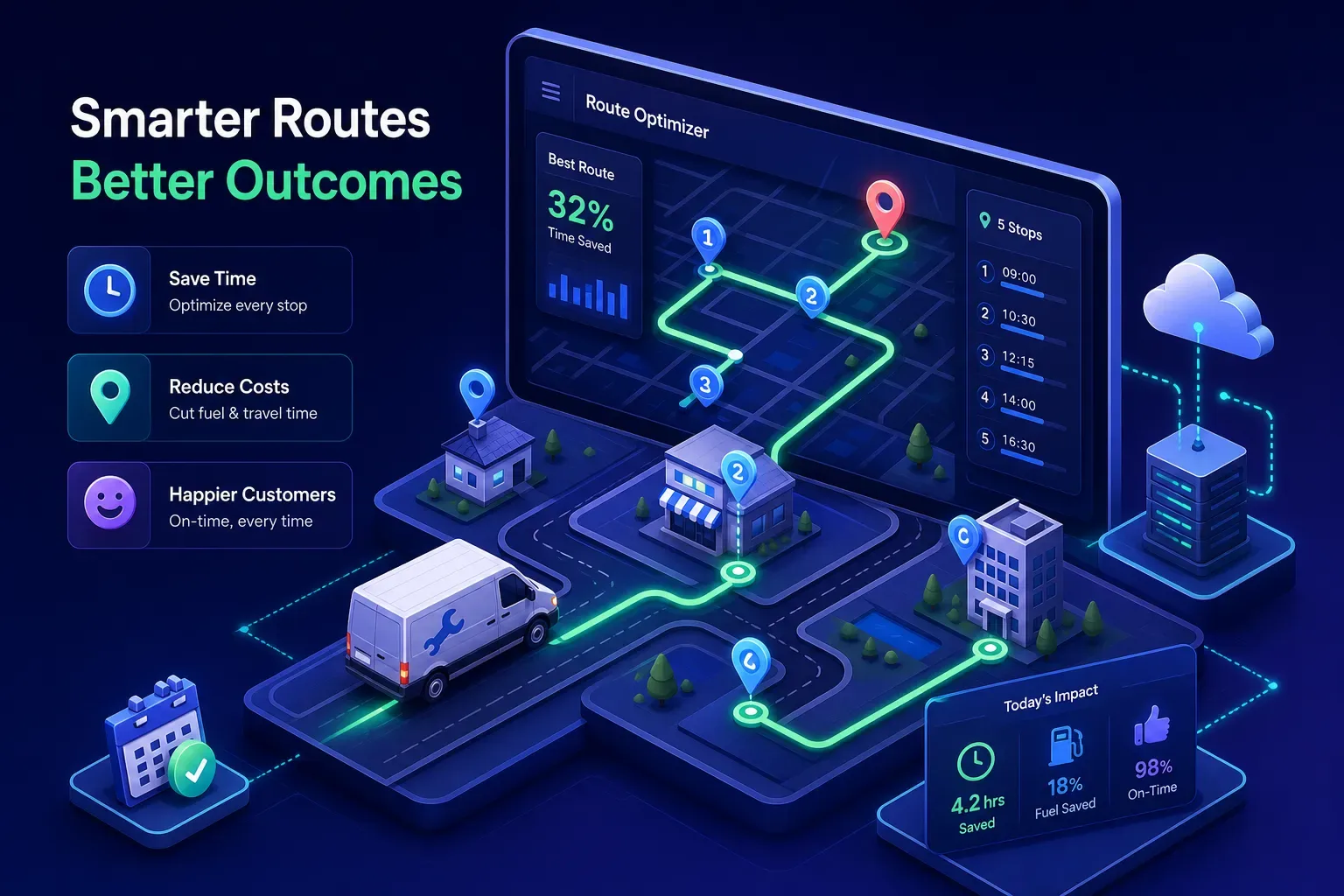
Choosing the best route optimization software for your field service team is one of the highest-leverage decisions you can make for a growing operation. Businesses that implement route optimization typically cut fuel costs by 10, 25% and shorten drive time by 15, 30%. For a 5-truck operation running full days, that's not a minor efficiency gain, that's one to two extra service calls per truck per week, which at an average ticket of $250 adds up fast. The problem is that most operators are still routing manually, burning dispatch time and money they don't have to lose.
This article breaks down the leading route optimization software options for field service teams in 2026, covering real pricing, standout features, integration fit with tools like Jobber and ServiceTitan, and the metrics that actually tell you whether a platform is worth deploying. By the end, you'll have a clear shortlist and a framework to evaluate vendors without wasting time on demos that go nowhere.
Best Route Optimization Software for Field Service: What Separates Good from Great
Not all route planning software is built for field service. Delivery-focused tools, what some call last-mile delivery software or delivery route planners, optimize for stop density and package volume. Field service routing has different constraints: technician skills, job duration estimates, service windows, and return trips for parts. Before comparing any platform, you need to know which features actually move the needle for your operation.
The features that matter most for service-based fleets
Dynamic rerouting is the most critical feature for field service teams. When jobs cancel or run long, your route plan needs to rebuild around it in real time. Beyond that, you need vehicle capacity and skill-based constraints so the right tech gets dispatched to the right job, plus multi-stop optimization that accounts for real traffic rather than just distance.
Without dynamic rerouting, a route plan becomes obsolete the moment your 9am job runs 45 minutes long. That single failure cascades through the rest of the day, costing you two or three jobs worth of windshield time.
Integration fit with Jobber, ServiceTitan, and the tools you already use
If your team runs Jobber or ServiceTitan for dispatch and job management, your route optimization tool needs to pull job data from that system cleanly. A standalone route planner that requires manual CSV imports every morning adds admin work instead of removing it. Look for native integrations or a reliable API before anything else. Many platforms connect through Zapier or open APIs, which is workable, but a direct integration is always the lower-friction path.
Setup time and learning curve for a small fleet
For a 3, 10 truck operation, the fastest platforms can have you operational in as little as 48 hours. Enterprise deployments stretch to 3, 6 months, but that's not your reality if you're running a tight crew. If you can't afford weeks of onboarding while managing dispatch at the same time, setup timeline matters as much as the feature list when you're comparing vendors.
Top Route Optimization Software Options for Field Service in 2026
Here's how the leading platforms stack up on the factors that matter most for field service owner-operators. These aren't ranked by marketing budget. They're ranked by fit for the typical 1, 15 truck field service shop.
Routific: best for transparent pricing and fast deployment
Routific earns a 4.8/5 on G2 and offers a free plan up to 100 orders per month, with paid tiers starting at $150/month for up to 1,000 orders. It's clean, fast to set up, and well-suited for small to mid-size field service teams that need straightforward multi-stop optimization without a heavy learning curve. It lacks some of the advanced constraint handling that larger operations need, but for most teams under 10 trucks, it covers the essentials well. The transparent pricing model alone puts it ahead of most competitors for budget planning.
OptimoRoute: best for skill-based dispatching and real-time adjustment
OptimoRoute starts at $35.10 per driver per month billed annually, making it one of the more affordable per-seat options for growing fleets. It supports skill-based routing, dynamic re-optimization, and real-time adjustments as jobs shift during the day. It also carries a 4.8/5 G2 rating. Based on G2 reviewer feedback, it's a well-regarded option for field service use cases where job types vary by technician certification or experience. For a 5-truck HVAC shop where not every tech handles every job type, that constraint-matching capability is the difference between a route plan that works and one that creates callbacks.
Route4Me and Upper: best for complex routing needs and budget-conscious teams
Route4Me is the power option for operations with multi-depot routing, API integrations, and complex constraint management. Pricing is quote-based, which means it tends to serve mid-size and larger fleets. Upper comes in at $80/month billed annually and is a solid mid-range pick for teams that need more stop volume than Routific's free tier allows but don't need the enterprise depth of Route4Me or Descartes. Upper also handles dynamic rerouting well for its price point, re-sequencing stops and adjusting ETAs when conditions change mid-route.
What Real-World Savings Look Like After Implementation
Vendor numbers are one thing. What field service businesses actually report after deploying vehicle routing software tells a more useful story, and the data is consistent across platforms and case studies.
Fuel, time, and cost benchmarks from real deployments
Based on self-reported data from platforms including Routific and OptimoRoute, the consistent ranges are: 10, 25% reduction in fuel costs, 15, 30% drop in total drive time, and 12, 25% improvement in overall transportation costs. For a 5-truck operation spending $4,000 per month on fuel, a 15% reduction is $600 back per month. That's $7,200 a year from routing alone, not counting the revenue from the extra jobs those freed-up hours enable.
How extra capacity translates to added revenue
When drive time drops, your techs gain time in the day. Consider a 30-minute reduction in daily drive time per tech, across five techs, over 250 working days. That's over 600 hours recovered annually. At an average ticket of $250, converting even half of that recovered time into one additional job per tech per week generates meaningful top-line growth.
HVAC-specific data backs this up: optimized fleets commonly report 1, 2 additional service calls per technician per day. That's the real ROI case for fleet routing optimization, and it's one most operators underestimate when they're evaluating route scheduling tools.
Where Free and Entry-Level Route Planners Hit Their Limits
Free tools are useful until they're not. For field service teams doing more than occasional routing, the constraints show up fast and they show up in the places that matter most.
Stop counts and traffic data gaps
Most free route planner apps cap out at 8, 26 stops per route, with many sitting at 10, 20. RouteXL, for example, caps the free tier at 20 stops. That's fine for a one-truck residential crew on a light day, but it breaks down quickly for multi-tech dispatching.
Beyond stop counts, free tools typically offer basic traffic-aware navigation rather than genuine traffic-based route optimization. The distinction matters: traffic-aware means it shows you traffic. Traffic-optimized means it recalculates the route around it. For a full day of service calls, that difference can mean 45 minutes of avoidable windshield time per tech.
Driver communication and dispatch features locked behind paywalls
Free tiers almost universally strip out live driver tracking, customer arrival notifications, proof of delivery, and dispatcher-to-driver messaging. These aren't premium luxuries for a field service business. They're the tools that keep your techs accountable and your customers from calling the office asking where their tech is. Once you account for the time your office spends fielding those status calls, the cost of a paid tier often pays for itself in hours saved within the first month.
The Piece Most Operators Overlook After Optimizing Their Routes
Here's what the routing software conversation almost always misses. You optimize routes, your techs gain 30, 45 minutes of recovered time per day, and suddenly you have capacity to fit in one more job per tech. But that extra slot only converts to revenue if someone is there to book it when the call comes in.
More job capacity means more inbound calls to handle
Tighter routing creates a predictable scheduling gap mid-day or at the end of the route. Filling that gap requires fast booking, especially for same-day or next-day calls. If those calls hit voicemail after hours or during a dispatch crunch, the capacity disappears unused. This is the gap that catches most growing field service operations off guard, and it's not something any route optimization platform solves on its own.
How AI-powered booking closes the loop without adding staff
This is where pairing the best route optimization software with a platform like Maximus changes the equation. Maximus handles 24/7 call answering and job booking, integrating directly with Jobber and ServiceTitan so that when a customer calls to schedule the job your newly optimized route just made room for, the booking gets confirmed automatically. The extra revenue from tighter routing actually lands on the books instead of going to a competitor who answered the phone. No additional office staff required, and no missed calls during the dispatch window when your team is heads-down in the field.
How to Choose the Right Route Optimization Tool for Your Operation
With the platforms and their tradeoffs clear, narrowing to a shortlist comes down to three practical filters: fleet size, stop volume per day, and whether you need skill-based dispatching. The answers to those three questions will eliminate half the market before you ever book a demo.
Match the tool to your fleet size and stop volume
For fleets under 5 trucks with straightforward routing, Routific or Upper cover most needs and deploy fast. For 5, 15 trucks with variable job types and skill constraints, OptimoRoute is the strongest fit at a per-driver price that scales predictably. For complex operations with multi-depot routing, API integration needs, or large stop volumes, Route4Me or Descartes are the right tier, with the understanding that implementation will take longer and pricing will require a sales conversation.
The four questions worth asking every vendor before signing
Before you book a demo, get clear answers on four things. First, how does their tool handle dynamic rerouting when jobs run long or cancel mid-day? Second, do they have a native integration with your field service management software? Third, what is the realistic onboarding timeline for a team your size? And fourth, is there a trial period using your actual job data before you commit? The answers to those four questions cut through any sales pitch faster than any feature comparison chart.
Getting This Right Matters More Than Picking the Perfect Tool
The best route optimization software for your field service team is the one that fits your fleet size, connects to the dispatch system you already use, and actually gets deployed. Routific, OptimoRoute, and Upper cover the majority of field service operations from small crews to growing mid-size fleets, with clear pricing and realistic setup timelines. Start there, verify the integration story with your FSM platform, and run a trial with real job data before you commit.
The bigger opportunity is what you do with the time and capacity you recover. Tighter routing creates room for more jobs. A platform like Maximus ensures that room gets filled, with 24/7 booking and direct Jobber and ServiceTitan integration, so every call that comes in after hours or during a busy dispatch window turns into booked revenue instead of a missed opportunity. Route optimization gets your techs on the road more efficiently. The right front-office automation makes sure the revenue follows. If you want to see how Maximus fits into that picture for your shop, book a call and we'll walk through it operator to operator.