Does Maximus AI Actually Work for HVAC Businesses?
So, does Maximus AI actually work for HVAC businesses? That's the right question, and it deserves a straight answer, not a pitch deck.
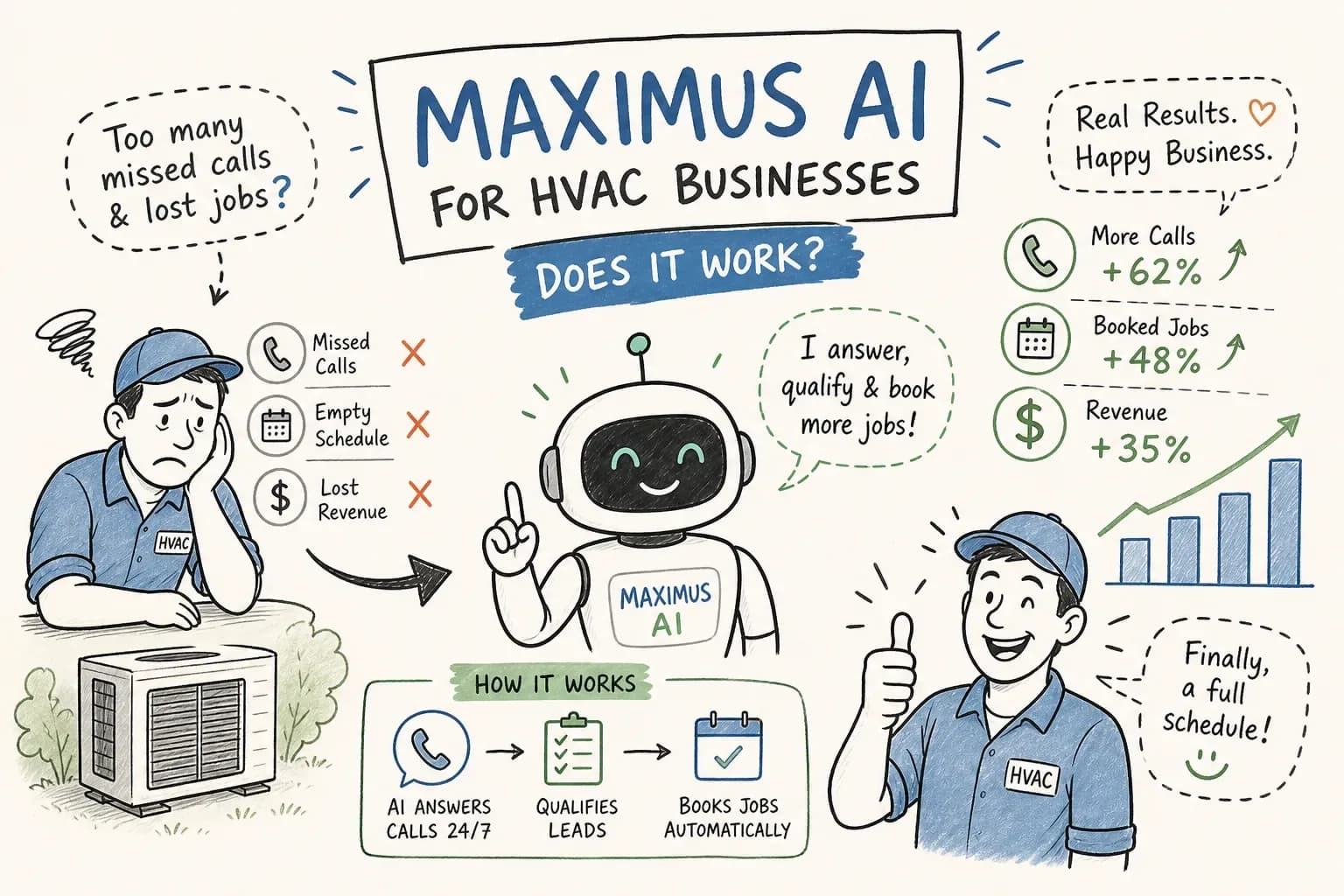
So, does Maximus AI actually work for HVAC businesses? That's the right question, and it deserves a straight answer, not a pitch deck. This article is a documented look at what happened when Maximus AI ran inside Temperature Pros Orlando, a working HVAC company the Maximus founders own and operate, for 90 days. The numbers came from the P&L, not a marketing slide. By the end, you'll know exactly whether Maximus AI belongs in your shop or not.
Most software vendors selling to HVAC owners make the same promises. They'll fix your phones. They'll chase your invoices. They'll free up your weekends. Many of them have spent their careers optimizing for demo appeal rather than field reality, so they build tools that look clean on a screen and create friction in the real world.
Why HVAC owners are right to be skeptical of AI tools
A lot of "AI for contractors" products are answering bots with a new logo. They answer a call, read from a script, and fall apart the moment a customer says something off-script. That's not a cynical take, it's a fair description of how many contractor AI tools on the market actually behave.
The real question isn't whether AI can answer a phone. It's whether it can handle the judgment calls that run through your front office every single day: routing an emergency no-cool call at 10pm, flagging the invoice that's been sitting 47 days, knowing when to book versus when to escalate. Those decisions require context, and many platforms are built by engineers who have never made them.
Most AI tools are built by people who've never run a shop
SaaS companies optimize for scale metrics and demo appeal. They are not optimizing for the HVAC owner who is personally handling Saturday dispatch while riding along on a job. The result is software that generates friction instead of removing it. Maximus was built and battle-tested inside an actual HVAC business before it was ever sold to anyone else. That's the core difference, and it shows in how the features are designed.
What a legitimate Maximus AI review actually needs to show
Real evidence means documented revenue recovered, not pipeline estimates. It means booking rate data with a before-and-after comparison. It means AR collection numbers pulled from actual financials. The rest of this article delivers exactly that, so you can make a real decision rather than a marketing-influenced one.
What Maximus actually does in your shop
The easiest way to understand Maximus AI for HVAC businesses is to walk through what a typical shop day looks like without it, and then with it. The 11pm emergency call that nobody answered: Maximus picks it up, asks the right triage questions, and routes it to the on-call tech immediately. The invoice that has been sitting for 47 days because everyone was too busy to make an awkward call: Maximus flags it and initiates follow-up automatically. The customer who hasn't called in 14 months: Maximus identifies them from QuickBooks history and sends a reactivation message.
HVAC AI call answering and after-hours job booking
Every inbound call gets answered. Maximus asks HVAC-specific triage questions, whether it's a no-cool, no-heat, or equipment-age situation, and routes urgent calls to the on-call tech right away. Routine appointments book directly into Jobber, Housecall Pro, or ServiceTitan without anyone touching a keyboard. The missed call at 9:15pm that would have gone to a competitor by morning doesn't happen anymore.
That's not a small thing. Based on data from shops in the Maximus network, small HVAC operations without dedicated call handling book roughly 20 to 25 percent of their inbound calls. The calls they're not booking are going somewhere, usually to a competitor who picked up the phone.
Accounts receivable chasing and invoice follow-up
The average small HVAC shop has aging AR sitting untouched because the owner is on a job and the office staff has a full queue. Invoices drift past 30 days, then 60 days, and at that point the recovery rate drops fast. Maximus flags invoices past 30 and 60 days and handles follow-up automatically, without the owner needing to make a single payment call. The $12,400 collected at Temperature Pros Orlando in 90 days didn't require a collections agency. It required a consistent system doing what a busy owner never has time to do.
Dormant customer reactivation and the 7am morning briefing
Two features that most owners don't know they need until they see the results. The reactivation campaigns pull directly from QuickBooks history, via OAuth connection, to find customers who haven't booked in 12 to 24 months, then send a short sequence of personalized messages to bring them back. The daily 7am briefing tells you what was handled overnight, what needs attention today, and what your financial picture looks like right now. Owning a business shouldn't mean starting every day by reconstructing yesterday from memory.
Does Maximus AI actually work for HVAC businesses? The 90-day results
These numbers came from a working HVAC company and were verified by the P&L. Three specific outcomes.
$31,247 recovered from a single dormant customer campaign
QuickBooks history was queried, dormant customers were identified, reactivation messages went out, and booked jobs were tracked back to the campaign. On a $1M to $3M HVAC shop, $31,247 from customers already in your system represents meaningful recovered margin without a single dollar spent on advertising. The customers already knew the company. They just needed a reason to call again.
$12,400 in accounts receivable collected within 90 days
Aging AR in a typical HVAC operation doesn't get chased because the owner is busy, the office manager moves on to the next open task, and invoices age past the point where anyone wants to make the call. Maximus handled this automatically. No awkward conversations, no time spent by the owner tracking down payments. The $12,400 was already owed. It just needed a consistent follow-up system to collect it.
Booking rate climbed from 40.2% to 91.7%
A 40 percent booking rate means more than half of every inbound call either doesn't become an appointment or requires a callback that sometimes never happens. At 91.7 percent, nearly every call that comes in becomes a job on the board. Run the math for your shop: if you're fielding 100 inbound calls a month at 40 percent, you're booking 40 jobs. At 91.7 percent, you're booking 92. That gap is larger than most ad campaigns ever close.
Integrations, setup, and what deployment actually looks like
Maximus layers on top of what you already run. You don't pull out ServiceTitan or Jobber. You connect Maximus to them and it handles the front-office functions those platforms don't cover.
Which platforms connect natively
Confirmed integrations include Jobber, Housecall Pro, ServiceTitan, QuickBooks via OAuth, Google Business Profile, and your existing phone system. If your shop runs on simPRO or something outside that list, the setup requires a direct conversation before you apply. No integration should be assumed. If you're not sure whether your stack connects, ask during the application process.
What 48-hour deployment actually means
Before Maximus touches a real call, it's trained on your shop's pricing, service area, staff names, and voice. The 48-hour timeline is real, but it works because the setup is tightly scoped to what the platform needs to operate correctly. Monthly one-on-one working sessions with the founder are also included, operator-to-operator conversations, not support tickets. That kind of direct access isn't something a standard SaaS subscription delivers.
Who this is built for (and who it isn't)
Maximus is not a tool for a 15-location franchise with a dedicated operations team. It was built specifically for the $1M to $5M owner-operator who is still running the front office themselves or with one person, and who can't yet justify a full-time office manager but needs one.
The shop profile that gets the most out of Maximus AI
You're doing ride-alongs. You're answering calls yourself at 7pm. You chase invoices once a month when you remember to. You've been saying you'll hire a full-time office manager when revenue gets a little higher, but revenue keeps growing and the hire keeps getting pushed. That's the exact problem Maximus was designed to solve.
If you're also thinking about an exit in the next five years, the operational documentation and process layer Maximus builds has real dollar value to a private equity buyer or strategic acquirer. Clean operations, documented systems, and a business that doesn't depend entirely on one person command higher multiples from buyers. That's not a pitch. That's how buyers actually score a deal.
Honest reasons it might not be right for you
If you already have a trained front office team of three or more people with clear ownership of phones, AR, and day-to-day admin, the incremental value of Maximus shrinks. If you're under $500K in revenue, the investment likely doesn't pencil at this stage. And if your shop runs on software that isn't on the confirmed integration list, the right next step is a conversation, not an application. Maximus isn't the right tool for every shop, and there's no point pretending otherwise.
The founding cohort: 20 spots and what they include
The founding cohort is capped at 20 HVAC shops in the $1M to $5M range. This is not a waitlist for a future product. Maximus is live, running in real shops right now, and the cohort is structured to give founding members direct access to the people who built it.
Founding members get monthly one-on-one working sessions with the founder, operator to operator, not sales rep to owner. They get priority access to new features and pricing that reflects early adopter positioning. If you've ever sat through a SaaS onboarding call where someone reads a slide deck at you, this is the opposite of that experience.
If the profile in the previous section describes your shop, the application takes a few minutes. Either it's the right fit or it isn't, and that conversation will tell you which. Apply for the Maximus founding cohort here.
The honest summary: Does Maximus AI work for HVAC businesses?
Yes, with one clarification. "Works" means something specific. Maximus AI for HVAC businesses recovers dormant revenue, collects AR you've stopped chasing, and answers every call your shop would otherwise miss. The $31,247 and $12,400 figures from Temperature Pros Orlando are documented from the P&L, not projected from a model.
If you're running a $1M to $5M shop and you're still personally holding the front office together, this is the kind of tool that changes what your week looks like. Not because it's impressive technology, but because it does the specific work that currently isn't getting done. So does Maximus AI actually work for HVAC businesses at your revenue level? Apply or don't. At least now you know what the evidence actually shows.