HouseCall Pro Website Pricing: What You Actually Get at Each Tier
Most shop owners searching for HouseCall Pro website pricing expect a single number.
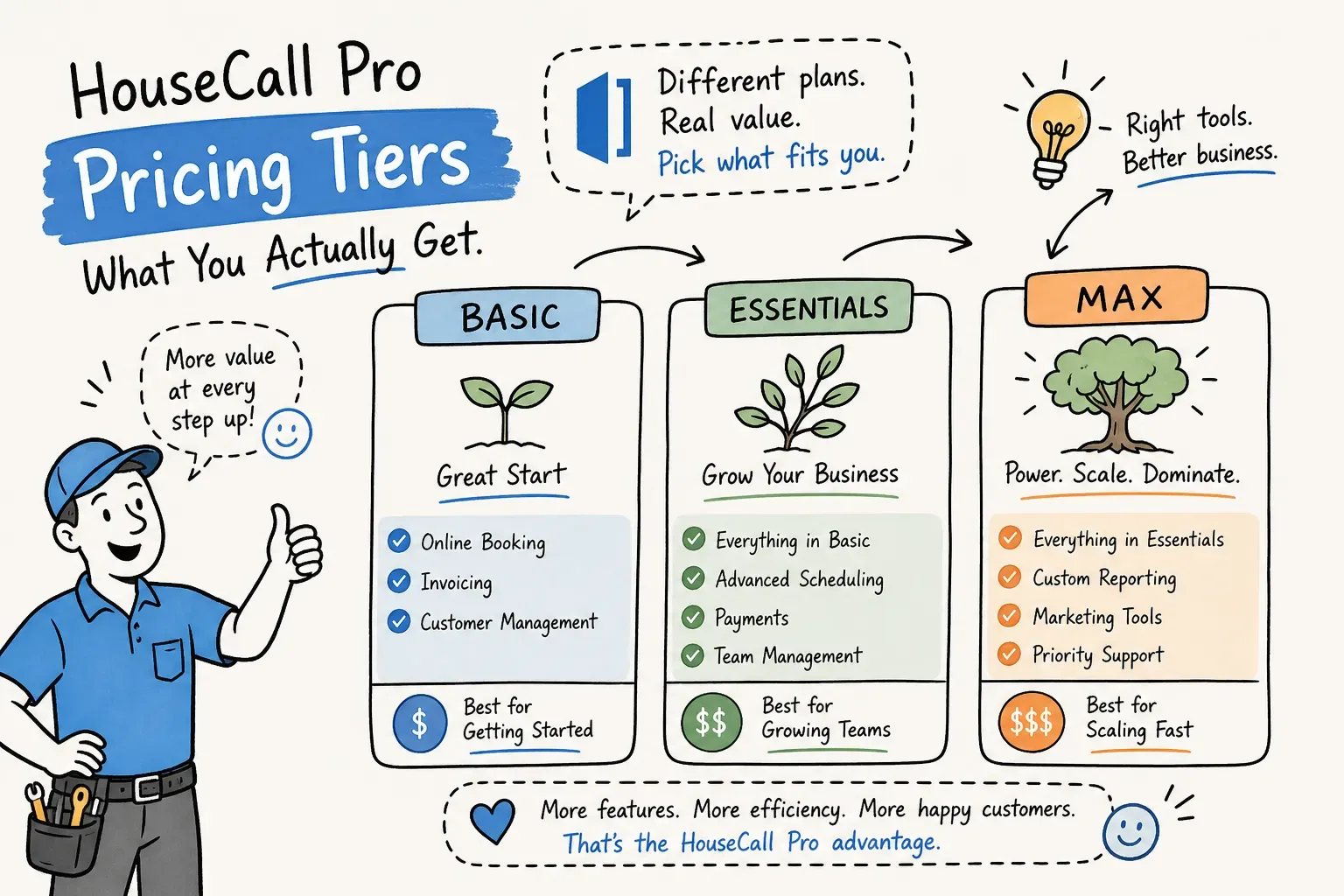
Most shop owners searching for HouseCall Pro website pricing expect a single number. What they find is three software tiers, a separate website builder product, per-user seat fees, and transaction percentages on every dollar they collect. The number on the pricing page is a starting point, not a finish line. This breakdown lays out every layer of HouseCall Pro website pricing and plans so you can build a real estimate before you commit your credit card. And at the end, there's one operational gap worth naming that no FSM subscription, at any price, actually closes.
HouseCall Pro is a legitimate platform with real users who get real value from it. This isn't a hit piece, it's an honest look at what the platform actually costs and what you're getting at each tier so you can make a clean decision for your shop.
HouseCall Pro's three base plans: the number before anything else
What Basic, Essentials, and MAX actually cost
HouseCall Pro publishes three core tiers. On annual billing, those run $59/mo for Basic, $149/mo for Essentials, and $299/mo for MAX. Pay month-to-month and those numbers jump to $79, $189, and $329. The annual discount is real: for a shop on the MAX plan, committing to a year saves $360 before you add a single feature or extra user.
User seat limits by tier and why they matter early
Each tier caps the number of users who can access the system. Basic covers one user, Essentials covers five, and MAX covers eight. If your team runs two techs and a part-time office person right now, Essentials is likely your entry point. Every person who needs system access beyond the included seats adds to the bill, and that math catches a lot of growing shops off guard mid-year.
Annual vs. monthly billing: when the math tips one way
Annual billing makes sense if you're confident in the platform and plan to stay through the seasons. Month-to-month is useful when you're still evaluating or mid-season and want flexibility to exit. Factor in the full annual commitment before signing. Customers have reported billing complications when switching plans mid-year, so going in with eyes open saves a support call later.
HouseCall Pro website pricing: website builder costs and tiers
Why the website product is separate from the core subscription
HouseCall Pro's website builder is not bundled into the base plans automatically. It's a distinct add-on offered in three tiers: a 1-page site, a 5-page site, and a 15-page site. HouseCall Pro builds and manages the site on your behalf, which is genuinely useful if you don't want to juggle a separate web host, SSL setup, and maintenance. It's a done-for-you product, not a DIY builder like Squarespace or Wix.
What every website plan includes
Regardless of the tier you pick, the website product includes secure hosting, site encryption, online booking integration, and the ability to take payments directly from the site or from Google. Customers can send messages directly into your HouseCall Pro inbox from the site, which keeps communication in one place rather than scattered across email and voicemail. A built-in analytics dashboard tracks basic site performance without requiring a separate Google Analytics setup.
On the SEO side, HouseCall Pro handles the technical basics for you:
- Keyword placement and meta tags
- Alt text and mobile optimization
- Page-speed tuning
- Google Search Console setup
For a shop that needs a credible web presence that converts calls and bookings, that coverage is solid. Where it falls short compared to standalone website builders is content depth: no blog, limited landing page flexibility, and less room to build a broader content marketing strategy over time.
What the website tiers don't spell out clearly
The official pricing page lists the tiers by page count but does not prominently publish a separate dollar amount for the website add-on independent of the core subscription. Before committing, ask a sales rep for the exact monthly cost of the page tier you want so you know your combined monthly total from day one. What looks like one purchase on the surface is often two line items on your invoice.
HouseCall Pro website pricing breakdown: add-ons and seat fees that inflate your bill
Per-user charges beyond the included seats
Extra users on the MAX plan run approximately $35 per person per month, based on publicly available user reports, though the official page doesn't always make this number prominent. On lower tiers, adding users may push you into a full plan upgrade rather than a simple per-seat charge, which costs more in the aggregate. A shop with four techs and an office person can hit user limits faster than expected, especially once a dispatcher or service manager needs access.
The add-on menu most owners underestimate
Common paid add-ons include Sales Proposals at around $40/mo, Recurring Service Plans at around $25 to $40/mo, Vehicle GPS tracking at around $20 per vehicle per month, and the Price Book feature at around $149/mo. These add up fast. A fully loaded Essentials plan with GPS on three trucks, a service plan module, and a proposal tool can run $300 to $400 per month before you process a single payment. That's a number worth running before you sign, not after.
Transaction fees on every payment you collect
If you process payments through HouseCall Pro, expect card fees in the range of 2.59% to 3.49% per transaction, and roughly 1% for ACH or bank transfers. For a shop collecting $50,000 per month in card payments, that's $1,300 to $1,750 in processing costs alone. These fees are standard for integrated FSM platforms, but they belong in any honest HouseCall Pro plans and pricing estimate because they scale directly with your revenue.
Real cost estimates for different shop sizes
What a one-tech shop realistically pays per year
A solo operator on the annual Essentials plan at $149/mo starts at $1,788 per year for the software base. Add the 5-page website add-on, one or two feature add-ons, and payment processing on modest revenue, and total annual cost typically lands between $3,000 and $5,000. That's a reasonable range for what HouseCall Pro website cost looks like in practice for a small operation running lean.
What a 3-to-5-tech shop should budget annually
A multi-tech shop on the MAX plan at $299/mo annual starts at $3,588 per year. Add extra user seats if needed, GPS for the fleet, service plan features, and transaction fees on higher revenue, and annual totals commonly run $6,000 to $10,000 or more. For a 4-tech shop running $600,000 in annual card revenue, our own cost breakdown using HouseCall Pro's published rates puts the total at roughly $21,000 per year once processing fees are factored in. That's a material business expense and it deserves a clear-eyed comparison before signing.
How that cost stacks up against standalone alternatives
For a pure website need, Squarespace or Wix runs $192 to $348 per year on standard plans, a fraction of the HouseCall Pro website builder price as a standalone add-on. For core FSM work without the website features, Jobber's Connect plan starts around $1,788 per year and scales more gradually as your team grows. HouseCall Pro makes economic sense when you want scheduling, invoicing, payments, and a web presence inside one system. It rarely makes sense when you're paying for a feature set you're only using half of.
Is HouseCall Pro worth it for a small home services shop?
Where the platform genuinely earns its cost
The combination of scheduling, dispatching, invoicing, online booking, a customer portal, and payment collection inside one system does save significant admin time for shops running 2 to 8 techs. Review platforms including Capterra and GetApp consistently score HouseCall Pro around 4.6 out of 5 for value at that scale. For shops that previously juggled three or four separate tools, consolidating into one platform often pays for itself within the first few months of serious use.
Where owners feel the pinch over time
Consistent complaints across Trustpilot and Reddit center on cost creep from plan upgrades and add-ons, billing disputes that take time to resolve, and UI changes that disrupt established workflows mid-season. Some users describe feeling "nickel-and-dimed" as features they assumed were included turn out to be paid extras. The platform is also significantly more expensive than Jobber for shops that don't need the full feature set, and the value proposition weakens as your team grows and you bump against more per-user limits.
The honest read on customer support
Support scores around 4.7 out of 5 on Software Advice for smaller queries and routine help. The picture changes when billing disputes enter the mix. Trustpilot reviews specific to billing describe long waits, generic responses, and difficulty getting unauthorized charges reversed. If support responsiveness matters to how you run your shop, read those Trustpilot reviews before you hand over your credit card, not after.
The gap FSM software doesn't fill, and what actually does
What HouseCall Pro doesn't automate for you
HouseCall Pro handles job management well. It doesn't answer your phone at 9pm when a customer calls about a broken AC. It doesn't follow up on the invoice that's 47 days past due. It doesn't send a reactivation campaign to the 200 customers who haven't booked in 18 months and are sitting idle in your billing history. It doesn't brief you each morning on what happened overnight and flag what needs your attention before you leave the driveway. That work still falls on you or someone you're paying to handle it.
The office labor gap most owners don't price in
Most shop owners who invest in FSM software discover that the software handles operational record-keeping while the office labor gap stays wide open. For a shop running $1M to $5M in revenue, that gap is often worth $40,000 to $80,000 per year in missed bookings, uncollected invoices, and dormant customer revenue that quietly disappears. Hiring an office manager is one answer. It's not the only one, and it's not always the right one for where your shop is right now.
How an AI layer like Maximus fills what the software misses
Maximus is an AI operations platform built specifically for home services shops running on tools like HouseCall Pro. It handles 24/7 call answering and job booking, chases aging accounts receivable automatically, runs dormant customer reactivation campaigns directly from your billing history, and delivers a daily 7am briefing summarizing what happened while you were off the clock. It integrates with HouseCall Pro, QuickBooks, and your phone system without adding headcount or requiring a new office hire. For shops already spending $5,000 to $10,000 per year on FSM software, layering in Maximus addresses the operational holes the software was never designed to close. Temperature Pros Orlando, the HVAC company behind Maximus, recovered over $31,000 from a single reactivation campaign and collected $12,400 in aging AR inside 90 days using the same system.
The bottom line on what HouseCall Pro actually costs
HouseCall Pro website pricing is not complicated once you separate the layers: base plan, website add-on, seat fees, feature add-ons, and transaction costs. A small shop realistically pays $3,000 to $5,000 per year. A multi-tech shop with a full feature stack can clear $10,000 to $21,000 per year depending on processing volume. That's a fair price for a platform that consolidates scheduling, invoicing, and online booking into one system, provided you're actually using what you're paying for.
The real question isn't whether HouseCall Pro is worth the sticker price. The question is whether you're getting a full return on that investment, or whether you're still manually chasing customers, answering calls yourself, and leaving invoices unpaid because the software tracks the jobs but doesn't run the office. The software handles the jobs. The office labor gap is a different problem, and it has a specific solution.
Frequently asked questions about HouseCall Pro website pricing
How much does HouseCall Pro website pricing cost in 2026?
HouseCall Pro's base plans run $59 to $299 per month on annual billing. The website builder add-on is priced separately by page count (1-page, 5-page, or 15-page tiers), ask a sales rep for the exact current dollar amount per tier since it isn't always published prominently. Factor in seat fees, feature add-ons, and payment processing to get a true all-in number.
Is the HouseCall Pro website builder included in all plans?
No. The website builder is a separate add-on, not bundled with any of the three core subscription tiers. You select a page-count tier and pay for it on top of your base plan.
What does the HouseCall Pro website builder include?
Every website tier includes secure hosting, SSL encryption, online booking integration, payment collection, a customer messaging inbox, and an analytics dashboard. SEO setup, including meta tags, alt text, mobile optimization, and Google Search Console, is also handled for you.
How does HouseCall Pro website cost compare to Squarespace or Wix?
Standalone website builders like Squarespace and Wix run $192 to $348 per year on standard plans. The HouseCall Pro website add-on typically costs more, but it integrates directly with your scheduling, dispatching, and payment systems, which changes the value calculation if you're already on the platform.
What are the biggest hidden costs in HouseCall Pro plans and pricing?
The most common surprises are per-user seat fees beyond the included seats, paid feature add-ons (GPS tracking, service plan modules, proposals, Price Book), and payment processing fees ranging from 2.59% to 3.49% per card transaction. These can double the effective monthly cost compared to the base plan price alone.