How HVAC Industry Trends Are Changing How Shops Operate
HVAC industry trends in 2026 tell a clear story: the global market sits at $299 billion and is projected to reach $407 billion by 2030 (MarketsandMarkets,…
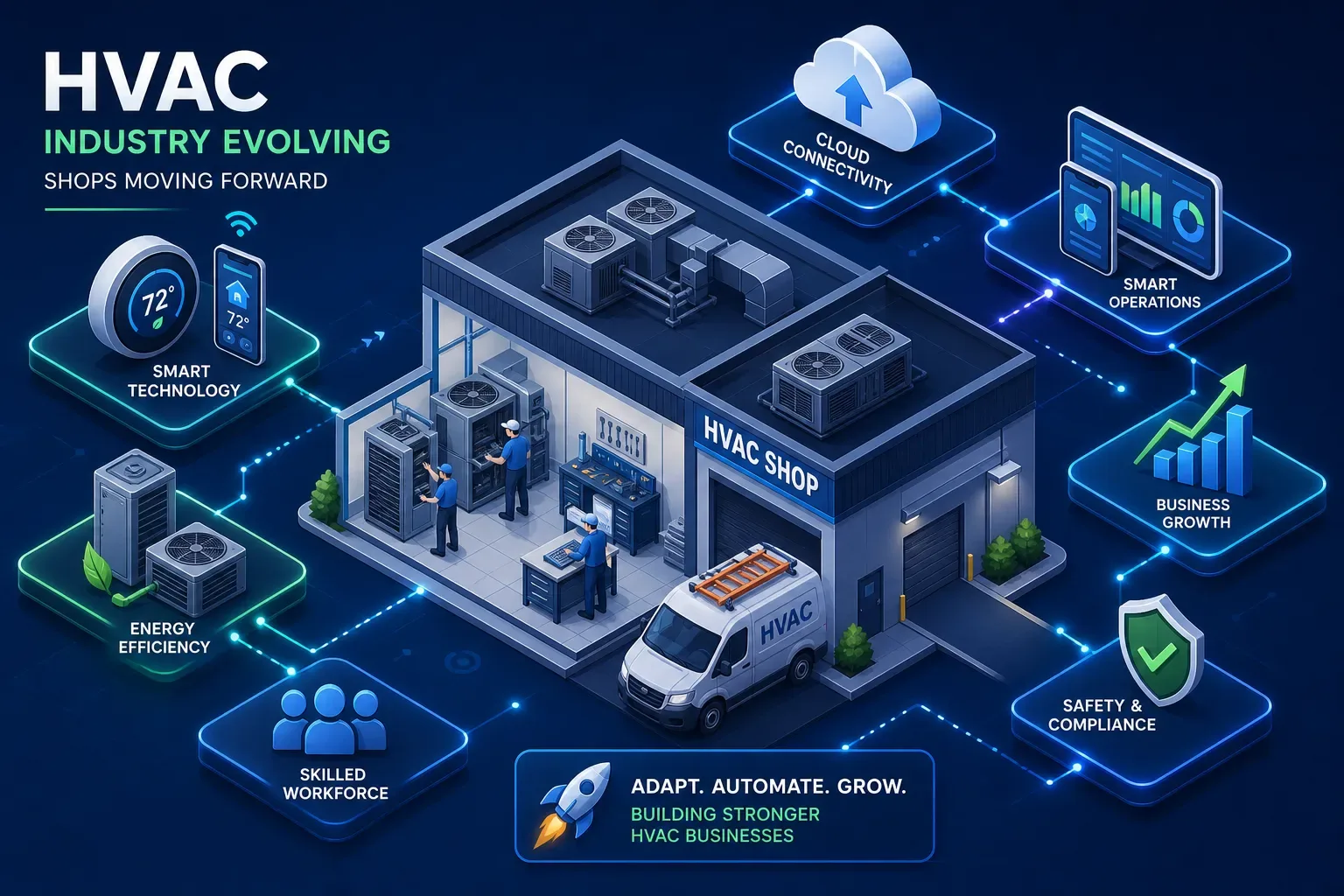
HVAC industry trends in 2026 tell a clear story: the global market sits at $299 billion and is projected to reach $407 billion by 2030 (MarketsandMarkets, 2025, 2030 forecast). The U.S. alone is tracking a 10.2% CAGR through 2035, with a market size of $156.9 billion. Those numbers sound like great news for every shop owner reading this. They're not, at least not automatically.
Market growth and shop-level growth are two different things. The shops capturing that expansion aren't the ones clocking longer hours or answering more calls themselves. They're the ones that built operations capable of handling demand without the owner holding everything together by hand. This article covers the highest-impact HVAC industry trends reshaping how businesses operate right now, what the data actually says, and what you can do about each one.
The market is growing fast, but it won't come to you
North America's HVAC market is projected to grow from $42.2 billion to $57.6 billion by 2030. The U.S. market, at $156.9 billion, is growing even faster. That demand is real. It's coming from aging housing stock that needs replacement equipment, new construction defaulting to heat pumps, commercial retrofits driven by energy efficiency mandates, and a sustained shift toward more time spent at home.
For an independent shop in 2026, demand is not the problem. Capacity and operations are the problem. The shops not capturing their share of this market are mostly losing it to missed calls, slow follow-up, and inconsistent customer experience, not a lack of available work. That distinction matters because it changes where you put your attention.
HVAC industry trends: technician shortage and what the math actually says
There are roughly 110,000 unfilled HVAC technician positions in the U.S. right now. About 25,000 technicians leave the workforce each year through retirement, burnout, or career changes. Training programs are producing 18,000 to 20,000 new entrants annually. The gap does not close on its own.
Wages reflect the pressure. The median HVAC technician wage hit $61,010 in May 2025, up roughly 6.4% from the prior year (Bureau of Labor Statistics). That's likely faster than most shops are adjusting their prices. If your labor costs are climbing at that rate and your ticket prices aren't keeping pace, you're watching margin disappear in real time. The shortage is a pricing signal, not just a recruiting challenge.
In a market this tight, keeping your best technicians is more valuable than recruiting new ones. Techs leave disorganized shops. Reducing administrative chaos, giving people clear schedules, and making sure the owner isn't visibly drowning are real retention levers. That's not a management philosophy; it's a competitive advantage when your competitors are always short-staffed.
Heat pumps and refrigerant regulations are already rewriting the install playbook
The heat pump shift is accelerating
U.S. residential heat pump shipments reached 4.3 million units in 2024, up 45% from the prior year, and outsold gas furnaces for the first time (AHRI shipment data). In Q1 2026, about 960,000 heat pumps shipped, running 32% ahead of gas and fossil-fuel furnace sales combined. Heat pumps were installed in 47% of newly built homes in 2024. This is not a niche trend moving through slowly.
Refrigerant phase-out regulations and your inventory strategy
The refrigerant transition runs parallel to this. R-410A has been the industry standard for decades, but EPA restrictions on manufacturing and importing new equipment using high-GWP refrigerants began taking effect in 2025 under the AIM Act. A 2026 EPA rule allows continued installation of some units manufactured before January 2025 until supply is depleted, with implementation effective July 27, 2026. Shops that haven't addressed inventory strategy, technician training on A2L refrigerants like R-32 and R-454B, and updated pricing for new-refrigerant equipment are already behind.
The training gap this creates is real but solvable. ACCA and ESCO both offer short-format A2L certification courses, ranging from 90 minutes to a half-day, covering safe handling, transport, and installation of mildly flammable refrigerants. Shops that get their crews certified ahead of the transition will be better positioned to capture install revenue over the next two years. Those that wait risk turning away profitable work or making costly mistakes on the job.
Repair revenue is rising and the best shops are building around it
Repair's share of total contractor revenue rose from 21.6% in Q4 2021 to 33.4% in Q4 2025, a swing of nearly 12 percentage points. Repair revenue per job climbed 47% over that same period (Housecall Pro platform benchmarks). This isn't a slow quarter for new installs. It's a structural shift in how residential HVAC revenue is distributed.
Install revenue is lumpy. It peaks in summer and winter, dries up in shoulder seasons, and depends on new construction cycles and equipment pricing you don't control. Repair and maintenance revenue is steadier, more relationship-driven, and harder for a competitor to poach with a lower bid. Shops with strong maintenance agreement bases run smoother P&Ls through market fluctuations.
Industry benchmarks point to a healthy target of around 55/45 install-to-service, with top-quartile shops approaching 50/50. Getting there means actively selling maintenance agreements, following up on aging equipment assessments, and making it easy for customers to book. Pricing the agreements correctly matters too: top programs run 40% to 55% gross margin on the agreement and use auto-pay with annual escalation clauses built in from day one. The math works if you build it intentionally.
Customers now expect 24/7 availability, and smart home tech raised the bar
Smart thermostats, connected HVAC systems, and home automation platforms have changed what homeowners expect from their contractors. When a Nest or Ecobee sends an alert at 10 p.m. that the system has a fault, that homeowner is not waiting until 8 a.m. to call. They're searching for who can respond now, and if your shop doesn't answer, someone else will.
The most common smart home platforms integrated with residential HVAC in 2026 are Amazon Alexa, Google Home, and Apple HomeKit, with Samsung SmartThings and Home Assistant popular in more advanced setups. Contractors who can handle smart thermostat configuration, basic ecosystem integration, and connected-system diagnostics are positioning themselves as more than mechanical installers. That positioning supports premium pricing and stronger customer loyalty.
After-hours and weekend calls represent roughly 35% to 42% of total service call volume for residential HVAC shops, depending on market and season. A homeowner whose air conditioning failed at 7 p.m. on a Friday is not a low-priority lead. They will pay for fast response. Shops that aren't answering those calls are leaving predictable, high-ticket revenue on the table every single week. Conservative estimates put the revenue loss from unanswered after-hours calls at $400 to $2,000 per month for a small residential shop, with higher figures during peak season.
The operational gap is where shops actually win or lose
Every trend above points toward the same conclusion: the businesses pulling ahead aren't working more hours. They're running tighter operations with better coverage and fewer manual bottlenecks. HVAC digitalization and IoT are raising customer expectations. Refrigerant phase-out regulations are forcing training and inventory decisions. The repair revenue shift rewards shops that can execute on service agreements at scale. And the 24/7 expectation means your front office has to work even when you're not in it.
A full-time HVAC office receptionist or dispatcher costs $43,000 to $106,750 per year in 2026, fully loaded. AI-powered call answering and booking automation runs roughly $948 to $10,000 per year depending on features and volume. That's an 80% to 95% cost difference, and the AI doesn't miss calls at 9 p.m. on a Saturday. Maximus was built specifically for home services owner-operators who need 24/7 call answering, job booking, accounts receivable follow-up, and daily operational briefings, without a full-time office manager on payroll.
Maximus integrates directly with Jobber, ServiceTitan, HCP, and QuickBooks. It was developed and proven first inside Temperature Pros Orlando before being offered to anyone else. In one dormant customer reactivation campaign, it recovered over $31,000. Within 90 days, it collected $12,400 in aging accounts receivable. Real numbers from a real shop.
Three moves to make right now
First, audit your after-hours call answer rate this week. Pull your missed call data for the last 30 days, multiply by your average ticket size, and see what that number actually looks like. Many shop owners have never run this calculation, and the result tends to be eye-opening.
Second, build a heat pump installation capability and A2L refrigerant training plan before the transition forces the issue. The equipment is already shifting. The regulation timeline is in place. Getting your technicians certified now is a straightforward investment that will pay back in install revenue over the next 24 months.
Third, evaluate whether your current office operations can handle 24/7 demand. Not whether they could theoretically handle it, whether they actually do right now. If the honest answer is no, close that gap before a competitor with better coverage takes the calls you're missing.
What these HVAC industry trends actually ask of you
The HVAC industry trends reshaping shop operations in 2026 aren't things to observe from a distance. They're operational decisions that have to get made. Wage growth and a structural labor shortage mean pricing and retention deserve more attention than most shops are currently giving them. The heat pump transition and refrigerant phase-out regulations mean training and inventory decisions are already overdue. The rise of repair revenue means maintenance agreements deserve serious investment rather than an afterthought sales pitch. And the 24/7 expectation means your front office has to function even when you're not available to run it.
Shops that treat these HVAC industry trends as strategic inputs, not just industry news, are the ones that will look back at 2026 as the year they separated from the pack. The market is growing. The question is whether your operations are built to capture it.