How Roofers Can Stop Missing Calls After Hours
A hailstorm rolls through your market on a Saturday at 7 PM. By 7:15, your phone is ringing.
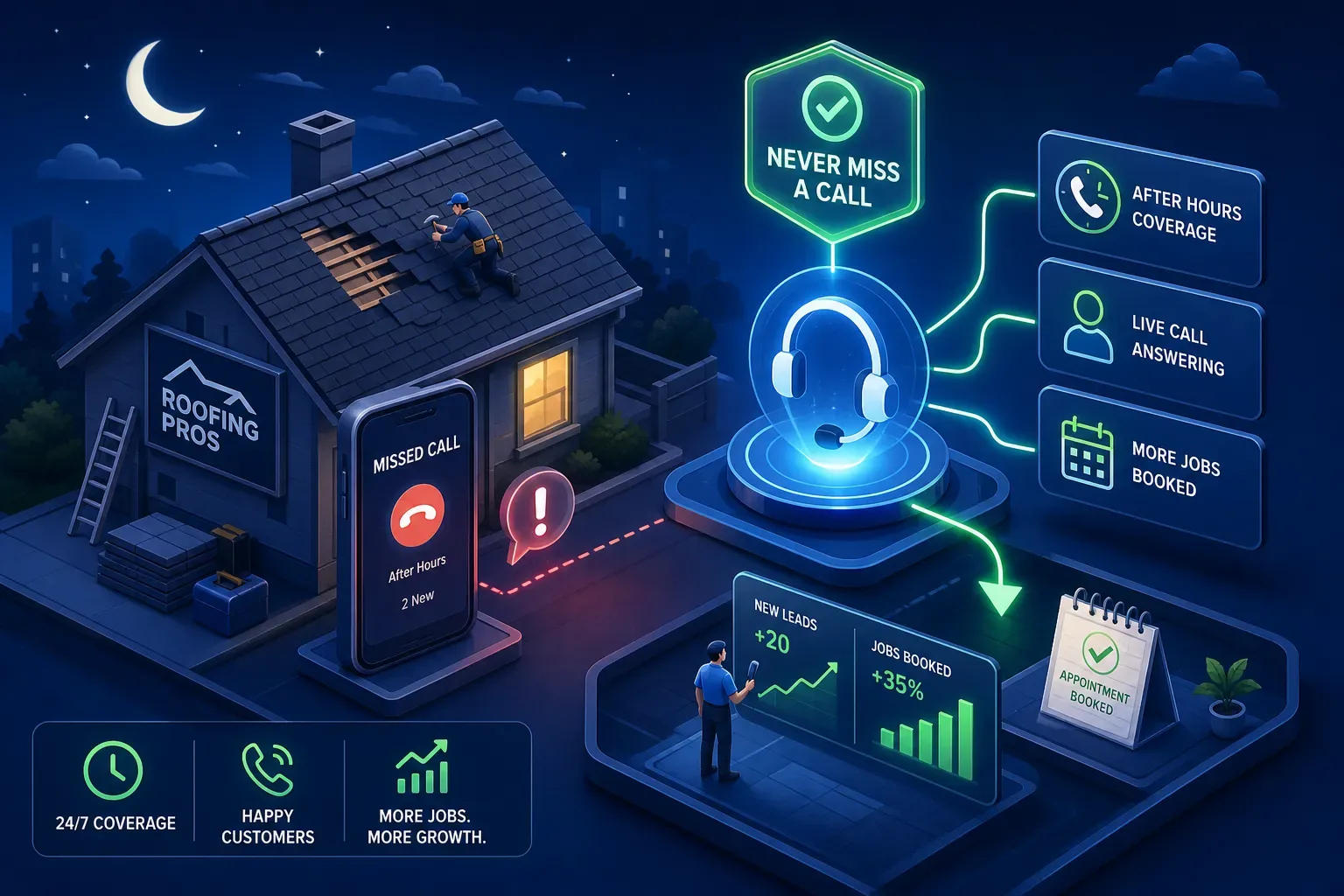
A hailstorm rolls through your market on a Saturday at 7 PM. By 7:15, your phone is ringing. By 9 PM, it's stopped ringing, not because the calls dried up, but because your voicemail picked up every single one. By Monday morning, those homeowners have already signed with the company that answered. This is the real problem most roofing contractors face during storm season, and the right answering service for roofers is the most direct fix available. This guide covers the features that actually matter, how pricing works across different service types, and the questions you need to ask before you sign anything.
The lead volume isn't the issue. The phone coverage is. When a storm rolls through and twenty callers hit your line inside of two hours, coverage determines whether those leads land on your board or a competitor's. That's a solvable problem, and solving it doesn't require hiring an office manager or staffing your crew to answer calls on weekends. It requires the right system built for the way roofing demand actually works.
What missed calls actually cost during storm season
Most roofing contractors underestimate the dollar value sitting behind every unanswered call. Residential roofing jobs typically range from $5,000 to $15,000, with storm-damage work skewing toward the higher end. Based on average job values and typical conversion rates, each missed call can represent $2,000 to $2,500 in lost revenue under normal conditions, and $4,000 to $6,000 or more when the caller has active storm damage and is ready to move. During a major regional weather event, a mid-size roofing company can field dozens to over a hundred calls across a single weekend. Even converting a fraction of those missed calls represents five or six figures in booked work that ended up on a competitor's schedule instead.
Homeowners with fresh storm damage are not patient shoppers. They're anxious. Water is coming in somewhere, and they call the first name they recognize. If you don't answer, they move to the next result. Many won't leave a message and wait, they'll simply call the next contractor on the list. In practice, the first company to make live contact wins the job at a dramatically higher rate than any company that calls back an hour later. Missing the call isn't just losing a lead. It's handing that lead to whoever answered.
Why generic call centers fall apart when storm season hits
A standard answering service is designed for predictable, steady call flow. Storm season is the opposite of that. After a major weather event, call volume can spike five to ten times overnight. Generic services often put callers on extended hold or route them to agents without roofing-specific training, agents who may not recognize a supplement request, don't know what an adjuster appointment is, and can't distinguish an active leak from a routine estimate inquiry. Callers feel that gap immediately, and they hang up.
The intake problem generic services create
The bigger issue is what gets missed during intake. A properly handled roofing call captures more than a name and a callback number. It captures the property address and service area confirmation, the damage type, whether there's an active leak, whether the caller is the decision-maker, and whether this is a cash job or an insurance claim. On insurance calls specifically, the carrier name, claim number, and adjuster contact should all be collected on the first call. When a generic answering service skips that intake, your office has to call the customer back just to get the basics. That adds delay and friction to every job during the exact window when speed wins the business.
Must-have features of an answering service for roofers
Twenty-four-seven coverage is the starting point, not the finish line. A quality answering service for roofing companies also needs a defined storm surge protocol: a concrete plan for scaling call-handling capacity when volume spikes, and a triage system that routes emergency calls ahead of routine estimate requests. When you're evaluating providers, ask them directly what their storm surge plan looks like. If the answer is vague or they seem surprised by the question, that tells you everything.
CRM integration and bilingual support
CRM integration is the second non-negotiable. If the answering service can't push data directly into your job management software, you're creating a manual data-entry step every morning. For roofing contractors, common platforms include JobNimbus, AccuLynx, and ServiceTitan. Not every answering service for roofing companies integrates natively with all three. Some use Zapier or webhook workarounds, which are better than nothing but introduce failure points. Confirm the integration type before you sign, and test it during a trial period before you commit to a full season's worth of leads running through it.
Bilingual support rounds out the must-have list. In markets across the South and Southwest, a meaningful share of homeowners calling about storm damage are Spanish-speaking. If your roofing answering service only handles English, you're filtering out part of your market by default. In competitive areas, bilingual capability isn't a premium add-on. It's a baseline.
AI answering versus live agents: what actually works for roofing
AI-powered answering services respond in seconds, handle unlimited simultaneous calls, and don't slow down during a Sunday-night storm surge. For a roofing company getting hit with calls after a major weather event, that capacity advantage matters more than almost anything else. Pricing is also more predictable: AI or hybrid plans typically run $29 to $500 per month, while fully staffed live answering at volume generally runs $325 to $1,500 or more per month during storm season. The best AI answering services for roofing companies are built and tested inside real home services operations, which means their call scripts and intake flows reflect actual field conditions rather than a generic call center training manual.
Maximus was developed and stress-tested inside a working home services business before it was made available to contractors more broadly, which is the kind of real-world grounding that separates purpose-built platforms from off-the-shelf call center software.
Live agents still have an edge in specific situations. Insurance calls with frustrated homeowners, complex commercial bids, and calls where a caller is clearly distressed are handled better by a real human voice. An agent can read tone, de-escalate, and adapt in ways that AI currently handles with less nuance. The practical answer for most roofing companies is a hybrid model: AI handles first contact, collects intake, and books standard appointments, while complex or high-emotion calls escalate to a live agent. That setup gives you storm surge capacity at a controlled cost without sacrificing quality on the calls that actually need it.
On the budget side, live answering at full coverage typically runs $325 to $800 per month at normal volume and $800 to $1,500 or more during storm season. Per-call billing generally falls between $1.50 and $3.00 per answered call, based on aggregated ranges across major providers. AI-heavy or hybrid plans are flatter and more predictable. Neither model is automatically the right choice. The right fit depends on your call volume, your market mix, and how much your back office can handle on the dispatch side once leads start coming in.
Questions to ask any provider before you commit
The answers to these questions will tell you more than any sales pitch:
- How do you handle call volume spikes during a regional storm event, and what does your surge protocol actually look like?
- Do you have a native integration with my CRM, or is it a third-party workaround?
- Can your agents collect insurance claim information on the first call, including carrier, claim number, and adjuster contact?
- Do you offer bilingual support, and is it included in the base plan or billed separately?
- What is your average answer time during peak hours?
- Can I review call recordings or transcripts after the fact?
A provider that can't answer these questions confidently is not equipped for roofing call volume.
Most reputable services offer a trial period. Use it deliberately. Run the service in parallel with your normal call handling for two to four weeks during a busy stretch. Track how many calls are answered, how complete the intake data is when it reaches your CRM, and whether any storm or emergency calls were misrouted. The trial will tell you more than any sales call. Don't sign a long-term contract before you've seen how the service performs under realistic volume. The point of the trial is to stress-test the system before it's your only line of defense on a storm weekend.
The bottom line on roofing call coverage
A roofing answering service is not an overhead line item. It's a revenue protection tool. Every call that rolls to voicemail after hours is a job that could be on a competitor's board by morning. The right answering service for roofers answers fast, collects the intake data your estimators actually need, connects to your CRM without manual work, and scales during storm season without breaking down.
Choosing the right answering service for roofers is one of the highest-leverage decisions you can make before storm season starts. If you want to see how an AI-powered platform handles this for home services businesses specifically, reach out to the Maximus team directly. The next storm doesn't wait for you to have the right system in place, so building that system now is the only move that makes sense.