How to Choose Roofing Estimating Software for Small Shops
Choosing estimating software for roofing is one of the fastest ways a small shop can send a professional bid while still on the phone with a homeowner.
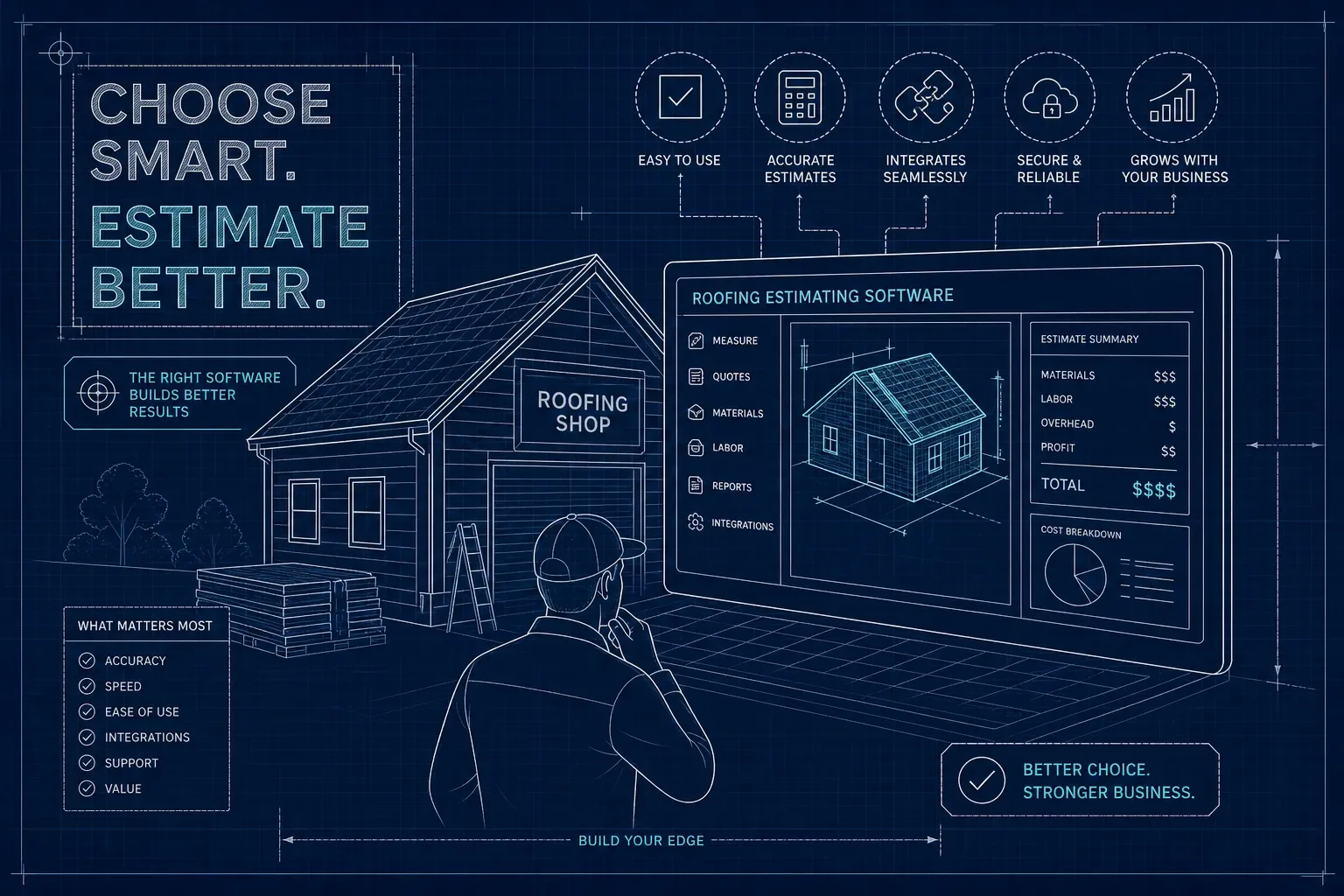
Choosing estimating software for roofing is one of the fastest ways a small shop can send a professional bid while still on the phone with a homeowner. According to industry research cited by the National Association of Home Builders and repeated across contractor trade surveys, the first contractor to respond wins the job roughly 81% of the time. If you sent a polished proposal in under 10 minutes and your competitor mailed a PDF two days later, you already know who got the call back. That gap isn't a sales problem. It's a process problem. The right roof estimating tool can close it by compressing the time between "homeowner calls" and "homeowner signs." This article covers what actually matters for a shop running 1 to 15 jobs per week, compares the platforms worth your time in 2026, and gives you a clear path based on your size and workflow.
What to look for in estimating software for roofing
The average small roofing contractor spends anywhere from 2 to 4 hours manually building a single estimate, based on ranges commonly reported by roofing trade associations and contractor forums. That's a capacity problem, not a pricing problem. The right roof estimator software should compress that to under 20 minutes without sacrificing accuracy. Vendors like Roofr publish case studies showing estimate time dropping to under 5 minutes for standard residential jobs. If a tool takes longer to operate than your current process, it isn't solving anything.
The biggest workflow unlock for small shops is satellite measurement. Enter an address, get roof area, pitch, and square footage back in seconds, and you can quote while you're still on the phone. Tools like Roofr, RoofSnap, and QuoteIQ's MapMeasure Pro all advertise this capability, though delivery time varies from near-instant to a few minutes depending on imagery quality. For small crews, cutting estimate time this dramatically can materially increase the number of bids you send per week without adding hours to your day.
Pricing is the other filter most shop owners skip until they've wasted a month trialing an enterprise platform. Most full-featured roofing operations platforms are built for multi-location contractors with dedicated estimating staff, and their price tags reflect that. For a one-to-five truck shop, look for plans under $200 per user per month with transparent pricing and no surprise add-on fees for core features like proposals and e-signatures. In 2026, options like QuoteIQ's Essentials tier at $29.99/month and Roofr's Measure+ at $109/month make that target achievable. Some team pricing for platforms like STACK can run higher, so verify before committing.
The top platforms worth your time in 2026
Roofr
Roofr is purpose-built around speed. Enter a property address, get a satellite measurement report, build a branded proposal, and send it for e-signature. Documented case studies from their published user base show estimate time dropping from 45 minutes to under 5, proposal creation falling from 15 minutes to under 2, and teams saving $400 or more per month after switching off heavier platforms. One contractor reported handling 42 roofs in 18 hours, with measurement reports ready by 5 a.m. and the bid won the next day. Paid plans start at $109/month for Measure+ and run to $349/month for Scale. For small shops prioritizing proposal velocity over deep CRM features, Roofr is the strongest starting point in this category of estimating software for roofing.
QuoteIQ
QuoteIQ is the lowest-friction roof estimating app for solo operators or crews just getting off spreadsheets. Its pricing ladder is one of the clearest in this category: Essentials at $29.99/month, Beginner at $74.99/month, and Pro at $149/month. The MapMeasure Pro feature brings AI-based satellite measurement and pitch detection into the lower tiers, which is uncommon among low-cost options. If your primary goal is sending professional-looking quotes fast without committing to significant monthly overhead, QuoteIQ is the place to start.
RoofSnap
RoofSnap earns its place by combining aerial measurement, proposal templates, and material ordering in a single platform. It's not as polished as Roofr on the proposal side, but it covers more of the job lifecycle. Small shops that want one tool to handle measurement through material pull will find it practical, especially if managing supplier orders through a separate system is already creating friction.
AccuLynx
AccuLynx is the most mature all-in-one option in this comparison, with CRM, estimating, supplier ordering, and production tracking all integrated. The tradeoff is real: users flag a steep learning curve and higher cost in reviews published on G2 and Capterra. For a shop already running 15 or more jobs per week with at least one admin person, it earns its complexity. For a solo operator or a two-person crew, it's likely overkill in year one. Onboarding AccuLynx typically takes weeks, compared to JobNimbus, which most small teams get running in days.
How satellite accuracy actually works in the field
When to trust satellite measurements
Vendor accuracy claims range widely across roofing takeoff software. RoofScope claims 99% accuracy, SkyRoof claims 98%, and EagleView is independently benchmarked at roughly 98.77% on standard residential roofs. QuoteIQ's MapMeasure Pro runs at roughly ±2 to 5% for usable roof-plane area on most residential properties. For comparison, RoofBidder is transparent about its ±10 to 15% preliminary-only accuracy. Satellite tools are most reliable on standard residential roofs with clear, recent imagery.
When to verify on-site
Complex rooflines, heavy tree cover, and recently modified structures all reduce satellite reliability. Treat satellite measurements as your starting point, not your final takeoff. For high-material-cost jobs or unusual geometry, verify on-site. The speed advantage of roof measurement software still applies even when you do a field check: you can qualify the job and set expectations before ever driving out.
On integrations, Roofr connects with CompanyCam, ABC Supply for real-time material pricing, and QuickBooks through Zapier. It does not appear to support a native Jobber or ServiceTitan connection. AccuLynx and JobNimbus both connect more broadly with field service management platforms and QuickBooks. Check integration compatibility before committing to any estimating software for roofing. Gaps here create double-entry and eat back the time you're trying to free up.
The ROI case for making the switch
The time math is straightforward. If you're spending 3 hours per estimate and sending 8 estimates per week, cutting that to 20 minutes per estimate gives you back roughly 21 hours per week. An AppliCad white paper puts the annual value of saving just 45 minutes per job at over $18,000 per year for a contractor billing at $45 per hour. At a higher billing rate, that number scales accordingly.
The documented case studies back this up. Roofr users report estimate time cut by 80% and $400 or more saved per month by replacing heavier platforms. STACK reports takeoff time reductions between 25% and 40% in published commercial roofing case studies. At the enterprise end, The EDGE cites one contractor saving $70,000 to $80,000 per year by avoiding an additional estimating hire, with the platform investment recovered in under 12 months.
These aren't projections. They're outcomes from contractors switching off manual processes, and they illustrate a consistent pattern: the savings aren't just in faster estimates. They're in the capacity to send more estimates without burning out your best people.
Matching the tool to your actual shop size
Under 5 jobs per week, start with QuoteIQ Essentials at $29.99/month or Roofr's entry-tier plan at $109/month. Both deliver satellite measurement and professional proposals without a steep learning curve or a large monthly commitment. Get the fundamentals right before layering in CRM and production tracking. At this volume, the goal is just getting professional bids out the door faster than your competition.
Scaling past 10 jobs per week, Roofr or RoofSnap handle this range well if your primary need is measurement-to-proposal speed. Once you start feeling friction around managing leads, tracking job status, and coordinating material orders, that's when AccuLynx or JobNimbus starts to justify its complexity. The rule here is simple: don't move to a heavier platform until the current one is actually slowing you down. Complexity you don't need yet costs you more than money. It costs you adoption.
After the estimate wins, don't let the job leak
Winning the bid is only half of it. Many small roofing shops run into the same back-end friction: invoices aging past 45 days, follow-up calls that never happen, and booked jobs that slip when the owner is mid-install on a roof. The estimate gets all the attention. The follow-up gets none.
That's the gap a platform like Maximus is built to close. Once you have the right estimating software for roofing locked in, Maximus handles what comes after the sale: aging accounts receivable follow-up, invoice collection, customer reactivation, and 24/7 call answering so a new lead doesn't hit voicemail while you're on a job. It integrates with Jobber, ServiceTitan, and QuickBooks, so the data from your field service tool flows where it needs to go. In a published 90-day case study, Maximus collected $12,400 in aging AR and recovered over $31,000 from a single dormant customer reactivation campaign for Temperature Pros Orlando. The estimating software gets you the job. What happens after determines whether it actually shows up on your bottom line.
The bottom line on picking your tool
The best estimating software for roofing isn't the one with the most features. It's the one your crew will actually use consistently, producing a professional proposal before the homeowner has time to call your competitor back. For most small shops in 2026, that means starting with Roofr or QuoteIQ as your roof estimating app, measuring results over 60 days, and scaling up only when the current tool becomes the bottleneck.
Pick one. Run it hard. Don't overthink what comes after that until you've made the first tool a habit your whole crew relies on.