How to Scale a Home Services Company to $5M and Beyond
Most home services businesses don't have a growth problem. They have a bottleneck problem. The phone keeps ringing. The schedule is full. Demand is real.
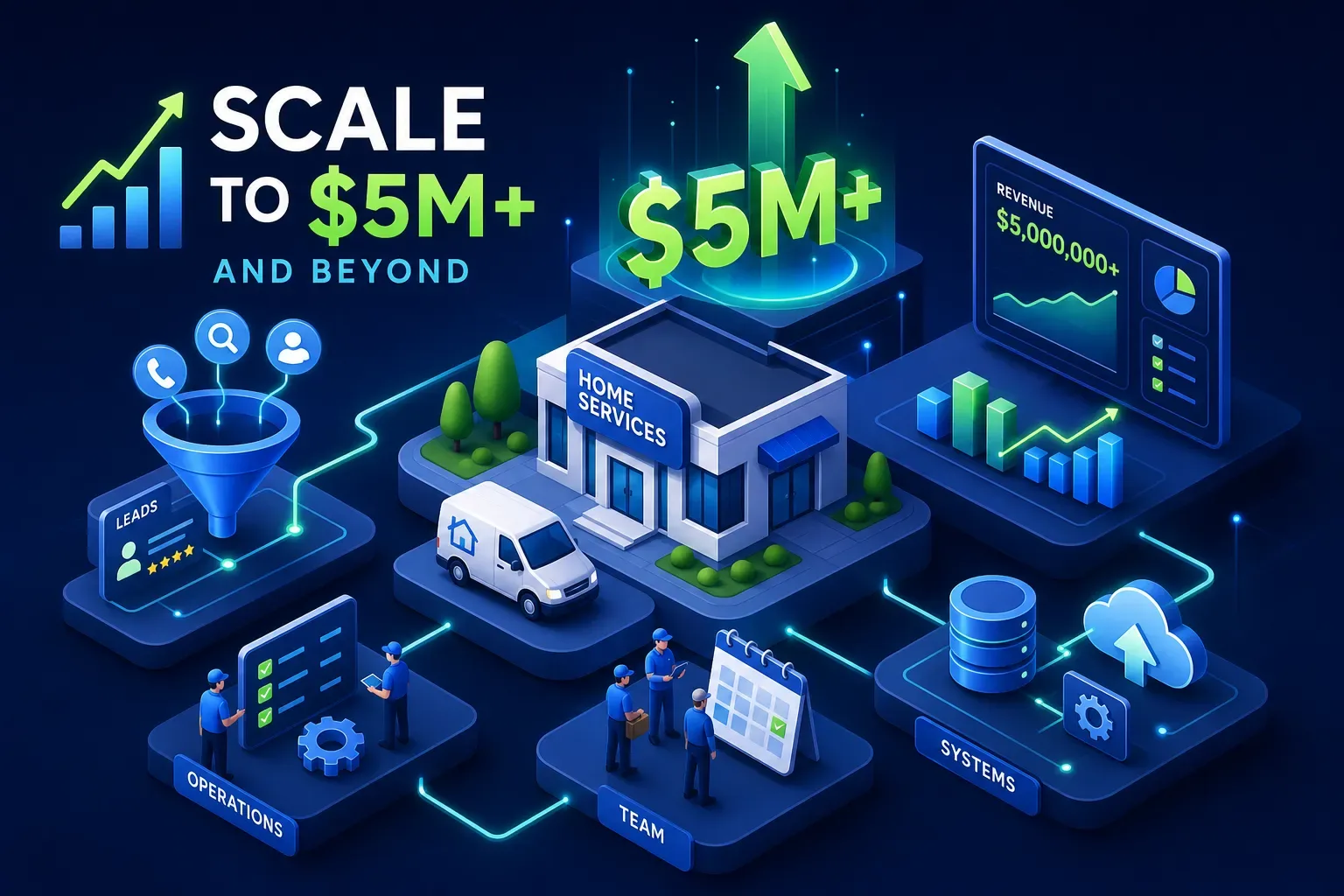
Most home services businesses don't have a growth problem. They have a bottleneck problem. The phone keeps ringing. The schedule is full. Demand is real. But scaling a home services company past seven figures requires more than hustle, it requires removing the owner as the operating system. Right now, that owner is still the dispatcher, the closer, the collections department, and the quality inspector rolled into one person. That's not a scalable business. That's a job with trucks.
Growth stalls in the $1M to $5M range not because of weak marketing or a bad market, but because the owner is the operating system. There's no version of that model that runs two locations at once. Before you add a single truck, a new service line, or a second territory, you need to remove yourself from the daily grind. Everything in this framework starts there.
Why Most Home Services Owners Stall Before $3M
The $1M to $3M range is where the bottleneck becomes visible. Companies at this stage aren't short on demand, they're short on the capacity to handle what's already coming in. The owner answers calls between jobs, chases overdue invoices at night, and personally approves every schedule change. That's not operations. That's improvisation.
What people call "systemization" isn't about org charts or fancy dashboards. It means any trained person, or any capable AI, can execute a task the same way every time without asking the owner. Until that's true for call answering, booking, dispatching, invoicing, and follow-up, adding a second location just doubles the chaos you already have.
Several operational gaps consistently kill home services growth at this stage. Missed after-hours calls let leads die before anyone picks up. Aging accounts receivable sits untouched for 60-plus days. Dormant customers who booked once never hear from the business again. Each gap represents recoverable revenue. Most operators leave it behind because the office infrastructure isn't there to capture it.
Standardize Operations Before You Touch a Second Location
The most common reason a second location underperforms has nothing to do with the market or the manager you hired. The owner's intuition, the invisible thing that held the first location together, can't be in two places at once. SOPs convert that tribal knowledge into repeatable processes. Without them, quality degrades the moment the owner isn't watching.
Good SOPs aren't manuals nobody reads. They're short, specific, and tied to a measurable outcome. Before any expansion discussion, you need four core processes documented and tested:
- Client onboarding, how a new customer is greeted and scheduled
- Quality control checkpoints, pre-job, on-site, and post-job sign-off
- Dispatch protocols, how jobs are routed and communicated to techs
- Warranty and callback handling, who responds, how fast, and what they say
Each one needs a single owner and a feedback loop so it improves over time.
Building this takes time. Most companies need 6 to 12 months to fully implement SOPs across departments, though a core library of five critical workflows can be completed in four to six weeks with focused effort. The risk of rushing is real: SOPs that skip the testing phase fail under pressure. Plan for 60 to 90 days of consistent training before you see measurable adoption. Do this work at your first location before the second location is even a conversation.
The Staffing Model for Scaling a Home Services Company from $1M to $5M
There's a specific hiring sequence that works for home services growth, and skipping steps in that sequence is expensive. The first hire isn't another tech. It's an admin or CSR who takes over call handling and frees the owner from answering phones between jobs. That single move pays for itself faster than almost anything else on the org chart.
From there, the sequence builds out in stages:
- A second technician to expand revenue capacity
- An office coordinator or dispatcher to unlock a third tech
- A marketing coordinator to own lead generation
- An operations manager or general manager as you approach $5M
At that revenue level, a GM runs between $130,000 and $200,000 fully loaded. That sounds steep until you recognize the alternative, the owner still running daily operations at $5M in revenue.
The hiring triggers are clear. Bring on a new technician when you hit 70 to 80 percent capacity, not 100 percent. Industry benchmarks for residential contractors typically put revenue per employee in the $150,000 to $250,000 range. If you're generating below $150,000 per employee, the business is either overstaffed or underpriced, and both problems need to be solved before adding headcount. By $5M, most well-run shops carry roughly 15 to 25 employees, with the owner spending the majority of their time in leadership and strategy rather than production.
The Tech Stack That Lets One Owner Run Multiple Locations
Core Field Service Software
The right tech stack isn't about loading up on tools. It's about having one source of truth for jobs, one for money, and one for customer communication. For companies under $2M to $3M, Jobber or Housecall Pro handles core scheduling, dispatch, and invoicing for $200 to $800 a month. Companies scaling past $3M generally need ServiceTitan, which runs $1,500 to $3,000 a month but adds the advanced analytics and automation that multi-location businesses require. Layer on CallRail for attribution and QuickBooks for financials, and you have the foundation.
The AI Operations Layer
The layer most operators miss is an AI operations layer that sits on top of those tools and handles the daily office work that currently runs through the owner. This is where platforms like Maximus come in. Maximus is designed to integrate with field service platforms, accounting software, and your phone system to handle 24/7 call answering and booking, accounts receivable follow-up, dormant customer reactivation, and a 7am daily briefing that gives the owner a clear picture of overnight activity and anything needing immediate attention.
The results from Temperature Pros Orlando, the HVAC company where Maximus was built and tested before it was ever sold to anyone else, illustrate what this layer can do. According to Maximus's internal case data, the company recovered over $31,000 from a single reactivation campaign and collected $12,400 in aging accounts receivable within 90 days. For a multi-location owner, that kind of automated visibility and follow-up is the difference between managing from a desk and actually managing. That's the piece most growing home services businesses are missing from their operations playbook.
Financial Targets to Scale Without a Cash Crisis
Margin Benchmarks to Hit Before Expanding
Growth increases fixed costs before revenue catches up. If your margins aren't healthy at the start of expansion, you'll be funding growth from a deficit. There are three targets to maintain:
- Gross margin: 50 to 60 percent, with 45 percent as the minimum viable floor
- Net margin: 15 to 20 percent. The industry average sits around 10 percent, which means most operators are underpriced or underpaying themselves.
- EBITDA margin: 12 to 18 percent as the healthy cash generation floor. For HVAC specifically, falling below 8 percent net margin puts the business one bad quarter from a cash flow problem.
Cash Flow Levers During Expansion
Four levers protect cash flow when you're scaling a service business into new territory. Keep direct labor costs at or below 50 percent of revenue. Target 75 to 85 percent technician utilization, idle techs drag gross margin and cash flow simultaneously. Build recurring revenue through maintenance agreements and service contracts, since recurring customers don't require new acquisition spend every season. And stay on top of accounts receivable; letting invoices age past 60 days is one of the fastest ways to starve growth of the cash it needs.
Marketing Channels That Fill New Locations from Day One
The paid media approach that drives home services growth is built in layers. Local Services Ads get 50 to 65 percent of the paid budget because they capture the highest-intent searches at $20 to $80 per qualified lead. Google PPC handles overflow and long-tail coverage at 25 to 35 percent of budget. Retargeting takes the remaining 10 to 15 percent to recapture visitors who didn't convert on the first visit. LSAs are the first dollar you spend in any new service area because nothing else matches the intent level of someone typing "HVAC repair near me" at 2pm on a Thursday.
LSAs fill the short-term gap. Local SEO fills it permanently. A fully optimized Google Business Profile that's ranking delivers leads at near-zero cost, making it the highest overall ROI channel over a 12 to 24 month horizon. For multi-location businesses, each location needs its own GBP, its own review velocity, and its own local citation profile. Managing that manually at scale is a full-time job. Automating review monitoring and response drafting at this stage isn't optional, it's table stakes.
The lead source most operators underestimate is already sitting in their CRM. Referrals convert three to five times higher than paid leads and carry the highest customer lifetime value. Before spending another dollar on acquisition for a new location, run a reactivation campaign against your existing database. Past customers who've used your service once are the cheapest leads you'll ever generate. Most home services companies leave that revenue untouched. That's where real growth starts.
The Whole Game in Six Moves
The operators who scale to $5M and beyond aren't working harder than the ones stuck at $1.5M. They've built a business that runs without them in the middle of every decision. The home services operations playbook comes down to this: remove operational bottlenecks first, document processes before you expand, hire in the right sequence, build a tech stack with an AI operational layer, maintain healthy margins, and lead your marketing with LSAs plus local SEO.
Scaling a home services company is less about growth tactics and more about building infrastructure strong enough to hold the growth you already have demand for. That demand exists right now. Build the systems to capture it. The growth follows.
If you're running a $1M to $5M home services business and want to see what the AI operational layer looks like in practice, Maximus was built for exactly that. Maximus typically deploys in about 48 hours, integrates with your existing software stack, and includes a monthly working session with a founder who still runs an HVAC company. That's the difference between a software vendor and an operator who's solved the same problems you're dealing with right now.