Lead Qualification Questions for HVAC, Plumbing and Electrical Calls
Every intake call at a trades shop should move through eight lead qualification questions before any appointment is offered.
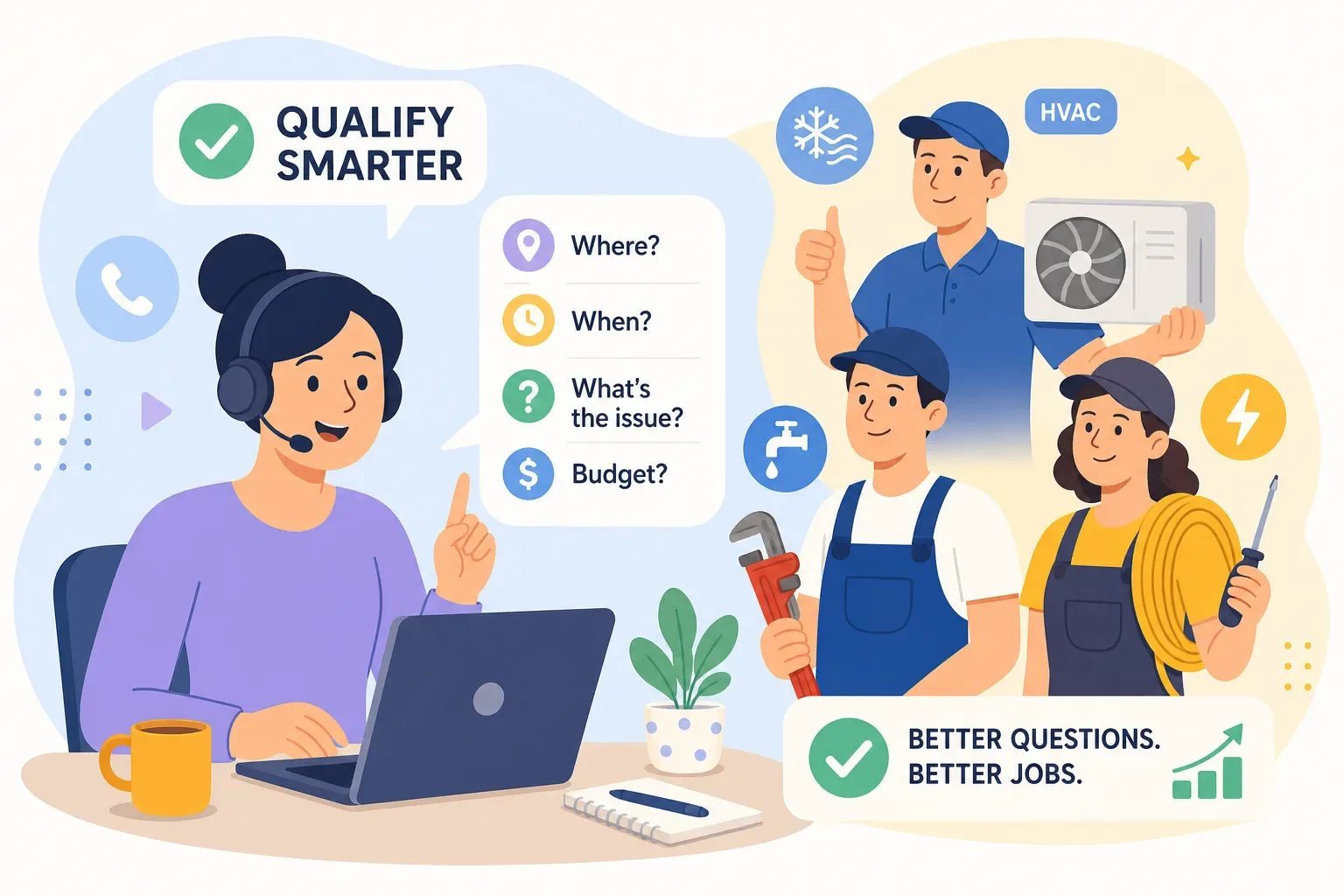
Every intake call at a trades shop should move through eight lead qualification questions before any appointment is offered. Those questions sort every caller into one of three buckets: the job is bookable, it needs a human to review it, or it is out of scope. That is the whole framework, and it works whether your CSR is answering the phone or a system like Maximus is handling the call on your behalf.
The 8 lead qualification questions (intake checklist for home service shops)
- What is the service address?
- What type of property is it?
- What work are you requesting?
- What are you observing?
- When did it begin?
- Is there a concern requiring our established escalation procedure?
- Who can provide access?
- Who can authorize the work?
Address, service area, and basic job fit (questions 1-3)
The first three prospect qualification questions filter a meaningful share of calls before any scheduling logic is needed. Question one is the full property address, confirmed against the shop's actual service area, not assumed from an area code or a general location description. Question two is property type: residential single-family, multi-family, light commercial, rental unit, or new construction. Question three is job type: does what the caller is describing match what the shop actually does?
These three discovery questions for leads will surface the caller who is two towns outside your boundary, the restaurant owner who assumes you handle commercial refrigeration, and the new construction framer who wants rough-in work your team does not run. Confirming the address is not confirming availability. It is confirming eligibility, which comes first.
Problem scope and timing without giving a diagnosis (questions 4-6)
Question four is what the system is doing or not doing, in the caller's own words. Not a tech's assessment. Not a diagnosis. Just what the caller observes: "it stopped cooling overnight," "there is water under the sink," "the breaker keeps tripping." Question five is how long the problem has been present. Question six is whether there is an urgent safety concern: a gas smell, no heat during a cold snap, active water damage, electrical arcing, or anything that puts people or the property at risk.
Safety-concern answers should follow the shop's established safety and escalation procedure, not routine appointment intake. Do not use this checklist to assess a hazard or make a caller wait for an ordinary callback. Everything else in this range of questions is about understanding urgency and scope so the right person can make that next call with real information in hand, not a vague note that says "something is wrong with the HVAC."
Visit access and decision authority (questions 7-8)
Question seven is whether an authorized contact can provide access under the shop's visit policy. A tech who arrives at an empty house cannot do the work and cannot leave without it feeling like a failure, even if nobody is technically at fault. Question eight is whether the caller is the property owner or an authorized contact who can approve the work.
Both questions clarify access and authorization before a visit. The answer to the authority question may not disqualify the lead, but it will almost always flag the call for staff review. A tenant calling about a repair the landlord needs to approve is not a dead lead. It is a lead that needs a human making the next move, not an automated booking.
How to ask lead qualification questions on an intake call: three trade examples
The HVAC no-cool call (hypothetical)
A caller reports no cooling during a summer heatwave. The checklist moves quickly: address confirmed inside the service area, residential single-family, system type is central air. The problem started two days ago. No safety concern flagged. The homeowner will be home between noon and five. Outcome: bookable. The request can proceed to availability and authorization checks; no appointment has been confirmed.
Now change one detail. The caller is a tenant who says the landlord "should be paying for this." The address still clears. The problem still clears. But question eight flags an authority gap. The call does not get disqualified; it moves to staff review. A dispatcher calls the property manager before anything is scheduled. That question identifies an authorization gap before the shop commits to a visit.
The plumbing slow-drain call (hypothetical)
A caller reports a slow kitchen drain. Questions one and two confirm the service area and the property type. Question three reveals it is a small restaurant, which the shop does not service commercially. Outcome: out-of-scope. The caller is referred elsewhere with a brief explanation. No truck is dispatched for work the shop does not handle.
The electrical panel question call (hypothetical)
A caller asks whether they need a panel upgrade before adding an EV charger. Questions one and two clear the area and confirm residential. Questions four through six show no current outage and no safety concern; this is planning work, not an emergency. Question eight reveals the caller is a buyer under contract, not yet the owner of the property.
Outcome: staff review. The shop's electrician or owner needs to decide whether to quote pre-purchase work and how to structure the authorization. The intake system captures everything, flags the authority status, and holds the call for a human decision. Holding for a human decision is exactly the right outcome here.
When does a call go to human review instead of the schedule?
How to hold the caller without promising an appointment
The intake interaction should confirm that all the information has been captured, give a callback window the responsible team member can actually meet, and be explicit that this is not yet a confirmed booking. Precision here matters more than friendliness. A caller who hears "we will call you back this afternoon" knows where they stand. A caller who hears "you are all set" and then gets a callback asking for more information feels misled, even if nothing wrong was intended.
Protecting the caller's time and protecting the shop's schedule are the same goal stated from two directions. Good intake language achieves both at once.
The intake record and the "requested, not confirmed" rule
What to capture before the call ends
The minimum intake record is: caller name and callback number, full address, property type, problem description in the caller's own words, the caller's stated timing and any escalation flag, access and authority status, and the outcome bucket the call landed in. That record is what makes human review fast, and it is what protects the shop if a caller insists they had a confirmed appointment when the record shows a request that was pending review.
The problem description should stay in the caller's language, not translated into technical terms. "The outdoor unit is making a grinding noise when it starts" is more useful than "possible compressor issue." The dispatcher reviewing the call needs the caller's words, not an intake system's interpretation of them.
Why "requested" and "confirmed" are not the same word
A caller asking for Tuesday at two o'clock has requested an appointment. A confirmed appointment is one that a human at the shop or an authorized system has verified against actual availability, service area coverage, tech skill match, and job scope. Skipping that distinction is how shops end up double-booked, dispatching the wrong tech, or fielding an angry callback from a customer who took the afternoon off work based on a slot that was never actually held.
Start with five calls from last week
Pull five recent intake calls from your records and note where the lead-qualifying questions were asked and where they were skipped. That exercise alone will show you exactly where your current process breaks down. If you want to see how the eight-question framework maps against your shop's actual calls, bring those five calls to a Maximus demo. Use the demo to map those questions and human-review rules to your shop before deciding what to automate.