Local SEO for HVAC: The Complete 2026 Guide
"HVAC near me" gets searched over 90,000 times every month. The businesses sitting in the Google Local Pack capture a disproportionate share of those clicks.
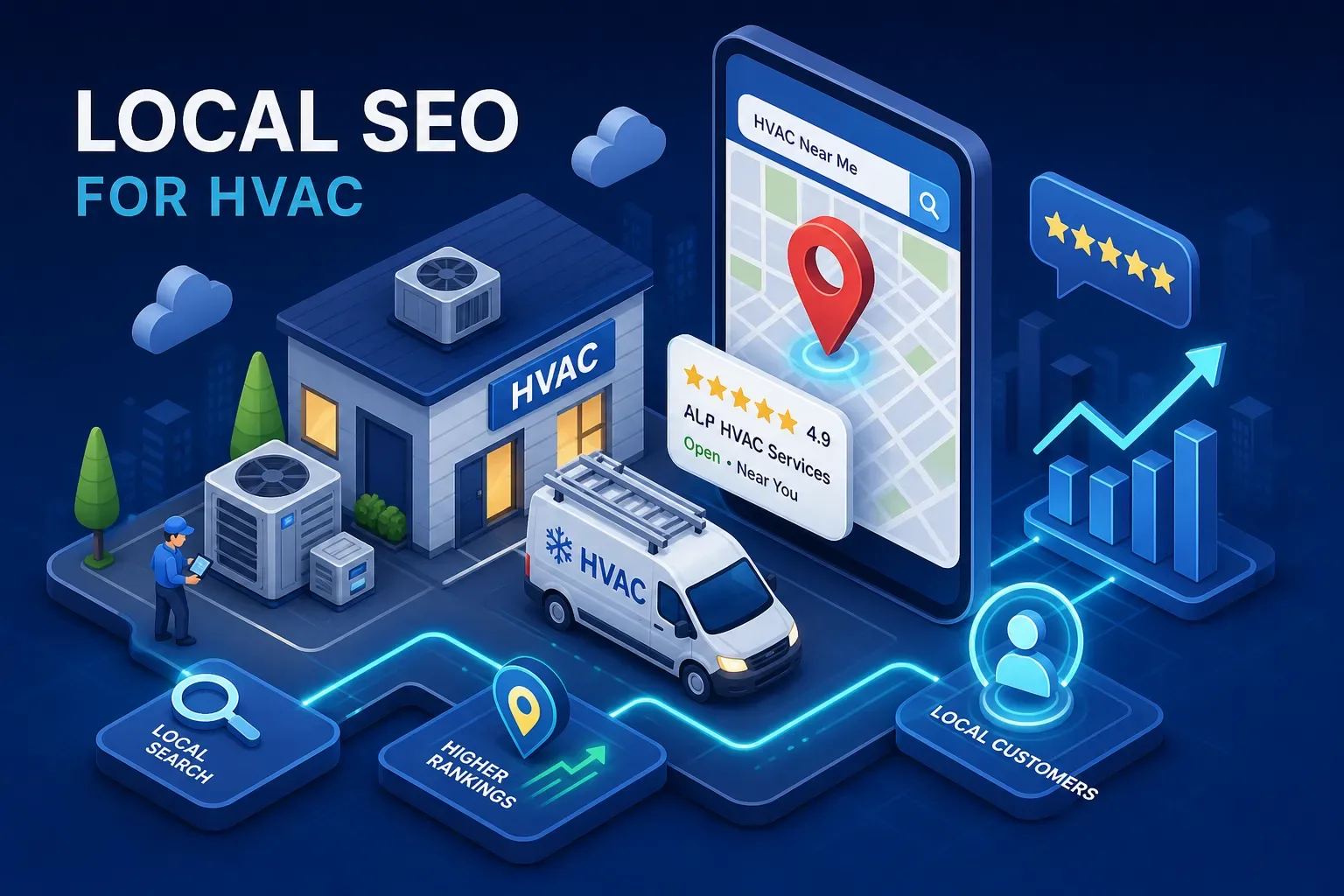
"HVAC near me" gets searched over 90,000 times every month. The businesses sitting in the Google Local Pack capture a disproportionate share of those clicks. The businesses below the map are left competing for whatever remains. Mastering local SEO for HVAC is how you get into that top group, and stay there.
Local SEO for HVAC companies is fundamentally different from traditional SEO. You're not chasing blue-link rankings on page one. You're chasing the map pack, and the rules there are built around proximity, relevance, and trust signals that most shops either ignore or set up once and forget. This guide covers the five areas that move the needle most: your Google Business Profile, citation consistency, review acquisition, city-level landing pages, and the operational piece that most local SEO guides never mention.
Why your Google Business Profile is your most valuable local SEO asset for HVAC
Many HVAC companies treat their Google Business Profile like a Yellow Pages listing, fill it in once, move on. Google treats it as a live signal of how active, relevant, and trustworthy your business is. The completeness of your profile, the volume of recent reviews, and how regularly you post all factor into whether you appear for queries like "AC repair near me" or "furnace replacement [city]."
Choosing the right primary and secondary categories
Set "HVAC Contractor" as your primary category. Then add specific secondary categories that match your actual services: Air Conditioning Contractor, Heating Contractor, Furnace Repair Service. Avoid adding generic categories like "Contractor" or "Home Services" as a catch-all. Google matches categories to search intent, and a vague category doesn't reinforce any specific query. It just dilutes the relevance of the ones that would otherwise work.
Filling out the fields most shops leave blank
The 750-character business description is prime real estate that most HVAC companies waste on generic copy. Use it to mention your core services, the cities you cover, and differentiators like same-day availability, emergency service, or financing. Beyond the description, add each service individually (AC repair, furnace installation, duct cleaning, and so on), fill in attributes like licensed, insured, and emergency service available, and seed the Q&A section with real questions your customers ask about pricing, response times, and service areas. Consistency between your GBP and your website's contact details is essential. Any mismatch in phone number format, address, or business name sends a conflicting signal to Google.
Staying active with posts and photos
Long periods without profile updates can signal a lack of activity to Google, so post at least once a week using a mix of Updates, Offers, and Events. For photos, skip the stock images. Real job-site shots, branded vans, and before-and-after installs consistently outperform anything generic. If you enable messaging on the profile, someone needs to respond promptly. Unanswered messages harm user experience and should be avoided unless you can reliably respond, a problem covered in the final section of this guide.
Building a citation foundation Google can trust
Citations are NAP references, your business name, address, and phone number appearing consistently across the web. Their value isn't in raw volume. Accuracy and authority matter far more. An HVAC company with 200 inconsistent citations sends weaker local signals than one with fewer clean, accurate listings, because conflicting information makes it harder for Google to confirm your business details.
The directories that carry the most weight for HVAC companies
Start with the core local platforms: Google Business Profile, Yelp, Apple Maps, Bing Places, and your Facebook Business Page. These reinforce the fundamentals of your local presence. Then layer in the HVAC-specific directories where buyers actually look: Angi, HomeAdvisor, Houzz, Porch, and HVAC.com. If you hold NATE certification or are an authorized dealer for Carrier, Trane, Lennox, or a similar brand, get listed in those manufacturer and association directories too. Local trust builders like BBB and your chamber of commerce carry real weight because they signal legitimacy to both Google and potential customers doing due diligence.
How to audit your citations before they hurt your rankings
Start by locking in one master NAP record: the exact version of your business name, address format, phone number, and website URL that you want everywhere. Then check each core listing against it field by field. Citation drift is most common after a phone number change, a move, or a rebrand. Duplicates are the other major problem, two profiles for the same business split authority instead of stacking it. Tools like BrightLocal or Moz Local automate discovery and flag inconsistencies across directories so you're not doing this manually.
Turning completed jobs into reviews that build local pack visibility
Review volume and recency rank among the strongest local pack signals for HVAC local SEO. In competitive Local Packs, companies with 50 or more recent reviews tend to outperform those with fewer. The bottleneck isn't customer willingness. Most shops simply don't have a repeatable system that removes friction from the ask.
The post-service SMS sequence that actually gets responses
Send a direct review request within a few hours of job completion, when customer satisfaction is at its peak. Keep the message short, personalize it with the customer's name and a reference to the service, and include a direct link to your Google review form. Follow up once at the 48-hour mark for anyone who didn't respond to the first message. SMS outperforms email for this use case because of higher open rates and one-tap access to the review form. The sequence works because it's systematic, not because it's clever.
Responding to reviews in a way that builds real trust
Review responses are public signals, and potential customers read them before calling. A canned "Thanks for your business!" tells them nothing. A response that says "Glad we could get your furnace running before the cold snap this weekend" tells them you're attentive and specific. Respond within 24 to 48 hours, reference the service mentioned in the review, and write in the owner's voice. For negative reviews, acknowledge the issue and invite the customer to reach out directly. Don't argue publicly, and don't copy-paste a generic apology.
Local SEO for HVAC: service-area pages that rank for city-level searches
A single "service areas" page that lists twenty city names does nothing for rankings. What works is a hub-and-spoke architecture: one central service-area hub page linking out to individual city pages, each built around a specific query like "AC repair in [city]" or "furnace installation in [city]." This is how HVAC companies earn local organic visibility beyond the map pack.
How to structure each city page for content and conversion
Use a title tag in the format: [Service] + [City] | [Company Name]. The H1 should mirror the target query naturally. Each page needs to cover the services you offer in that area and include local trust signals: ZIP codes, neighborhoods served, location-specific reviews, and real job photos. Add a city-specific FAQ and a clear call to action. The difference between a genuine city page and a doorway page is unique local content. Swapping a city name into a template gets ignored or penalized. Real references to local neighborhoods, common equipment types in that market, and area-specific climate considerations make the page genuinely useful.
Local schema markup for HVAC city pages
Use the HVACBusiness schema type on each city page, or LocalBusiness if your implementation requires it. The properties that matter most are areaServed (with the target city and relevant ZIP codes), serviceType for the specific service the page covers, provider linking to your business entity, and openingHoursSpecification. Keep schema page-specific. Copying the same JSON-LD block across every city page gives Google nothing new to work with and signals thin implementation.
Measuring which local SEO activities are actually driving calls
Activity without measurement is just noise. HVAC owners need to know whether the citation cleanup and GBP posts are generating real phone calls, not just profile views. The tracking setup doesn't need to be complex.
Setting up call tracking tied to GBP and city pages
Assign a unique tracking number to your GBP profile and separate tracking numbers to your city landing pages. Tools like CallRail, WhatConverts, and CallTrackingMetrics all support GBP-specific tracking by letting you set the tracking number as the primary phone in the profile while keeping your real business line as a secondary. This setup lets you attribute calls to specific sources instead of lumping everything under "organic." GBP Insights gives you a starting point with data on search queries, direction requests, and call clicks, but those are leading indicators. Booked jobs tied back to local search are what you're actually managing toward.
The three numbers that tell you if local SEO is working
Track three metrics monthly: Local Pack impressions from GBP Insights, click-to-call rate from the profile, and actual booked jobs tied to local search. Impressions growth is an early signal that your GBP optimization is working. Call volume growth is the outcome that pays the bills. Many businesses begin to see Local Pack movement within a few months of consistent GBP activity and review acquisition, though results vary significantly by market and competition level. Assuming citations are clean and the profile is fully built out, that timeline can shorten considerably.
Making sure every locally sourced call actually reaches someone
This is the section most local SEO guides skip entirely, and it's the one that costs HVAC owners the most money. All the optimization above drives phone calls. A meaningful share of those calls happen at 7pm on a weekday, Saturday morning before a family event, or the first cold night of October when a furnace stops working.
When "HVAC near me" searches peak and what that means for your phones
Homeowners frequently notice HVAC problems outside business hours, which means high-intent searches often occur during evenings and weekends. Ranking in the Local Pack during those windows means nothing if the call rolls to voicemail and the next listing picks it up. This isn't an edge case. It's a consistent pattern, and it represents real revenue walking directly to a competitor who answered.
The 24/7 answering gap and how AI front-office tools close it
Once inbound calls are flowing, converting them around the clock without paying for a night-shift receptionist becomes the core challenge. AI-powered front-office platforms, including Maximus, which is built specifically for home services businesses, handle after-hours calls, book jobs, and respond to new Google reviews in the business owner's voice, all without adding headcount. That kind of operational coverage is what makes a local SEO investment pay its full return. The shops that rank in the Local Pack, answer calls reliably, and respond to every review are the ones that grow market share regardless of what competitors spend on ads.
Where to start and what to do next
The priority sequence is straightforward. Start with GBP optimization and citation cleanup: highest impact, lowest cost, and the foundation everything else builds on. Layer in the review acquisition system next. A consistent post-service SMS request can be set up quickly, often in a day or less, and the results compound over months. Then build out city pages as time and resources allow, starting with the highest-value markets in your service area.
HVAC local SEO is not a one-time project. It's a monthly cadence where posts go up, photos get uploaded, reviews come in and get answered, citations get checked after any business change, and performance numbers get reviewed. The shops that treat it as a system rather than a campaign are the ones that hold Local Pack positions long-term. If you're ready to audit your current setup, start with your GBP completeness score and citation consistency, those two fixes alone move the needle faster than almost anything else in local SEO for HVAC companies.