Maximus AI for Home Services: A Real-World Review
Most AI tools built for contractors were designed by people who have never dispatched a technician at 7am, chased a past-due invoice at 9pm, or watched a call…
Most AI tools built for contractors were designed by people who have never dispatched a technician at 7am, chased a past-due invoice at 9pm, or watched a call roll to voicemail because everyone was on a job. The tools look polished in a demo. They fall apart in the field, and many contractor-focused AI tools reach that point because they're built without meaningful field testing behind them.
Maximus AI home services automation is different in one specific way: it was developed and stress-tested inside a working HVAC operation, run on actual customers, real invoices, and real missed calls before it was offered to anyone else. That origin story matters more than any feature list.
This review covers what Maximus AI for home services actually does, what it costs you to keep ignoring the problems it solves, and what 90 days of real results look like for a home services shop that deployed it. The honest question to hold in mind while reading: is this another SaaS tool to manage, or is it closer to hiring an operator who works while you sleep?
What Maximus AI Home Services Actually Is (and Why It's Different)
Built inside a working HVAC company, not a startup lab
The platform came out of necessity. The founders needed something to run their HVAC operation, and nothing they found in the market did what they needed without requiring a full-time office manager to babysit it. So they built it themselves, proved it on their own revenue, and then brought it to other shops.
That development path shows in the product. The features aren't a pitch deck wish list. They're the specific things an owner-operator needs covered: phones, invoices, old customers, daily numbers. Nothing decorative made it in.
Generic AI tools for contractors promise automation built by people who read about the trades. Maximus was stress-tested by people who run service trucks. That difference shows up when something goes sideways at 11pm on a Saturday.
The problem it's solving for the $1M to $5M shop
Owner-operators at this revenue level almost never justify a full-time office manager on paper. So they absorb the work themselves: answering phones between jobs, chasing invoices after hours, forgetting to follow up with customers who fell off the schedule a year ago. The business runs, but it runs on the owner's personal availability.
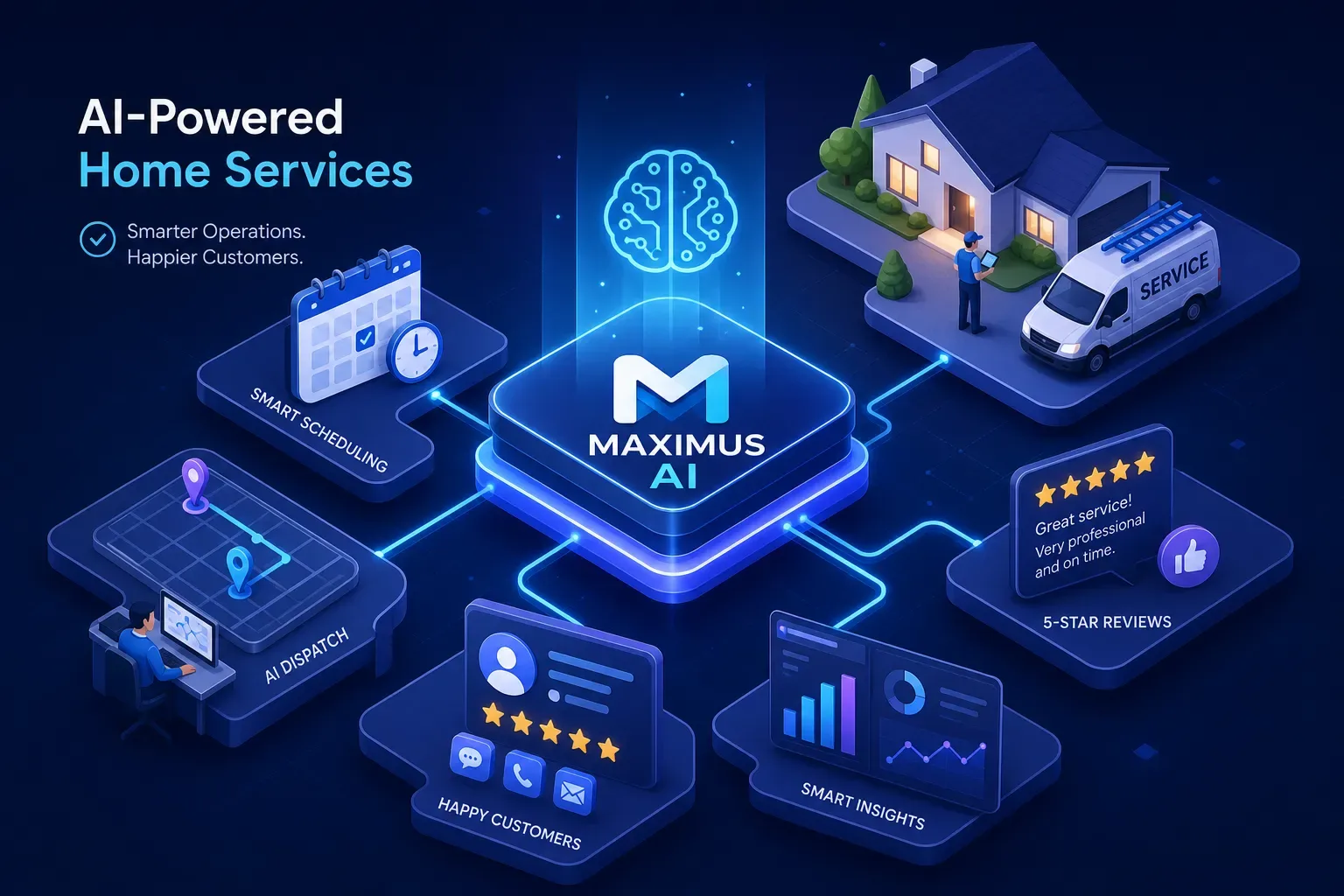
Maximus AI for home services fills that operational gap without adding headcount. It connects directly to Jobber and QuickBooks, and lists support for Housecall Pro and ServiceTitan as well, which means it works with the systems the owner already uses. There's no ripping and replacing the stack, just a layer that sits on top and handles the work that currently falls through.
Maximus AI Home Services: 24/7 Call Answering and Job Booking
What happens to a call at 11pm on a Saturday
The workflow is simple and it's the same every time. A call comes in after hours, this AI answering service for contractors answers in the company's voice, identifies what the caller needs, and acts on it. Routine service request: it books directly into the schedule and sends a confirmation text. Actual emergency: it routes to the on-call tech. No voicemail queue, no message to sort through in the morning.
The owner wakes up to a job already on the calendar. That's the entire point. The 24/7 coverage isn't a feature you brag about to customers. It's the difference between a booked job and a missed call that went somewhere else.
Lead qualification happens in real time during the call. As a virtual receptionist for roofing, HVAC, and plumbing businesses, Maximus captures the caller's name, issue, and urgency before the call ends, so the next morning doesn't start with cold callbacks on incomplete messages.
Why missed calls are a revenue problem most owners undercount
Industry benchmarks put the average value of a missed call in HVAC at roughly $350, with individual jobs often running several hundred dollars or more depending on market and job type. A $2M shop typically misses 7 to 12 calls per week. Run that math across a month and the number stops feeling abstract. The office closed at 5pm, but the customer's AC didn't wait until morning to stop working.
The compounding problem is that missed calls don't just cost you that job. They cost you the maintenance agreement, the future service calls, and the review the customer would have left if someone had picked up. The revenue loss from unanswered calls is almost always bigger than owners estimate, because they're only counting the call they know they missed, not the ones they never knew happened.
How Maximus AI Home Services Recovers Aging AR and Dormant Revenue
How Maximus tracks aging invoices automatically
Maximus flags invoices past 30 and 60 days, then initiates a follow-up sequence without the owner having to open a spreadsheet or remember who owes what. The follow-up goes out in the company's voice, not a generic collections tone. That distinction matters because these are customers you want to keep, not write off.
This contractor call automation for AR runs as a sequence of SMS and email touchpoints tied directly to the invoice in QuickBooks, with escalation built in. The system keeps pushing until the invoice gets paid or the owner decides to write it off. The follow-up sequence alone tends to close out accounts that simply went quiet because nobody reached back out.
What a dormant customer reactivation campaign actually looks like
Maximus pulls from QuickBooks history to identify customers who haven't booked in 12 to 24 months. It builds a targeted outreach campaign for that list, personalized to each customer's service history. This isn't a mass email blast with your logo at the top. It's a structured re-engagement sequence built to generate booked appointments.
The reactivation window matters. Customers inactive for 3 to 18 months convert at a meaningfully higher rate than those who've been dormant for longer. The system runs the campaign while the owner is on a job site, not on a weekend afternoon when there's finally time to think about it. Temperature Pros Orlando ran one of these campaigns and the results are worth covering in detail.
The 7am Briefing: What Your Daily Business Summary Covers
What the briefing includes each morning
Every morning at 7am, this home services appointment booking AI sends a summary covering overnight activity, calls answered, jobs booked, invoices flagged, AR status, and items handled automatically. The owner starts the day knowing exactly where things stand, not discovering a problem at noon after it's already grown.
The briefing covers:
- Jobs booked and revenue on the board
- AR flags and outstanding invoice status
- Overnight calls handled and how they were resolved
- Review activity on Google Business Profile
- Urgent follow-ups requiring a decision from the owner
- Any mispriced jobs or underquoted work flagged for review
Why this matters for the operator running on instinct
Most owner-operators at this revenue level manage by gut feel and memory. They know roughly what's on the board, roughly what's owed, and roughly how yesterday went. The briefing replaces "roughly" with actual numbers, without requiring a login to three different systems before the first cup of coffee.
Revenue leak detection is built into the morning summary. If a job was underquoted, Maximus flags it. If a technician certification is about to expire, it shows up. It's the closest thing to having a business partner review the books with you every morning.
Temperature Pros Orlando: What 90 Days with Maximus Produced
$31,000 recovered from a single reactivation campaign
Temperature Pros Orlando ran a dormant customer reactivation campaign using Maximus pulling directly from their QuickBooks history. The campaign targeted customers who hadn't booked in over a year. The reported result was over $31,000 in recovered revenue from a single campaign run against a customer list the business already had.
To put that number in context: for a $2M HVAC shop, that's more than 1.5% of annual revenue from one campaign, targeting people who were already in the system, had already been served, and simply hadn't heard from the business in a while. No new leads purchased. No advertising budget. Just a reactivation of existing relationships.
$12,400 in aging AR collected within 90 days
Separately, Maximus's AR chasing workflow recovered $12,400 in outstanding invoices over the same 90-day period. This wasn't new revenue from new jobs. It was money already owed to the business that had been sitting uncollected because nobody had the bandwidth to follow up consistently.
Combined, the two results represent $43,400 recovered in 90 days, customer-reported figures from deploying AI answering and dispatch for service companies across both the front and back office. Zero new hires. No changes to the field operation. The trucks ran the same routes. The technicians ran the same calls. The back office just stopped leaking.
What these numbers mean at scale
The Founding 20 pricing is $497/month or 8% of recovered revenue, whichever is higher. With $12,400 in AR recovered across the first 90 days, the math on cost-to-return closes fast, recovered revenue covered the platform fee well before the reactivation campaign results came in. That's the ROI case for a business tool: it covers its own cost before you finish the first quarter.
The reactivation campaign is repeatable. The dormant customer list refreshes over time, and the campaign can run again against the next cohort of inactive customers. This isn't a one-time result. It's an AI lead generation workflow for home services that runs on a schedule the owner sets and forgets.
Who Maximus AI for Home Services Is Built For (and Who It Isn't)
The operator it fits best
Maximus fits home services owner-operators running $1M to $5M in revenue who are still personally absorbing the work of an office manager. Shops already using Jobber, Housecall Pro, or ServiceTitan with aging AR sitting untouched, missed calls going uncounted, and a dormant customer list gathering dust in QuickBooks, these are the businesses with the most immediate, measurable gains available.
It also fits operators who are starting to think about what comes next. A second location, a sale, a step back from the day-to-day. None of those paths work if the business only runs because the owner shows up. Maximus builds the operational layer a buyer or a second location actually requires: documented processes, clean AR, consistent follow-up, daily performance visibility.
How to get started: rapid deployment, operator-to-operator terms
Maximus is designed for fast deployment, trained on the shop's pricing, voice, service area, and staff with no multi-month implementation and no dedicated IT project. The founding cohort is limited to 20 shops in the $1M to $5M range and includes monthly one-on-one working sessions with the founder, operator to operator. That's not a support ticket. It's a working session with someone who runs an HVAC company.
Here's who it doesn't fit. Multi-location franchises with dedicated office staff already in place won't see the same leverage. The platform was designed for the owner who is the office manager, not for the business that already has one.
The Bottom Line on Maximus AI Home Services
Maximus AI home services automation isn't another tool to manage. It's the operational layer that most owner-operators in the $1M to $5M range are missing and personally compensating for every single day. The missed calls, the aging AR, the dormant customers, the morning scramble to figure out where the business stands, these aren't small inconveniences. They're measurable revenue problems with measurable solutions.
Temperature Pros Orlando reported $43,400 recovered in 90 days without adding a single staff member. That result came from a real HVAC company running a real platform on actual customers, not a case study built to justify a software purchase.
If you're running a $1M to $5M home services shop and the problems described in this article sound familiar, the founding cohort is where to start. Twenty spots. Operator-to-operator terms. A 90-day money-back guarantee if the platform doesn't recover more than you pay in fees. Apply for your founding cohort spot today, the results are there. The only question is whether you want them.