Selling Your HVAC Company Without Leaving Money Behind
Most HVAC owners who start thinking about selling their HVAC company have a number in their head.
Selling Your HVAC Company Without Leaving Money Behind
Most HVAC owners who start thinking about selling their HVAC company have a number in their head. It's usually too high, and the reasons they believe it's too high are the same reasons a buyer will use to bring it down. Owner-dependent operations, inconsistent financials, no documented processes, and a maintenance agreement book that's smaller than it should be. These aren't fatal problems, but they are expensive ones if you discover them after a buyer has already run diligence on your business.
This article is a plain-talk roadmap covering what buyers pay, what they look for, how to prepare your business, and how deals actually get structured and closed. The team behind Maximus has worked extensively inside home services businesses, so what you're reading isn't theory. It's what we've seen from both sides of the equation: as operators and as people who spend every day inside the numbers of home services businesses.
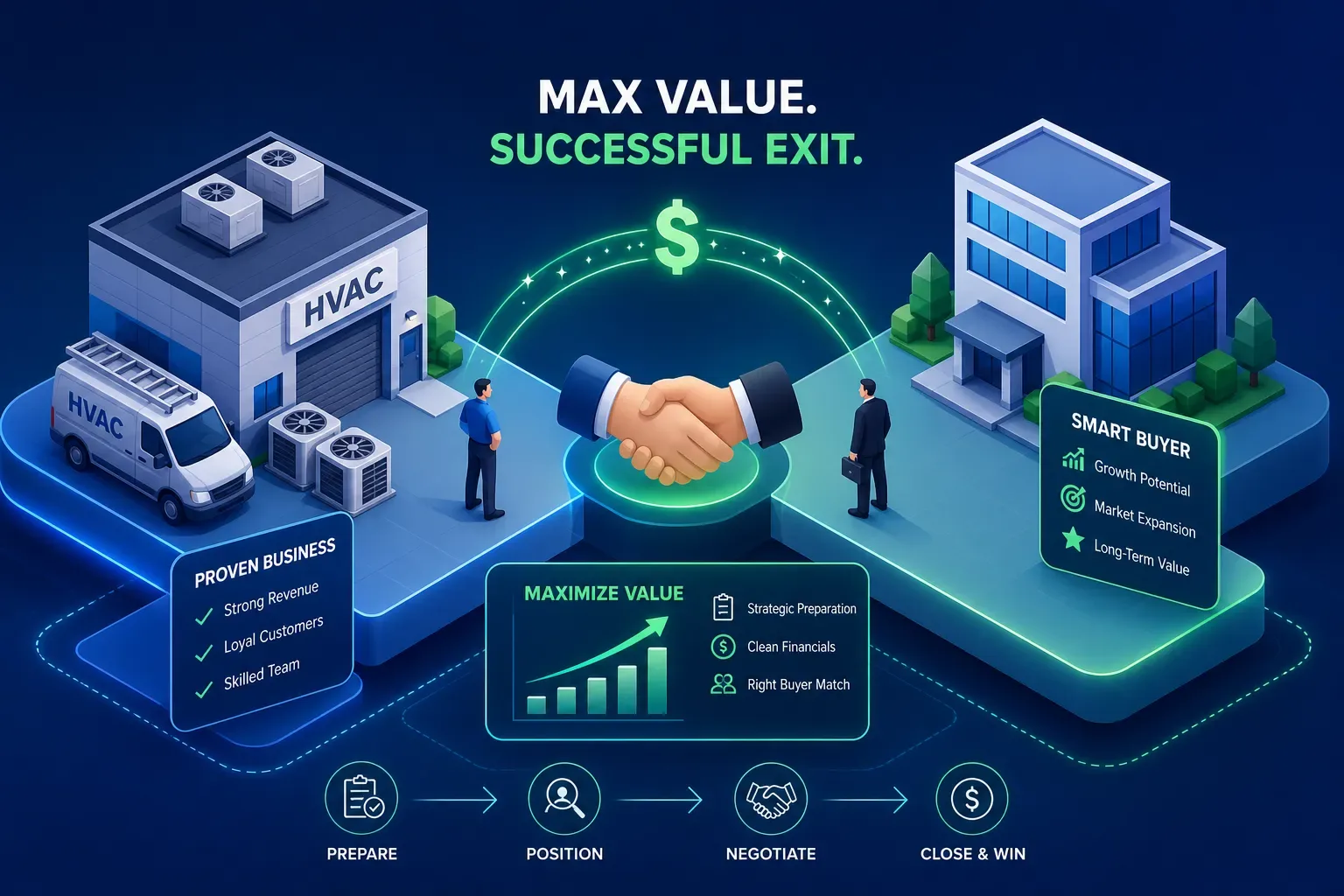
The exit doesn't start when you find a buyer. It starts 12 to 24 months before that, with the decisions you're making right now.
What Buyers Actually Pay When Selling an HVAC Company in 2026
How valuations are calculated (EBITDA, not revenue)
Buyers don't care about your top-line revenue the way you do. They care about EBITDA: earnings before interest, taxes, depreciation, and amortization. That number, multiplied by a range of 3.5x to 8.0x depending on your size and business quality, is what determines your sale price. For a $1M to $3M revenue shop in 2026, that multiple typically lands between 4.5x and 6.5x. Businesses under $1M in revenue are often valued on Seller's Discretionary Earnings instead, usually at 2.5x to 3.5x SDE.
The jump from a 4x multiple to a 7x multiple isn't random. It comes down to controllable factors: how much of your revenue is recurring, how dependent the business is on you personally, how clean your financials are, and what your margins look like. A $400,000 EBITDA business at 4x sells for $1.6M. The same business at 7x sells for $2.8M. That $1.2M gap is entirely created by preparation.
Why maintenance agreements move the needle more than any other factor
If you want one lever that changes your valuation more than anything else, it's your maintenance agreement book. Buyers typically assign a separate value of 1x to 3x annual contract revenue to your agreement base, layered on top of the EBITDA multiple, with 2x to 3x achievable for strong, low-churn books in high-demand markets. A shop with 500 agreements at $250 per year has $125,000 in annual recurring revenue. That's not just a line item. That's $125,000 to $375,000 in additional sale value, plus it shifts your whole business into a higher multiple band.
When your maintenance revenue represents 40% or more of total revenue, buyers see a fundamentally different business. The cash flow is predictable, the margins on planned maintenance are higher than emergency service calls, and those agreements generate pull-through revenue in repairs and parts. A $3M shop with a strong agreement base can command multiples that a $3M shop without one simply cannot reach.
Selling Your HVAC Company When You're Too Involved: The Deal-killer Most Owners Miss
What owner dependency actually costs you at the closing table
Buyers are not buying your revenue. They're buying a system. If that system only works because you show up every day, handle the hard calls, and keep everything running on institutional knowledge stored in your head, the buyer is purchasing a job, not a business. Owner dependency is one of the most common reasons HVAC deals fall apart during diligence or get repriced significantly downward. Buyers ask directly: can this operation run for a reasonable transition period without the owner present? If the answer is no, the multiple drops.
Think about what a buyer actually inherits when they purchase your HVAC business for sale. They inherit your customers, your technicians, your agreements, your reputation, and your processes. If those processes live only in your memory, they're not transferable. A business that requires you is worth far less than one that runs on documented systems any capable manager can follow.
How automation creates proof that the business works without you
Platforms like Maximus help owners systemize call answering, invoice follow-up, customer reactivation, and daily operational reporting so the business runs on documented processes instead of the owner's memory. When a buyer's diligence team sees 24/7 call coverage, automated AR follow-up, and a daily operational briefing that any manager can read and act on, they see a transferable asset. That's what commands the higher multiple.
The goal is to make yourself optional before you put the business on the market. Not absent, but optional. Every system you document, every process you automate, and every task you remove from your personal to-do list is a direct contribution to your sale price.
The Due Diligence Package Buyers Will Demand
Financial records: what years and what format
Buyers and brokers want three to five years of annual profit and loss statements, balance sheets, and cash flow statements. They also want 24 to 36 months of monthly P&Ls that reconcile cleanly to your federal tax returns. Three years of tax returns are non-negotiable. And they want a clean add-back schedule that documents every owner-related normalization with a clear explanation: personal vehicle, owner health insurance, one-time expenses, and any family members on payroll whose roles won't transfer.
Missing or inconsistent add-backs are one of the top reasons valuations get cut during diligence. If you can't explain the gap between your tax return net income and your claimed SDE with a clear, documented schedule, a buyer will assume the worst and adjust their offer accordingly. Get this package together before you list, not after someone asks for it.
Contracts, licenses, and the documents most sellers overlook
Beyond the financials, buyers want your maintenance agreements with renewal rates, all vendor and supplier contracts, a complete fleet schedule with age and mileage, your real estate lease with confirmation it's assignable, technician certifications and license records, and current liability insurance certificates with a clean claims history. They want to verify there are no open legal claims, no license lapses, and no single customer representing more than 15 to 20% of your revenue. Customer concentration above that threshold is a direct valuation risk in a buyer's model.
Pull this entire package together proactively. Walking into a sale process with an organized data room tells buyers that this is a professionally run operation. Scrambling to find five-year-old contracts after an LOI is signed tells them the opposite.
Who Buys HVAC Companies and What Drives Their Offer
The four buyer types and what each one wants when you sell your HVAC service company
Private equity-backed platforms are among the most aggressive buyers in the market right now. Names like Apex Service Partners, Wrench Group, and Sila Services are actively building regional platforms and tend to pay the highest multiples, sometimes exceeding 8x EBITDA for platform-ready businesses with strong recurring revenue and scalable management. But they want specific things: $1M or more in EBITDA, strong recurring revenue, and a management team that doesn't collapse when the founder steps back. If you don't have those, you're not their target.
Strategic buyers, regional or national operators looking to expand their footprint, move faster and care more about geographic coverage than financial perfection. Individual owner-operators, usually SBA-financed, are the most common buyers for sub-$1M SDE businesses. They want a clean operation they can step into without a major overhaul. Family offices sit in a fourth category: patient capital with long hold horizons, willing to pay fair multiples without PE-style pressure to flip in five years.
Where to find these buyers (and who finds you)
PE and strategic buyers source deals primarily through specialized M&A brokers and their own proprietary outreach networks. If you're running a $3M or larger shop, a broker with a track record in home services M&A is worth the commission. Individual buyers use public marketplaces like BizBuySell and work with local brokers and SBA lenders. Knowing which buyer type fits your size and exit goals before you go to market determines whether you hire a broker, work a direct channel, or list publicly. Don't approach this backward.
How Deals Are Structured and How Long This Takes
Deal structure: cash at close, earnouts, and seller notes
Most HVAC deals close as asset purchases. A PE buyer typically delivers 65 to 70% cash at close, with 10 to 20% tied to an earnout based on contract retention or gross profit over 12 to 36 months, and the seller retaining 5 to 20% rollover equity in the acquiring platform. SBA-financed deals work differently: the buyer brings 10% equity, an SBA 7(a) loan covers 80 to 90% of the price, and the seller carries a subordinated note for the remaining 5 to 10% at 6 to 8% interest over five to seven years.
Earnouts are not free money. They're contingent money. If your maintenance agreements churn after the sale, or if gross profit doesn't hit the target, you won't collect. Negotiate earnout terms carefully and make sure the metrics are ones you can actually influence during the transition period.
The timeline most sellers underestimate
From the decision to sell to cash in hand, plan for six to twelve months. Preparation takes one to three months; marketing and buyer outreach takes two to four months; LOI negotiation runs two to three months. Due diligence runs six to eight weeks, and closing paperwork takes three to four weeks. Strategic buyers can compress this to three to six months. PE buyers typically run six to nine months given their fund processes and institutional diligence requirements.
Most sellers underestimate the preparation phase because they assume their business is already in good shape. It rarely is. Starting the preparation process 18 to 24 months before you intend to list gives you time to fix the things that would otherwise reduce your multiple.
The Work That Drives a Premium Sale Price When Selling Your HVAC Company Happens Long Before Listing
Most HVAC owners wait until they're ready to sell and then try to make the business look good in the 90 days before listing. That almost never works. Buyers are not looking at a snapshot. They're looking at three to five years of history. The decisions you made two years ago show up in your diligence package whether you like it or not.
The difference between a 4x multiple and a 7x multiple is not luck. It's recurring revenue built over years, owner involvement systematically reduced through documented processes and automation, clean financials that tell a consistent story, and a due diligence package that's ready before the first buyer conversation. Every one of those things takes time. None of them can be manufactured in 90 days.
If you're running a $1M to $5M HVAC shop and beginning to think about an exit, the most productive thing you can do right now is audit your business the way a buyer would. Walk through your financials, your agreements, your owner involvement, and your operational systems as if you were the one writing the check. What would you pay? If you're serious about selling your HVAC company, start that audit today, the multiple you command tomorrow depends on the work you do right now.