The Best Answering Service for Electricians
A four-person electrical shop can bleed over $52,000 a year from calls that ring out unanswered. Not from slow seasons. Not from bad marketing.
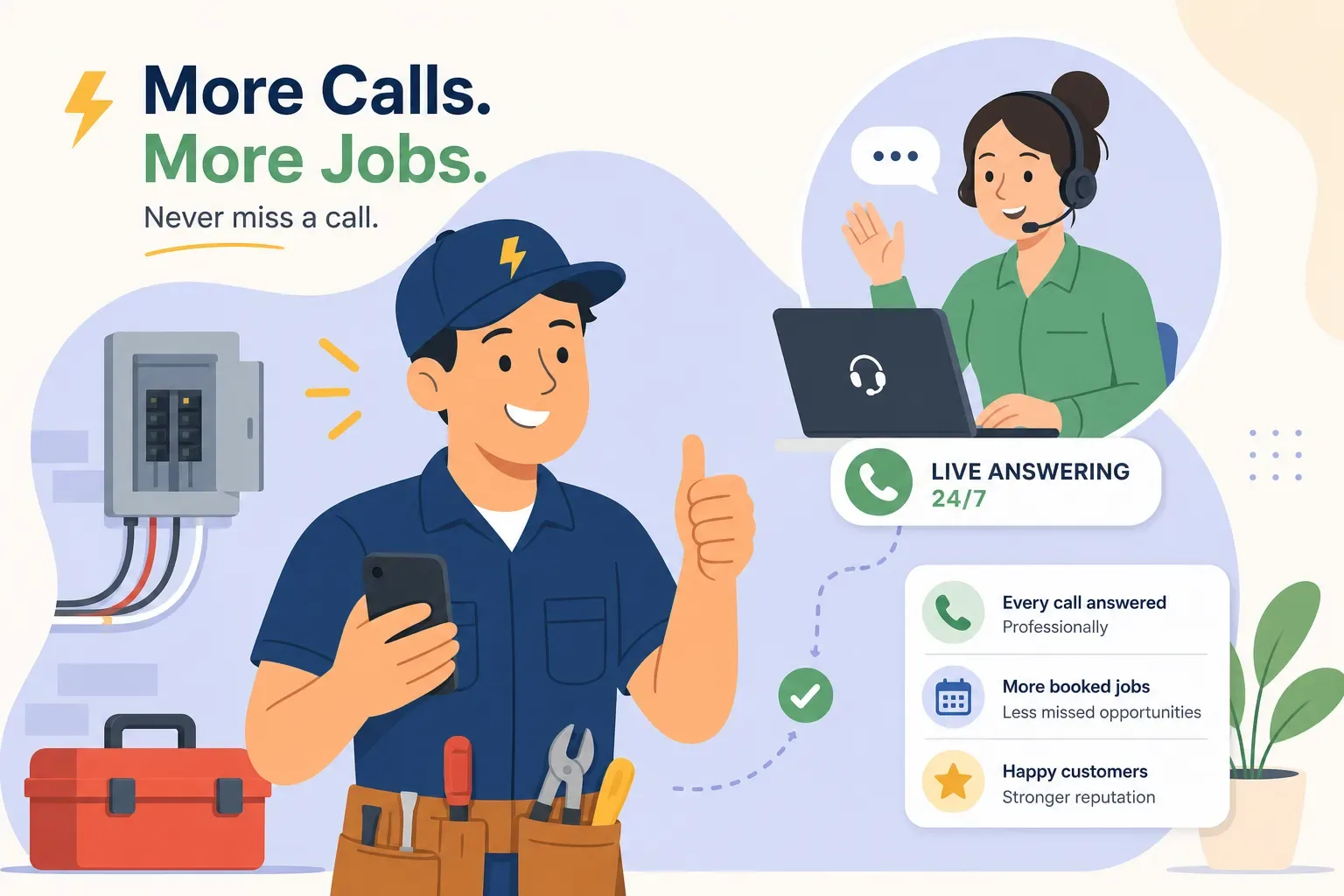
A four-person electrical shop can bleed over $52,000 a year from calls that ring out unanswered. Not from slow seasons. Not from bad marketing. From the after-hours window, when someone with a sparking panel or a dead circuit calls your number, gets no answer, and immediately dials the next electrician on Google. That job is gone in under 60 seconds. An answering service for electricians closes that gap before it costs you another emergency job. This guide skips the vendor fluff and tells you exactly what phone coverage for electrical contractors actually requires, what different provider types cost, and how to choose one without tying your crew in knots during the transition.
The options have expanded considerably. Human receptionists, AI-driven platforms, and hybrid models all compete for the same monthly budget. Each has a real use case and a real set of tradeoffs. The goal here is to help you match your shop's actual needs to the right fit, not to sell you on the most expensive option or the shiniest technology.
What a missed call is actually costing your electrical business
Most electricians assume voicemail handles the overflow. It doesn't. A homeowner calling at 8 p.m. about a burning smell near the breaker box is not going to leave a message and wait for a callback. They're going to call the next number. Emergency electrical situations (panel replacements, power restoration, wiring faults) carry your highest ticket values, and those are exactly the calls that come in after 5 p.m. and on weekends.
The after-hours window where emergency jobs walk out the door
Roughly one-third of inbound calls to small electrical contracting businesses come in outside normal business hours or on weekends. That window is where electrical emergencies concentrate, because people are home and using their electrical systems heavily in the evenings. One Ohio electrical contractor case study tracked 48 emergency calls per month captured after adding consistent after-hours coverage, generating $21,600 per month in emergency revenue that had previously gone unanswered. When you model the full range of missed emergency and routine booking losses, annual revenue losses for a typical shop can run from $78,000 to $156,000, with mid-size operations potentially losing far more once you factor in both emergency and routine booking gaps.
Average emergency electrical ticket values reinforce why this matters. Panel replacements run $1,300 to $3,000. Emergency outage troubleshooting commonly lands in the $300 to $800 range after service fees. A single booked panel job that would have otherwise gone to a competitor covers several months of answering service fees. The math is not subtle.
Why voicemail doesn't work for electrical emergencies
Caller psychology is straightforward here. Someone with no power or a burning smell needs an answer now, not a callback tomorrow morning. When you run a mid-size shop's full call volume through average ticket size and a realistic conversion rate, the modeled annual loss from unanswered calls can exceed $720,000. That number feels extreme until you run it through your own call volume. The point is not to alarm you. The point is that every unanswered call is a decided revenue event, not a neutral one. A 24/7 answering service for electricians is the most direct way to stop that bleed.
Features that actually matter in an answering service for electricians
Most answering services were built for law offices and medical practices. Their scripts, their triage logic, and their integrations reflect that. An electrical contractor has different requirements, and a generic service that takes messages and emails them over is not solving the problem. It is adding a step.
Emergency triage built for electrical hazards
A provider worth considering must distinguish between a true electrical emergency (sparking panel, burning smell, whole-house power loss) and a routine service request (adding an outlet, replacing a ceiling fan). That distinction determines dispatch priority. Providers that train their agents or their AI specifically on electrical hazard scenarios handle this correctly. Providers that use generic service scripts treat every call the same way, which means your on-call tech gets dispatched for a ceiling fan and a sparking panel gets the same callback window. That is a problem both operationally and from a liability standpoint.
Booking and dispatch, not just message-taking
The service must book the job directly into your schedule, confirm an appointment time with the caller, and dispatch your on-call technician for true emergencies. Taking a message and sending an email is a 1990s solution. A proper call handling service for electrical contractors functions as an extension of your dispatch process, not a separate step that your office staff then has to act on the next morning. If a provider cannot book directly, it is not solving the actual problem.
Software integrations that connect to your existing workflow
The service needs to work with whatever field service management platform you already run. Jobber, Housecall Pro, and ServiceTitan all have integration paths that let a well-configured answering service book directly into your scheduling system. Without that connection, you get double entry, booking errors, and a team that stops trusting the service within the first two weeks. SMS confirmations to the caller, call transcripts delivered to the owner, and Google Calendar sync are practical necessities, not upsells. If a provider cannot check those boxes, move on.
Human, AI, or Hybrid: Which Model Fits Your Shop
Three provider types exist in the market. Each has a different cost structure, response speed, and level of trade specificity. The right choice depends on your call volume, your emergency dispatch needs, and how tightly you need the booking to connect to your existing workflow.
Live answering services: what you get and what you give up
Human answering services offer genuine conversation and judgment calls that a script cannot replicate. A live agent can handle nuance, calm a panicked homeowner, and make real-time decisions. The tradeoffs are real: higher per-minute or per-call costs, variability in agent quality, and the ongoing question of whether your provider is US-based or offshore. Industry-standard SLA for live services is 80% of calls answered within 20 to 30 seconds. For shops with high call volumes or complex dispatch needs, live services work well. Budget $99 to $500 per month for a small to mid-size electrical shop, and more if you need dedicated live dispatch coverage around the clock.
AI-powered virtual receptionist for electricians
AI-driven call handling platforms have improved enough to be genuinely useful for trade businesses, and adoption among electrical contractors reflects that shift. The important distinction is between generic AI tools built for any industry and platforms built specifically inside home services operations. Maximus, for example, was built and tested inside an actual HVAC company before it was ever offered to anyone else. Every feature was proven on real revenue first. That matters because an AI receptionist for electricians that understands the difference between a panel emergency and a routine service call handles the conversation differently than one designed for a law firm or a dental practice. For electrical contractors, that trade-specific logic is the difference between a tool that books jobs and one that creates confusion.
AI platforms also handle volume without per-minute billing, which changes the cost structure significantly at higher call counts. Speed-to-answer is near-instant, which directly affects call abandonment rates. When callers hear a ring and a voice immediately, they stay on the line. When they wait 30 seconds or longer, a significant percentage hang up and call someone else.
Hybrid models and when they make sense
Some providers route routine booking calls to AI and escalate flagged emergencies to live agents. For electrical shops with a high volume of after-hours emergency calls, this middle option balances cost with the human judgment that can matter when a caller is describing a fire risk. Before committing to a hybrid model, ask the provider exactly where the handoff happens, how fast it occurs, and whether the caller experiences any friction in that transition. A handoff that feels clunky to a panicked homeowner defeats the purpose.
What these services cost and what you should realistically earn back
The monthly fee alone tells you nothing about whether a service is worth it. Context matters. A $200/month service that captures two emergency jobs per month that would have otherwise been missed more than pays for itself in the first week. A $99/month service that takes messages nobody acts on costs you more than it saves.
Here is the practical pricing breakdown by model:
- AI flat-rate plans: $29 to $349/month depending on volume and features
- Per-minute live answering: $0.75 to $2.00/minute, typically $99 to $500+/month for small to mid-size shops
- Per-call billing: $6 to $15 per call, with variable monthly totals
- Tiered bundles: $49 to $800+/month scaled by minutes, integrations, and scheduling features
For most electrical contractors running one to four technicians, the practical monthly spend lands between $99 and $400. Higher-volume shops or those requiring dedicated live dispatch coverage will pay more.
The ROI math is straightforward: one panel replacement job booked after hours instead of missed runs $1,500 to $3,000. A composite analysis of a four-electrician shop projects $52,000 in annual revenue lift from consistent call coverage, split roughly $42,000 from estimate conversion and $10,000 from after-hours emergency capture. Those are not guarantees. They are the realistic upside when coverage is consistent and the booking process actually works.
How to trial and integrate a service without disrupting your crew
Most electricians stall on this decision because they worry about the transition. The concern is understandable. A new call handling layer that confuses customers or creates booking errors is worse than the problem it was supposed to fix. The good news is that a properly scoped trial removes most of that risk before you commit fully.
What to set up before the first call goes live
Before launch, give the provider your pricing structure, service area, on-call technician schedule, emergency dispatch protocol, and software credentials for integration. Good providers offer a setup session where they train their system or agents on your specific call types, your voice, and your service categories. Expect 24 to 48 hours for a basic AI platform to go live. Live-agent services typically need one to two weeks of onboarding to build scripts, configure escalation rules, and run test calls. Do not skip the test call phase. Run your own calls through the system before it touches real customers.
What to measure in the first 30 days to know if it is working
Track four things: calls answered versus calls missed (establish your baseline before launch), jobs booked through the service, emergency dispatches triggered, and booking errors that required manual correction. If the service integrates with Jobber or your FSM platform, this data should surface without manual tracking. At day 30, multiply the jobs booked through the service by your average ticket value. That number either justifies the monthly fee or it doesn't. The answering service for electricians that picks up at 9 p.m. on a Friday is the one that earns the customer's trust before your competitor even has a chance to answer.
Stop losing jobs to a phone that rings out
Missing calls is an operations gap, not a marketing problem. It is also one of the most straightforward revenue leaks to close in an electrical business. The right answering service for electricians pays for itself fast, often within the first week if a single emergency job converts. The decision comes down to your call volume, your emergency dispatch requirements, and how tightly you need booking to connect to your existing workflow.
Full disclosure: this is exactly what Maximus was built to do. If you want an answering service for electricians that was built inside a real home services company and proven on actual revenue before being offered to anyone else, reach out to our team. We deploy in 48 hours, integrate directly with Jobber, Housecall Pro, and ServiceTitan, and include a monthly working session with an operator who has run the same kind of shop you're running. Start with a 30-day trial. Measure the jobs booked. Let the numbers make the case.