Top 7 ServiceTitan Alternatives for Home Services Businesses
If you're searching for a ServiceTitan alternative, you've probably already done the math and didn't like what you found.
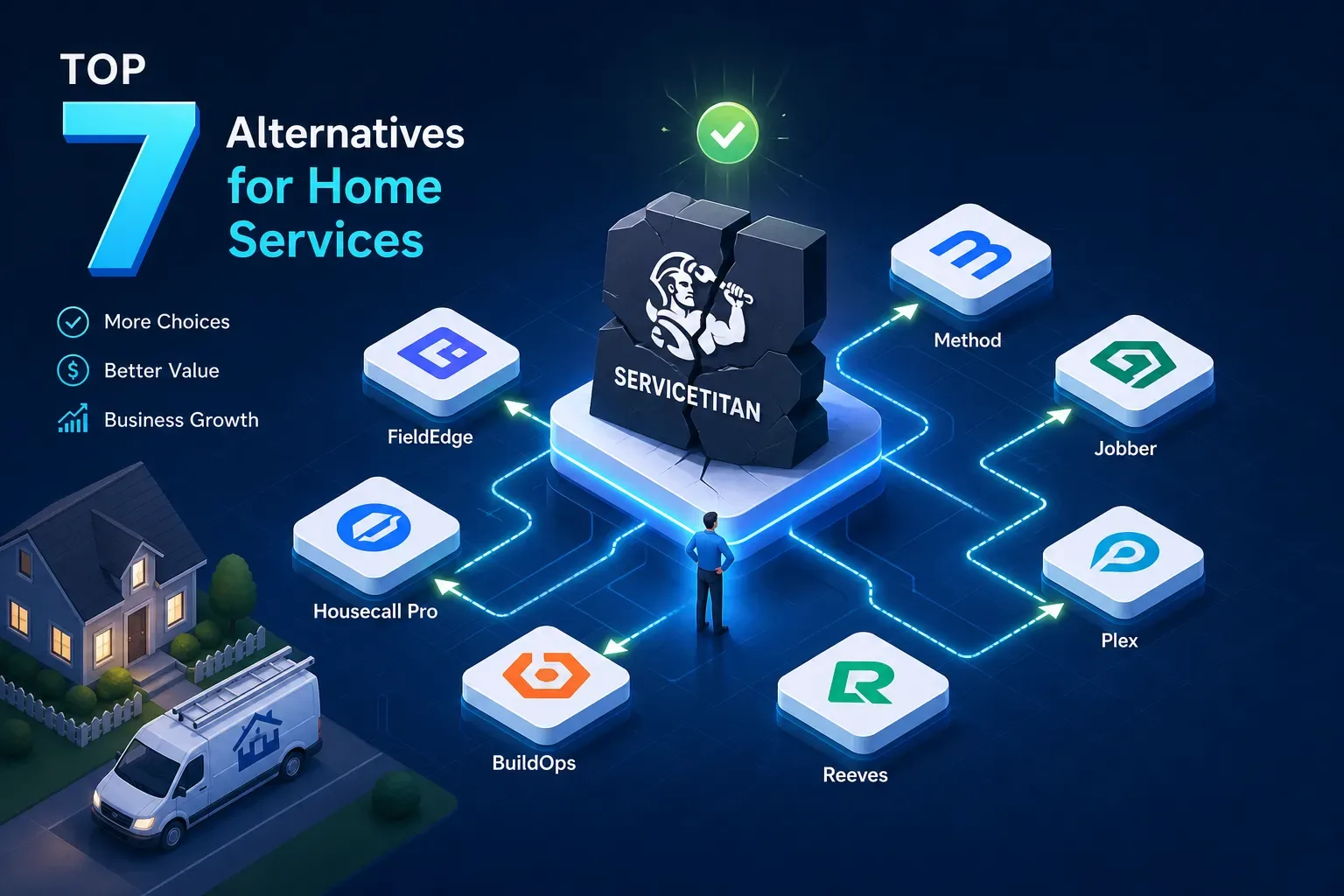
If you're searching for a ServiceTitan alternative, you've probably already done the math and didn't like what you found. ServiceTitan was engineered for multi-location enterprises with full-time admins, dedicated trainers, and the margin to absorb implementation fees that run into the thousands. For a $1M, $5M HVAC or home services shop, that's the wrong tool for the job. The platform is genuinely impressive. It's just not built for you.
What follows is a direct comparison of seven alternatives to ServiceTitan worth evaluating, organized by where your shop sits today. Before you pick your platform, know this: the smartest operators aren't just switching software. They're adding an AI layer on top of their field service management software to close the gaps no FSM handles on its own. Platforms like Maximus exist specifically for that. Start with the platform.
Why small shops keep hitting ServiceTitan's ceiling
The real cost for a sub-$5M shop
ServiceTitan doesn't publish pricing. You call, get a demo, and receive a quote. Based on figures owners have shared publicly on forums and review sites, expect implementation fees in the thousands, per-technician monthly costs that stack fast, and an add-on structure that charges separately for features you'd assume were included. A 4-technician shop doing $2M in revenue can spend $10,000 or more annually before reaching full feature use. That's a real margin hit for a shop where the owner is still doing ride-alongs and personally handling office work.
When complexity becomes a liability
The learning curve is not a minor inconvenience. Reviews on G2 and Capterra consistently flag slow onboarding, support friction, and UI complexity that requires a dedicated admin to manage well. If you're an owner-operator still doing field work, you don't have a full-time person to run an FSM software platform with this much surface area. It's a daily time tax on the person the business can least afford to slow down, which is you.
Lightweight ServiceTitan alternative picks for shops under $2M
Jobber: the clean starting point for growing shops
If you're under $1.5M and still running jobs from spreadsheets or a basic calendar, Jobber is the fastest path to a real FSM. The Core plan starts at $39/month for one user. The Connect Team plan runs $169/month for up to five users, with additional users at roughly $29/month each. The mobile app is clean, onboarding takes days not months, and no manual is required to get your team using it. As a cheaper ServiceTitan alternative, nothing in this price range matches it on simplicity and adoption speed.
The tradeoff is reporting depth. Jobber's analytics work well for small shops but thin out for owners who want to dig into job profitability by technician or track revenue trends over time. It's a great starting point, not a long-term ceiling.
Housecall Pro: best for customer-facing experience
Housecall Pro gets overlooked in most ServiceTitan comparisons, but it outperforms both on customer communication. Automated review requests, customer messaging, and marketing integrations are genuinely strong relative to other tools in this price range. Pricing starts at $79/month for one user, $189/month for up to five users, and $329/month for up to eight users, with additional seats at $35/month each. If your differentiation is customer experience and repeat bookings, this is the natural fit. If you need deep financial visibility or complex dispatch workflows, it starts showing limits before you hit $2M in revenue.
Workiz: best for dispatch-heavy operations with call tracking
Workiz sits in a useful middle ground for shops where call handling and dispatch are daily friction points. It includes a built-in phone system, call recording, QuickBooks sync, and an AI dispatcher feature called Genius Answering. G2 reviewers consistently flag it as easier to use, set up, and administer than ServiceTitan. For a shop that loses revenue to missed calls and needs a platform that handles communication and dispatch in one place, Workiz is one of the stronger FSM software alternatives in this range.
Mid-range ServiceTitan alternatives with more operational depth
FieldPulse: the CRM-focused operator's choice
FieldPulse explicitly positions CRM as a core part of the platform, not a bolt-on. Scheduling, estimating, and customer lifecycle management are built to work together. It's a better fit than Jobber or Housecall Pro for shops where the sales pipeline matters as much as the dispatch board. Pricing isn't public and requires a demo call, which slows evaluation for busy owners. That said, if CRM depth is your primary need, it's worth the conversation.
Service Fusion: solid operational depth without the enterprise price tag
Service Fusion offers stronger inventory management and scheduling depth than the lighter SMB tools, without jumping to ServiceTitan-level complexity. It's a logical step-up option for shops that have genuinely outgrown Jobber or Housecall Pro and need more control over their operations. As a ServiceTitan competitor in the $2M, $5M range, it's one of the more balanced picks for owners who need operational depth without a full-time admin to manage the system.
FieldEdge and Projul: trade-specific tools worth a demo
FieldEdge is built specifically for HVAC, plumbing, and electrical contractors. It includes flat-rate pricebooks through Coolfront, service agreement management with renewal reminders, equipment history tracking, and HVAC-specific quoting workflows that general platforms simply don't provide. Pricing runs roughly $100/month per office user and $125/month per field technician, putting a 4-tech shop in the $500, $700/month range before add-ons. Projul targets the contractor segment with a focus on project management and job costing, making it a better fit for project-based work than recurring HVAC service.
Neither is a universal recommendation. Both are worth a demo if your shop runs on trade-specific workflows that general FSM platforms aren't designed to handle.
The operational gap every FSM tool leaves open
What falls through the cracks after you pick your platform
Picking the right platform gets the foundation right. It does not close the operational gaps that exist in every small shop regardless of which software you choose. Calls that come in at 10pm go to voicemail and never convert. Invoices that hit 45 days get ignored because nobody has time to chase them. Dormant customers from three years ago sit in QuickBooks with money left on the table. The FSM tracks the job. It doesn't recover the revenue. These aren't platform failures. They're structural gaps that software alone doesn't close.
How an AI platform like Maximus layers on top to close those gaps
Maximus was built and battle-tested inside Temperature Pros Orlando, an actual HVAC shop, before it was ever sold to anyone else. It integrates directly with Jobber, Housecall Pro, ServiceTitan, and HCP alongside QuickBooks to handle 24/7 call answering and job booking, AR chasing on invoices past 30 and 60 days, dormant customer reactivation campaigns, and a daily 7am briefing summarizing what was handled overnight. One reactivation campaign recovered $31,000. Ninety days of AR chasing collected $12,400. The point is not to replace your FSM choice. It's to make whichever platform you pick actually perform at full capacity, without hiring more office staff to do it.
How to pick your finalist and make the switch
Questions that narrow it down fast
Before you book a demo with anyone, run through three filters. How many technicians do you have, and what does per-user pricing do to your total annual cost across a 12-month contract? Is your biggest daily friction in dispatch, customer communication, invoicing, or all three, and does the platform you're evaluating actually address that specifically? Do you need QuickBooks integration from day one, or can you migrate financial data later? Honest answers to those questions will eliminate most options on this list and surface one or two clear finalists worth trialing.
Migration checklist before you commit to a switch
- Export your customer data from ServiceTitan via CSV before your contract ends. That data belongs to you and should never be the reason you stay.
- Confirm QuickBooks sync works on the specific plan tier you're evaluating, some platforms gate integrations behind higher-priced plans.
- Run a 30-day parallel pilot before full cutover and set a hard go-live date so the pilot doesn't drift indefinitely.
- Most teams can complete a core data migration to Jobber or Housecall Pro in two to four weeks when the data is clean.
The right ServiceTitan alternative puts your operational foundation on solid footing. Pairing it with an AI layer like Maximus is what turns a better platform into a business that runs without the owner in the middle of everything. Pick the platform, then close the gaps the platform was never designed to fill. Book a demo with Maximus to see how it layers on top of whichever FSM you choose.