What Keeps HVAC Owner-Operators From Scaling Past $2M
What is holding back most HVAC owner-operators from scaling past two million dollars? In most cases, it comes down to the same four or five structural problems…
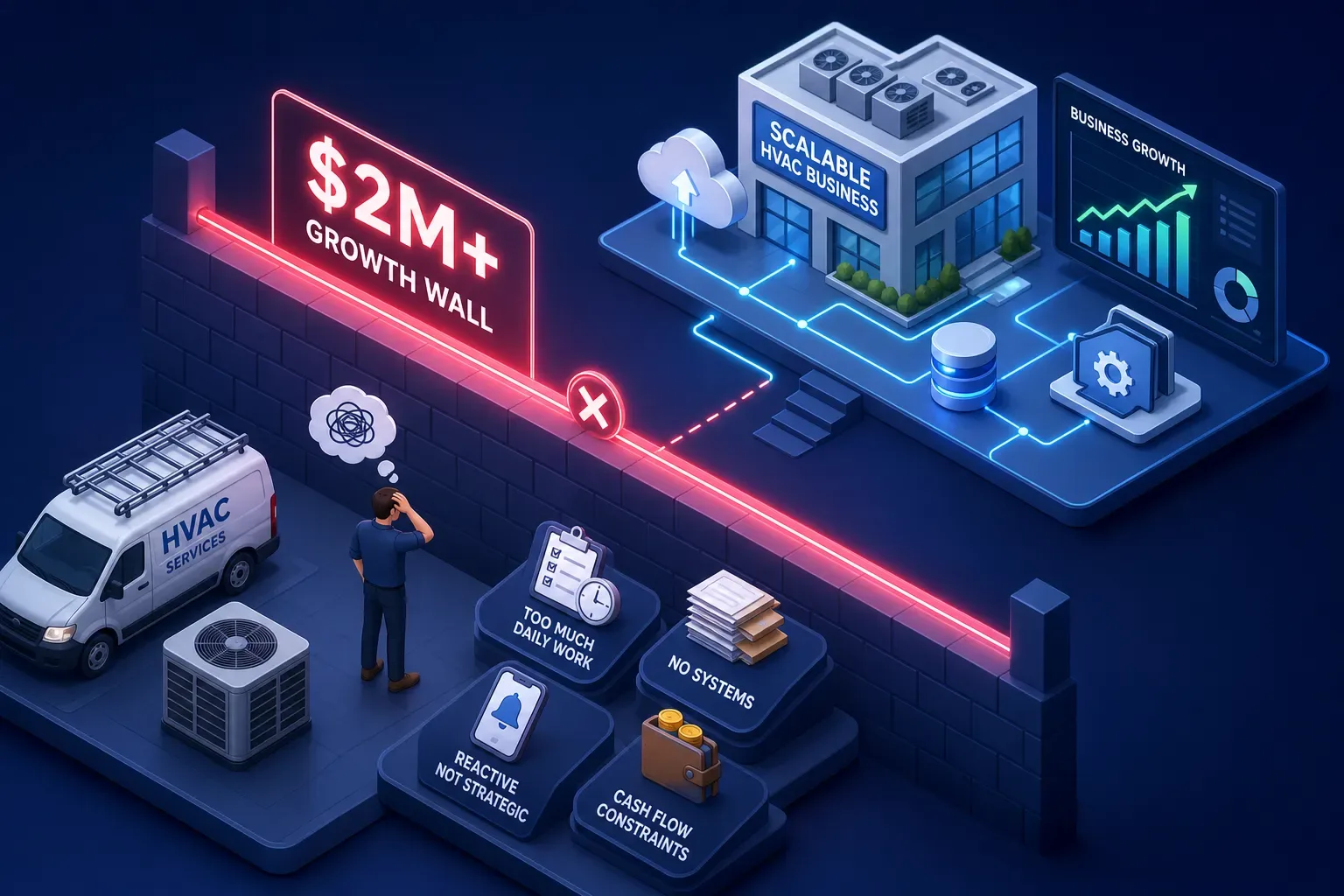
What Keeps HVAC Owner-Operators From Scaling Past $2M
What is holding back most HVAC owner-operators from scaling past two million dollars? In most cases, it comes down to the same four or five structural problems showing up in nearly every shop at that revenue level, and the owner is usually too close to the operation to see them clearly. The market isn't the issue. Working harder isn't the answer. The ceiling is structural, and it's fixable.
This article names those problems directly, puts real numbers against them, and outlines what fixing them actually looks like. Not in theory. The founders at Maximus built and tested these fixes inside their own HVAC company, Temperature Pros Orlando, before offering them to anyone else. That context matters, and you'll see it in the numbers.
By the end, you'll know which bottlenecks are costing you the most and what to prioritize in the next 90 days.
What is Holding Back Most HVAC Owner-Operators From Scaling Past $2M: The Founder-Dependency Trap
The most common growth ceiling in HVAC isn't a market problem. It's a structure problem. The business runs on one person: you. At the $1M, $2M level, most owner-operators are personally handling dispatch decisions, customer complaints, pricing negotiations, and tech oversight simultaneously. When every escalation lands on your phone, growth becomes physically impossible past a certain point. Owner-dependent decision-making creates a hard revenue cap tied directly to what one person can process in a day, typically somewhere between $500K and $1M annually.
Here's what a founder-dependent shop looks like at $1.5M: the owner is doing ride-alongs, fielding after-hours calls personally, and manually approving estimates before jobs go out. It works until it doesn't. Adding a second truck without an operator layer between you and the field doesn't double your capacity. It doubles your chaos. The business needs someone handling daily operations so you can work on the business instead of being the business. That distinction, operator versus owner, is what unlocks the next level.
The fix isn't always a new hire. It's building the layer that lets decisions get made without you. SOPs, flat-rate pricing books, and automated communication systems do more to remove the owner from daily operations than most people expect. Shops that scale past $2M have one thing in common: they documented processes before they needed them, not after.
90-day checklist to reduce founder dependency
- Identify the top five decisions that land on your desk daily and document the logic behind each one
- Build a flat-rate pricing book so techs can close jobs without your approval
- Set up an after-hours call coverage system so calls stop going to voicemail when you're unavailable
- Draft a one-page SOP for your three most common service calls and test it with your lead tech
- Review your week: flag every task you did that didn't require you specifically. Those are your first candidates for delegation or automation
Operational Revenue Leaks Hiding in Plain Sight
There's money already moving through your business that never makes it to your bank account. Two sources account for most of it: unanswered calls and uncollected invoices. Neither one feels urgent on a Tuesday morning. Both are quietly expensive.
Missed calls are not a phone problem. They're a conversion problem with a measurable dollar value. An unanswered call during peak season or after hours isn't a minor inconvenience. Mid-size HVAC contractors lose an estimated $120,000, $280,000 annually from missed calls. During peak season, miss rates can exceed 35, 50% of inbound volume. Each missed emergency call represents $500, $1,200 in immediate lost revenue and erodes roughly $2,340 in lifetime customer value. The caller doesn't wait. They call the next company on Google and never come back.
Aging accounts receivable is the other leak most shops ignore. Invoices past 30 and 60 days represent cash that's already been earned but sits uncollected, usually because nobody owns the follow-up process. The money is there. It just needs someone to go get it. At Temperature Pros Orlando, once a disciplined AR follow-up process was applied, $12,400 in aging receivables was collected within 90 days, no new customers, no new marketing spend, just a system applied to money that already existed.
Healthy AR benchmarks for residential home services: 80, 90% of receivables should sit in the current (0, 30 day) bucket. If your over-60-day balance is growing and nobody on your team owns the collection process, you're financing your customers' cash flow problems with your own operating capital.
How to stop losing revenue to missed calls
Track your miss rate weekly. Pull your inbound call volume from your phone system or CRM and compare it against answered calls. If you're missing more than 15% during business hours, the problem is staffing or routing. If the gap blows up after 5pm, the fix is after-hours coverage, answered calls, not voicemail. A shop running at a 35% miss rate during peak season and charging an average of $800 per job is leaving hundreds of thousands on the table before a single tech turns a wrench.
The Hiring Hesitation Loop Keeping Your Shop Capped
Most HVAC owners know they need another tech. They've known it for six to twelve months. The hesitation is understandable: cash flow uncertainty, finding the right person, wondering whether there's enough work to justify it. That hesitation has a real cost most owners never quantify.
A well-run technician generates $150,000, $250,000 in annual revenue, with elite operators reaching $250,000, $450,000. Every month you run understaffed is revenue that never gets scheduled. A six-month delay in hiring, when you account for the revenue a tech would have generated, represents a significant hole in your year. Compound that with HVAC technician turnover running 18, 25% annually, and shops without structured onboarding systems are permanently in recovery mode, cycling through the same hiring problem on repeat.
The conversation most HVAC owners need to have isn't "how do I find good techs?" It's "how do I keep the ones I have?" Replacing a single HVAC technician costs $15,000, $30,000 when you factor in recruiting, onboarding, and the productivity gap during ramp-up. A new tech takes 90, 120 days to reach full output. A structured onboarding SOP closes that gap by three to four weeks. Without one, owners absorb the training personally, which loops directly back to the founder-dependency problem. The tech doesn't scale the shop. The owner just gets busier.
Key HVAC hiring and retention metrics to track
- Annual turnover rate: if yours exceeds 20%, a retention problem is eroding your growth math before you even start hiring
- Time to full productivity: track how many days it takes a new tech to hit your revenue-per-tech target; use this to measure whether your onboarding SOP is working
- Cost per replacement hire: (https://stealthagents.com/research/hvac-industry-staffing-costs-2026) if you don't know this number, assume $15,000, $30,000 and build retention initiatives accordingly
The KPI Gap Between Shops That Stall and Shops That Scale
Shops that scale past $2M track different numbers. Not more numbers. Different ones. Owner-operators who stall tend to watch revenue and bank balance. Scaled operators watch revenue per tech, billable utilization, and gross margin by job type. Those aren't vanity metrics. They're diagnostic tools that tell you where the business is healthy and where it's bleeding.
Here are the HVAC profitability benchmarks that matter for businesses in the $1M, $5M range:
- Net profit margin: industry average is 5, 8%; well-run shops target 10, 15%
- Revenue per technician: average shops hit $120K, $180K; well-run shops reach $150K, $250K; elite operators hit $250K, $450K+
- Technician utilization: 75, 85% billable hours is the standard for scaled companies
- Gross margin on service/repair: well-run shops target 50, 65%
Revenue per tech is the single most actionable metric at this stage. If your shop is below $150K per tech, that's not a hiring problem. It's a pricing or utilization problem. If you're above $250K per tech and still not scaling, the bottleneck is usually dispatch capacity or the owner themselves. This number doesn't just show you how you're doing. It shows you exactly where to look next.
Most shops at $1.5M are flying blind on these numbers, tracking total revenue monthly but never breaking down gross margin by job type or utilization by technician. Shops that scale build weekly scorecards and review them. The discipline of looking at the right numbers consistently is itself a competitive advantage at this revenue level.
What Removing These Bottlenecks Actually Looks Like In Practice
Diagnosing the problem is step one. Most owners already sense these issues. The harder question is what to do about them without adding a full-time office manager, a bookkeeper, and an operations director you can't yet afford. The answer isn't more headcount. It's building the operational layer that replaces the things currently landing on your plate.
That layer looks like this: inbound calls answered around the clock, including after hours and weekends. Aging invoices flagged automatically and followed up without owner involvement. Dormant customers reached through reactivation campaigns pulled directly from your existing customer history. A morning briefing delivered at 7am so you walk into the shop with clarity instead of chaos.
None of that requires a new hire. It requires a system that runs while you're focused elsewhere.
At Temperature Pros Orlando, once that operational layer was in place, a single dormant customer reactivation campaign recovered over $31,000. Aging AR follow-up collected $12,400 within 90 days. After-hours calls stopped going to voicemail. The owner stopped being the operational filter for everything. That platform is Maximus, built and proven inside a real HVAC business, using real revenue data, before it was ever offered to anyone else. The reason it works: every feature was tested in an actual shop before being sold to anyone.
The operational gap between where most $1.5M shops are and where $3M shops operate isn't talent. It isn't market size. It's the systems layer. Shops that close these gaps add capacity without adding overhead, which is the only math that makes scaling feel sustainable instead of just stressful.
Start With The Bottleneck That Felt Most Uncomfortable
If you've been wondering what is holding back most HVAC owner-operators from scaling past two million, the answer is almost never the market or the effort. It's that the operational infrastructure hasn't kept pace with the revenue. The business grew. The systems didn't. That gap is what creates the ceiling.
If you recognized your shop in any section above, start with the one that felt most uncomfortable. That discomfort is usually pointing at the highest-leverage problem. For most owner-operators working to break through $2M, that's founder dependency or missed revenue from operational gaps, not hiring, not marketing.
Progress on these bottlenecks is achievable in 90 days. AR collection improves fast once someone owns the process. After-hours miss rates drop as soon as coverage is in place. Founder dependency starts to ease the moment a single decision gets documented and delegated. Close these gaps, and you're not just adding revenue, you're building a business that can run without the owner standing in the middle of everything. That's the version worth building. That's the one worth selling.