10 HVAC Lead Generation Tactics Ranked by ROI
HVAC lead generation is often a mess of guesswork, you're running Google Ads, paying for Angi leads, and boosting a Facebook post every spring when the AC…
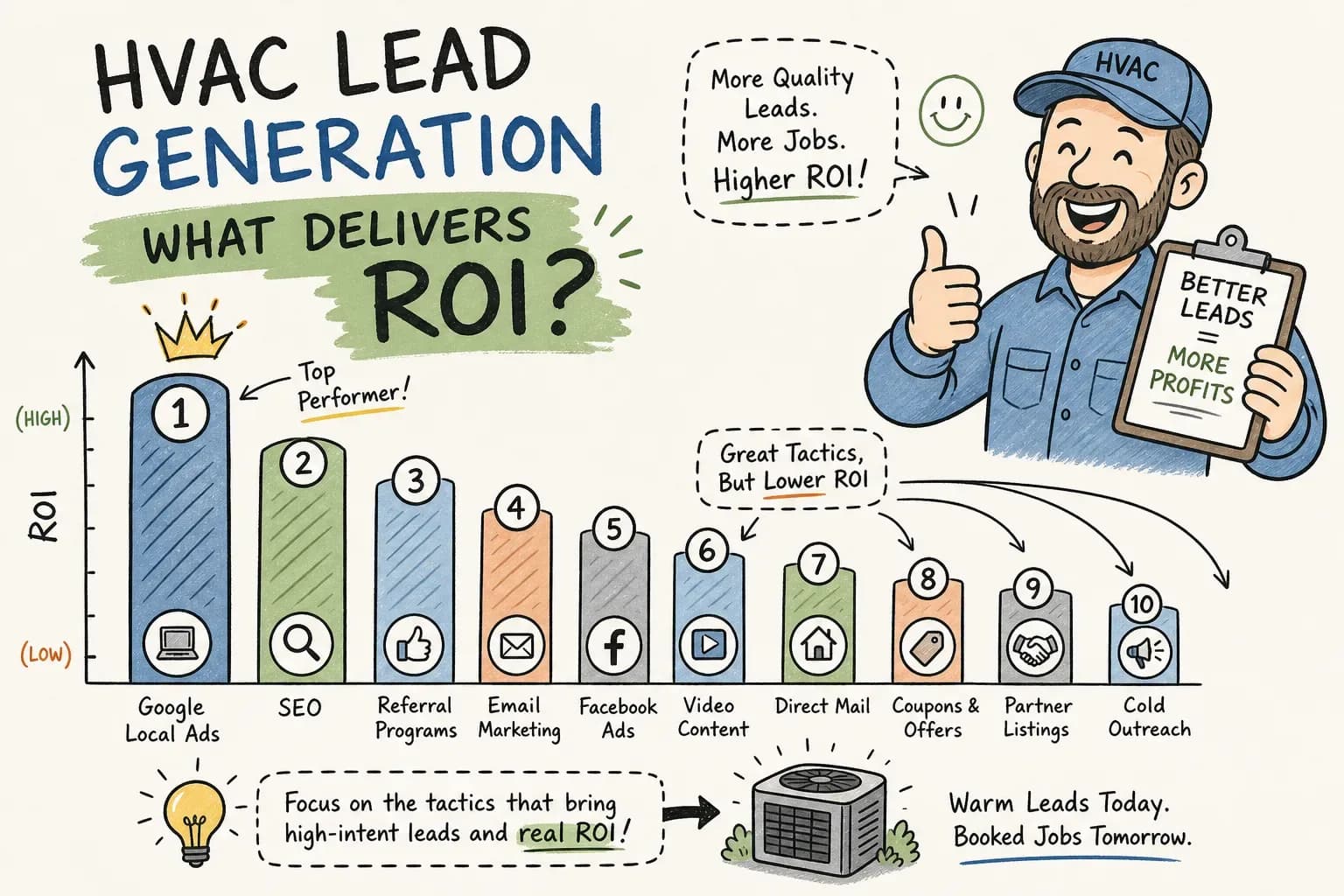
HVAC lead generation is often a mess of guesswork, you're running Google Ads, paying for Angi leads, and boosting a Facebook post every spring when the AC calls start coming in. The schedule fills up some weeks. Other weeks, it doesn't. And if someone asked you which channel is actually responsible for the booked jobs, you'd have to guess. That's not a marketing strategy. That's expensive hope.
Not all HVAC lead sources are created equal, and the one with the highest ROI doesn't cost you a single ad dollar. At Temperature Pros, my HVAC company in Orlando, one outreach campaign to past customers recovered $31,247 in revenue without touching a paid channel, no Angi, no Google Ads, no Facebook boost. Just a systematic reach-out to people who'd already paid us once. (This is a single-company case study, not an industry-wide result, but the mechanics are repeatable.) This article ranks 10 HVAC lead generation tactics by cost per lead and conversion rate so you can stop spreading budget thin and start putting money where it actually produces booked jobs.
The ranking framework: CPL and conversion rate (and why both numbers matter)
Cost per lead alone will mislead you every time. A $20 Facebook lead that never answers the phone isn't cheaper than a $100 Google lead that books on the first call. The only number that actually matters is your cost per booked job, which you get by dividing CPL by your lead-to-booking conversion rate.
Here's what that math looks like in practice. A non-branded Google Ads lead at $149 CPL with a 20% close rate works out to $745 per booked job. An organic search lead at $30 CPL with a 30% close rate comes out to $100 per booked job. Same industry, very different economics. That's why this ranking uses both numbers together, not either one alone.
Why intent level separates good channels from expensive ones
High-intent channels, meaning search-based channels, consistently outperform awareness channels like social and display for HVAC digital marketing. Someone Googling "AC repair near me" is already in buying mode; they have a broken system and a credit card. Someone scrolling Instagram is not. Intent level is one of the most underrated variables in HVAC marketing decisions, and it's why two channels with similar CPLs can produce wildly different revenue results. Studies on paid search consistently show close rates for search-intent channels running two to three times higher than awareness-based channels at comparable spend levels.
The CPL benchmarks anchoring this ranking
These are 2026 ranges drawn from contractor benchmark data: Google Ads blended at $104, branded search at $34, non-branded at $149, Google LSAs at approximately $51, Facebook/Meta at $20, $60, organic SEO at $10, $30 once mature, and shared lead marketplaces at $50, $100. Treat these as directional benchmarks, not guarantees. Your market, your call handling, and your website conversion rate all shift the actual numbers.
Tactics 8, 10: the channels draining budget without proportional return
These three channels aren't useless. The problem is that most HVAC shops dramatically over-invest in them because they're visible and feel like marketing. Visibility and ROI are not the same thing.
Tactic 10: shared lead marketplaces (Angi, HomeAdvisor)
CPL lands between $50 and $100, but the real damage is in the close rate. The same lead often gets sold to multiple contractors simultaneously, which means you're in a race to call back first while competing on price against companies who bought the exact same number. Industry data from contractor surveys puts shared marketplace close rates at 8, 15%, compared to 20, 35% for exclusive leads, though these are directional estimates that vary by provider and market. Use these sparingly to fill gaps in a slow week, not as a primary channel you depend on month after month.
Tactic 9: Facebook and Meta paid ads
The $20, $60 CPL makes these look cheap on paper, and that's exactly why they get over-funded. The problem is intent. Someone who engaged with a Facebook ad for a furnace tune-up deal is not the same as someone who Googled "furnace not working." These leads require faster follow-up, more nurture sequences, and still convert at meaningfully lower rates than search-based sources. Facebook can support seasonal promotions and brand awareness, but it's a supporting channel, not a lead engine.
Tactic 8: non-branded Google PPC
At $149 per lead blended, non-branded paid search carries the highest CPL on this list. It can still be profitable with disciplined landing pages and tight call handling, but it punishes shops that haven't built the conversion infrastructure to support it. When your website converts at 2, 3% and your team isn't calling leads back within minutes, this channel burns cash fast. Get the foundation right before you pour budget into non-branded terms.
Tactics 5, 7: mid-ROI HVAC lead gen channels worth building steadily
These three channels sit in the middle of the ROI ladder. They're worth investing in consistently, but they require patience before they compound into reliable lead flow. Unlike the top tier, where return is largely driven by relationship equity, these channels depend on platform mechanics you can actively optimize, review counts, badge status, bid structure, which means steady effort pays off faster than you might expect.
Tactic 7: Google Local Services Ads
LSAs charge per lead, not per click, and the average HVAC CPL runs around $51 based on 2026 benchmark data covering more than 400 contractor accounts (per SearchLight Digital's February 2026 HVAC report, which tracked $1.52M in spend across 409 accounts). More importantly, leads come pre-qualified: the homeowner already saw your reviews and your Google Guarantee badge before they clicked. That pre-vetting produces stronger close rates than standard display ads. LSAs specifically reward shops with high review volume and fast response times, both of which you control directly. Aim to respond within five minutes; practitioner benchmarks consistently identify that threshold as the point where response speed begins to protect your ranking position, though Google does not publish an official cutoff.
Tactic 6: branded Google Ads and remarketing
Branded search at $34 CPL is one of the most efficient paid channels for capturing people who already know your name. Without it, a competitor can bid on your brand terms and intercept warm traffic you already earned. Remarketing to past site visitors compounds this by converting browsers who didn't book on the first visit. This isn't how you grow a cold audience, but it's how you make sure warm audiences actually convert instead of wandering off to a competitor. It should run continuously, not seasonally.
Tactic 5: Google Business Profile and the local map pack
A fully optimized GBP with strong review velocity, accurate service listings, and regular job photos can generate leads at near-zero marginal cost once it's built. That velocity, new reviews arriving weekly, is the single strongest lever here. Shops with a substantial base of recent reviews (local SEO guides consistently point to the 100-plus range as a meaningful threshold) that respond to every single one tend to outrank competitors in the local map pack without buying a single ad. Get your primary category set to "HVAC contractor," fill out every service field individually, and post job photos weekly.
Tactics 2, 4: high-ROI HVAC lead generation channels that compound over time
These three get more efficient the longer you invest in them. They're not quick wins, but they produce the best long-term return per dollar spent. What separates them from the mid-ROI tier is that the asset you're building, reputation equity, organic rankings, a referral network, keeps generating leads even when you stop actively managing it.
Tactic 4: referral programs with structured incentives
A referred customer costs almost nothing to acquire and closes at a materially higher rate because the trust transfer is already done. Most HVAC shops get referrals passively without doing anything systematic to generate them. A structured program offering a $50, $100 credit for each referral that books turns a passive trickle into a repeatable channel. Track it in your field service platform, and specifically follow up with customers who left five-star reviews, they've already told you they're happy and just need an easy way to tell someone else.
Tactic 3: mature organic SEO and service-area page architecture
Once SEO compounds, CPL can drop to $10, $30 per lead. That takes 6, 12 months of consistent investment in service pages, city pages, and local backlinks. The mechanics are straightforward: build one focused page per high-intent service, AC repair, furnace replacement, heat pump installation, paired with one page per core service area. Keep review velocity feeding your GBP alongside it. The compounding return is why organic SEO should sit in every HVAC shop's long-term budget even when month three shows no visible results yet.
Tactic 2: exclusive pay-per-lead and pay-per-call providers
Exclusive leads from providers typically run $80, $200 per lead, pricing that varies significantly by vendor and market, which looks expensive until you compare it against shared marketplace close rates. Exclusive leads go to one contractor only, and appointment-set rates can reach 70, 80% when your call handling is fast and the lead is properly vetted. That outperforms shared marketplaces on ROI despite the higher face-rate CPL. Use these to supplement organic and referral volume rather than as a replacement for either.
Tactic #1: the highest-ROI HVAC lead source sitting in your own files
Here's the one most HVAC shops are completely ignoring: the customers who already paid you. They trusted you once. They have a system you serviced. And they cost zero dollars to reach because you already have their contact information on file.
This is dormant customer reactivation, and what makes it different in 2026 is running it systematically instead of hoping past customers call back on their own. At Temperature Pros in Orlando, one reactivation campaign pulling directly from QuickBooks history recovered $31,247 in revenue. No ad spend. No lead marketplace. No bidding war against three other contractors. These were customers who hadn't called in 18, 24 months, reached through a targeted outreach sequence, converting at rates no paid channel matched, because the trust was already established from the prior job. This is one shop's result, but the underlying mechanics apply broadly to any business with an inactive customer list.
Maximus, the revenue growth and recovery system built for $1M, $5M home-service shops, runs these campaigns automatically. It pulls dormant contacts from QuickBooks, segments them by last service date and equipment type, and deploys personalized outreach without the owner lifting a finger. Many shops in the $1M, $3M revenue range carry several hundred dormant customers sitting untouched in their system, a pipeline most operators have never opened.
Why dormant customers outperform cold leads on every metric
A cold lead has never made the trust decision with you. A dormant customer already has. That's the hardest part of any sales cycle, and it's already done. You're not convincing someone to hire an HVAC company; you're reminding someone to call theirs. CPL is effectively zero because acquisition already happened in a prior job cycle, and conversion rates outpace every paid channel on this list as a result.
What a reactivation campaign actually looks like
Identify customers who haven't booked in 18, 24 months. Segment them by equipment age or last service type so the message references their specific system, not a generic "we miss you" blast. Send a personalized outreach, follow up once via text, and keep the sequence short. Based on case studies from shops running this quarterly, revenue recovery in the $10,000, $40,000 range per campaign is a realistic outcome for businesses with active dormant lists, though results vary by list size and market. The sequence doesn't need to be complicated. It needs to be personal and timely.
Building your 3, 5 channel stack and tracking every lead
Chasing all 10 channels at once produces mediocre results from all of them. A shop doing $1M, $2M in revenue needs a different channel mix than one pushing $4M, $5M, and both need a clear tracking system before adding any new spend.
How to pick your channel mix by revenue stage
At $1M, $2M, focus on five channels: GBP with strong review velocity, Google LSA, branded PPC, a referral program, and dormant customer reactivation. These five cost the least to maintain and compound the fastest. At $3M, $5M, layer in mature SEO, exclusive pay-per-call, and systematic remarketing. Don't add a channel until you can measure the ones already running.
CRM and lead-tracking setup you actually need
Every lead source needs a trackable path to a booked job: a unique phone number or form tag per channel, logged in your field service platform from the moment the inquiry comes in. Jobber, Housecall Pro, and ServiceTitan all support lead-source tagging at intake. If you can't tell which channel produced the job at the end of the month, you can't rank your channels by actual ROI, and you'll keep funding the wrong ones.
Start with the list you already have
Effective HVAC lead generation means stopping the habit of treating every channel equally and letting data make the decisions. The highest-CPL channels on this list are exactly the ones most shops over-invest in because they're visible and feel like marketing. The lowest-cost, highest-conversion source in any solid home services lead generation strategy is the one most operators have never activated: their own past customers.
Before you sign another lead marketplace contract, run a reactivation campaign on your dormant customer list. Then build your paid and organic stack from the ranked framework above, track every channel to a booked job, and cut the ones that don't convert. That's how an HVAC lead generation strategy turns into actual revenue growth, not just a bigger ad budget.
If you want to see how Maximus handles dormant customer reactivation and AR recovery automatically for shops in the $1M, $5M range, request more information directly. Current availability is limited, so the sooner you reach out, the better.