How an HVAC Answering Service Stops You From Missing the Calls That Book Jobs
The average HVAC shop misses somewhere between 7 and 12 calls a week. At an average job value of a few hundred dollars, that's thousands of dollars walking out…
The average HVAC shop misses somewhere between 7 and 12 calls a week. At an average job value of a few hundred dollars, that's thousands of dollars walking out the door every month - and most owners never even see it happen.
Here's the part that stings. A missed call in this business isn't a missed message. It's a homeowner with no AC in July who dials the next number on the list before you ever knew they called. An HVAC answering service exists to stop exactly that from happening.
This guide breaks down what an answering service for an HVAC company actually does, the difference between a live service and an AI one, what you should expect to pay, and how to tell a good one from a waste of money. By the end you'll know whether you need one and what to look for.
What is an HVAC answering service?
An HVAC answering service answers your phones when you can't, in your company's name, and does something useful with the call. At a minimum that means greeting the caller, taking their information, and getting a message to you.
The good ones go further. They ask the right questions for a heating and cooling job, figure out whether it's routine or an emergency, and book the appointment straight onto your schedule.
Answering services for HVAC companies come in two flavors: a live service staffed by people, or an AI service that answers automatically. Both pick up the phone. What happens after that is where they split, and it's the difference that decides whether the call turns into a booked job.
Why HVAC shops can't afford to miss calls
Run the math on your own shop for a second. Industry estimates put the average value of a missed HVAC call at roughly $350 once you account for the mix of diagnostics, repairs, and the occasional replacement.
Miss 10 calls a week and you're looking at about $3,500 a week in work you never quoted. Over a month, that's a number most owners would rather not see written down.
And that's just the job you missed. You also lost the maintenance agreement that job could have become, the repeat service calls over the next five years, and the five-star review that customer would have left if someone had picked up. The real cost of a missed call is always bigger than the one call, because you're only counting the calls you know about - not the ones that rang out while you were under a house or up on a roof.
The office closes at five. The customer's furnace doesn't wait until morning to quit. That gap is the whole problem, and it's exactly what an answering service is supposed to close.
Live answering vs. AI answering service
Every answering service falls into one of two camps. Picking the right one for your shop matters more than the price.
Live (human) answering services
A live HVAC phone answering service uses real people to pick up your calls. The upside is obvious: a human voice, a friendly greeting, someone who can handle a caller who goes off-script.
The downsides show up fast for a trades business. Most live services charge by the minute, so a busy July burns through your plan and racks up overage fees you can't predict. And the person answering is usually a generalist covering dozens of businesses at once - they can take a message, but they often can't confirm whether you service a caller's zip code, quote a diagnostic fee, or tell an emergency from a routine call. For a homeowner with a dead AC at 9pm, a vague answer sends them straight to your competitor.
AI answering services
An AI answering service answers every call automatically, the same way every time, and doesn't get tired at 2am. The better ones are trained on your specific business - your pricing, your service area, your staff - so they answer like they work for you.
The bigger difference is what happens next. A good AI service is connected to your scheduling software, so it doesn't just take a message - it books the job. Pricing is usually a flat monthly rate instead of per-minute, which means no nasty surprise when your call volume spikes in peak season.
If you're weighing the two side by side, we broke down the full comparison in AI receptionist vs. live answering service. And for the broader home-services version of this, see AI answering service for home services.
What to look for in the best HVAC answering service
Not all of these services are built for the trades. When you're comparing options, the best answering service for an HVAC company checks these boxes:
It asks HVAC-specific questions. A generic script can't tell a no-cool emergency from a routine tune-up. A real HVAC specialty answering service triages the call the way your best dispatcher would - no-heat, no-cool, equipment age, urgency - before it ends.
It books directly onto your calendar. Taking a message just moves the work to tomorrow morning. The best HVAC answering service connects to your field service software and drops the appointment straight onto the schedule, so you wake up to a booked job, not a callback list.
It covers you after hours and on weekends. That's when the high-urgency, high-ticket calls come in. A service that only works nine-to-five is missing your best jobs.
Its pricing is predictable. Flat-rate beats per-minute for a seasonal business, because your slow spring shouldn't be the only month the math works.
After-hours coverage is where the money is
If you only fix one thing, fix your nights and weekends. After-hours calls in HVAC skew toward exactly the work you want - the no-cool call in July, the no-heat call in January, the emergency that books same-day at a premium.
If your phone rolls to voicemail at night, you're not missing nuisance calls. You're missing your most valuable ones. We go deeper on this in HVAC after-hours answering service.
How Maximus answers every call
This is the problem Maximus was built to solve - and he was built inside a real HVAC company, not a software lab, before he was offered to anyone else.
Here's what he does. A call comes in, day or night, and Maximus answers in your company's voice. He asks the right triage questions, books routine jobs straight into Jobber, Housecall Pro, or ServiceTitan, and routes real emergencies to your on-call tech. No voicemail queue. No cold callbacks in the morning.
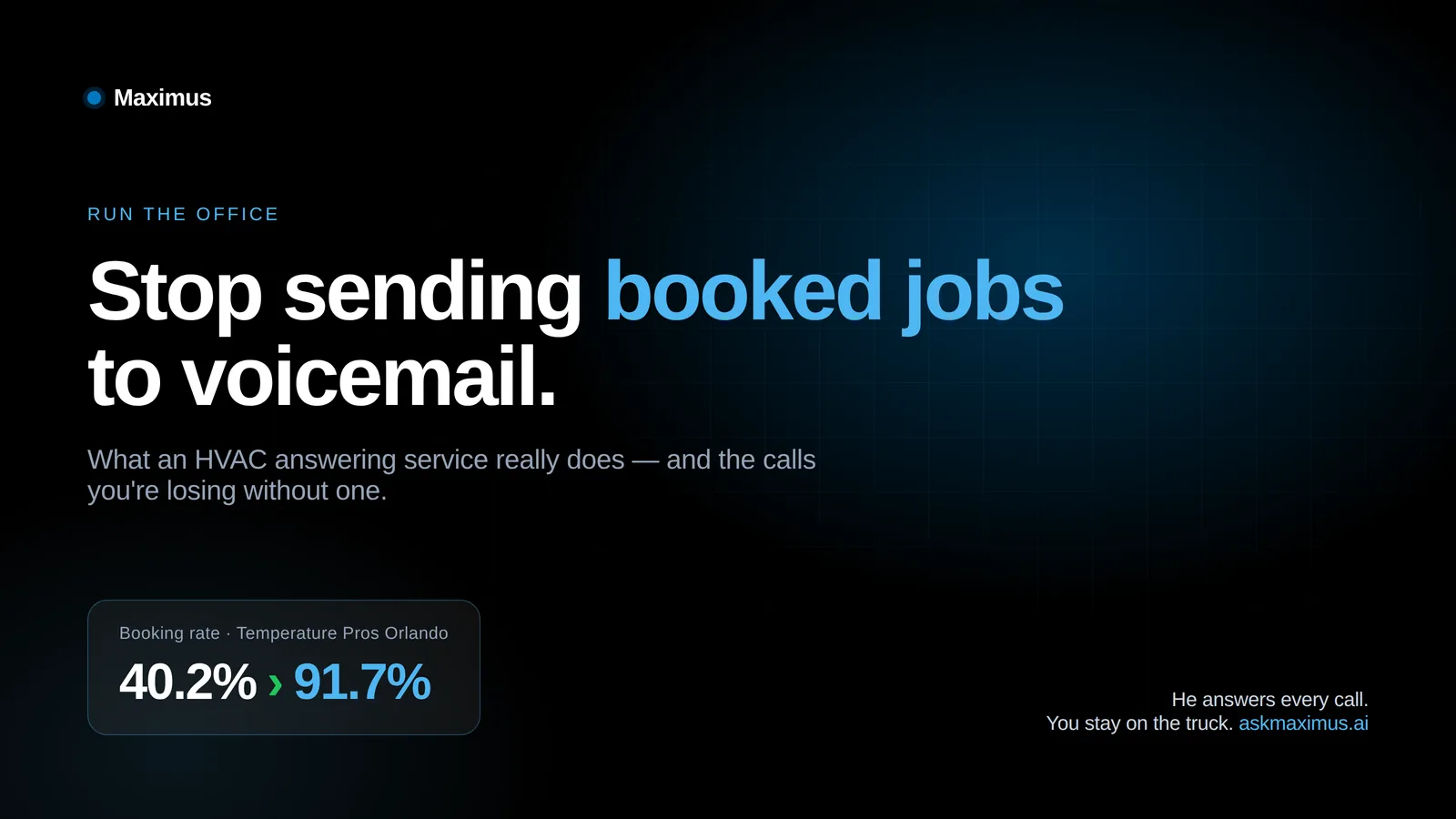
The numbers from the field are real. At Temperature Pros Orlando, the booking rate went from 40.2% to 91.7% - nearly every call that comes in now becomes a job on the board. Over 90 days, the shop recovered $43,400 across missed calls, aging invoices, and dormant customers, without hiring a single person.
That's the point of an HVAC answering service done right: not a nicer voicemail, but the difference between a booked job and one that quietly went to the shop down the road. You can see the full breakdown in the Temperature Pros case study.
Frequently asked questions
What does an HVAC answering service cost? Live services usually charge per minute, often $250 to $1,700+ a month depending on your call volume, plus overage fees. AI services typically run a flat monthly rate. We break the numbers down in what an AI receptionist costs.
Is an AI answering service better than a human receptionist? It depends on what you need. A human sounds warm but can't always book the job or triage an HVAC emergency. A well-trained AI service answers consistently, books directly onto your schedule, and doesn't cost more in your busy season. For most shops under $5M, the consistency and booking wins.
Will it book jobs or just take messages? The good ones book. If a service only takes messages, you've just moved the work to tomorrow. Look for one that connects to your scheduling software.
Does it work after hours? The best HVAC answering services run 24/7 - which matters, because nights and weekends are when your highest-ticket calls come in.
Stop losing the calls you're already paying to generate
You spend real money to make the phone ring. Letting those calls hit voicemail is the most expensive mistake in the business, and it's the easiest one to fix.
Maximus answers every call, books the job, and chases the money you're already owed - without you hiring anyone. He's live in real HVAC shops right now, and the founding cohort is capped at 20 companies in the $1M-$5M range.
Apply for a founding cohort spot and see what he books while you're on the truck.