How to Choose Commercial Roofing Estimating Software
Most roofing contractors who buy commercial roofing estimating software end up frustrated.
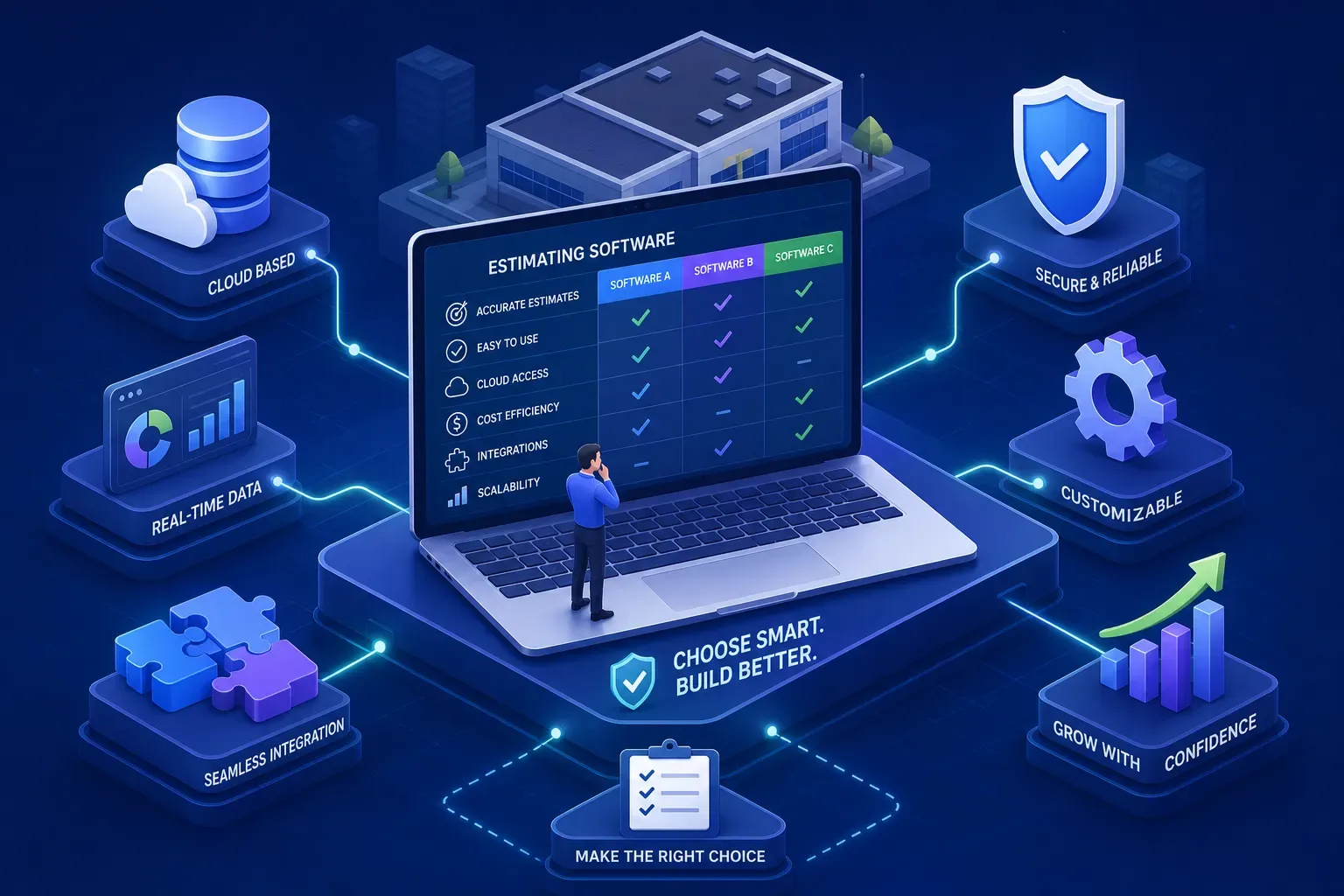
Most roofing contractors who buy commercial roofing estimating software end up frustrated. Not because the software is bad, but because they bought the wrong one for how their shop actually runs. Many contractors report that mismatch when a purchased solution doesn't match their workflow, and that's a distinction worth holding onto before you sit through a single demo.
Commercial roofing estimating software has moved fast. AI-driven takeoffs, satellite measurement tools, and proposal automation are now standard talking points in every vendor pitch. The feature lists are long. The demo videos are polished. And the gap between what a platform promises and what it actually does for your specific operation can cost you months of wasted subscription fees and a team that quietly stops using the tool after week three.
This article breaks down what these platforms genuinely cover, how to read pricing without getting burned, what real contractors have seen in time savings and win rates, and one gap that almost every estimating platform leaves open, one that most contractors don't notice until they're chasing a late invoice with no system behind them.
What commercial roofing estimating software actually covers
Most contractors come to these platforms expecting a complete business tool. What they get is a very good bidding tool. That distinction matters more than any feature comparison you'll read on a vendor's website.
The core workflow these platforms handle
Good roof estimating tools do a few things exceptionally well: measuring roof surfaces from plans or satellite imagery, building material quantities, applying labor and overhead formulas, and generating a client-facing proposal. Many vendors and case studies report reductions from a full workday to a few hours or less for a trained estimator. That's real, and it's where these tools earn their subscription fee every single month.
The accuracy claims from top providers back this up. EagleView has published independent validation showing approximately 98.43% area accuracy and 98.49% slope accuracy based on third-party benchmark testing with CompassData. Togal.AI cites up to 98% accuracy on plan-based takeoffs. Those numbers don't all mean the same thing across vendors, but the underlying technology has matured to the point where human-error-driven measurement mistakes are genuinely becoming the bigger risk.
Where the typical estimating platform stops
Be clear-eyed about this boundary: these tools are built around winning the job, not running it. Most platforms offer thin or no CRM, limited scheduling, and minimal post-sale workflow. Once a proposal is accepted, most estimating tools hand off the baton, deposit collection, job scheduling, and invoice follow-up typically require separate software or manual processes. Some integrations help bridge that gap, but they rarely cover it completely. That's not a knock on the software; it's just the honest scope of what these platforms were designed to do.
Commercial roofing estimating software: features that separate good platforms from great ones
Not all of these platforms are built the same. Knowing what's under the hood before you sign up saves you from a very expensive education.
AI takeoff automation and what accuracy claims actually mean
AI-powered takeoffs analyze satellite imagery and uploaded plan sets to produce area, pitch, linear footage, and penetration counts automatically. The accuracy benchmarks from EagleView and Togal.AI are impressive, but published accuracy rates don't always measure the same thing across vendors. Some report geometry accuracy; others include scope assumptions that still need human review. Before you commit, test the platform's accuracy on a roof type similar to your most common commercial work, not the vendor-supplied demo roof they've had two years to optimize.
When evaluating roofing takeoff software, it helps to know which data sources each platform supports. ArcSite, for example, supports both PDF plan uploads and satellite measurement takeoffs in the same workflow, useful if your projects pull from architect drawings one week and aerial imagery the next. ServiceTitan handles this through integrations with Hover and GAF QuickMeasure. Confirm that the platform handles both input types natively before you buy, especially if your commercial work regularly mixes both.
Proposal quality and QuickBooks integration depth
For commercial roofing, where you're often presenting to a property manager or facilities director, the quality of the proposal document carries real weight. Some platforms generate clean, branded PDFs in minutes. Others produce functional but plain documents that estimators then dress up manually. Ask vendors for actual sample output during any demo, not a screenshot of a demo output.
QuickBooks integration is the most commonly requested feature in roofing estimating apps, and it varies significantly across platforms. AccuLynx has the deepest documented two-way sync, its two-way integration supports job costing and progress billing workflows at the enterprise level. JobNimbus offers two-way sync for contacts, jobs, invoices, and payments, but its commercial feature depth reflects a primarily residential focus. Roofr's QuickBooks integration is the most limited of the three: it's restricted to QuickBooks Online only, and as of mid-2026, the native integration remains in beta according to vendor documentation. If job costing and progress billing are central to your commercial workflow, AccuLynx is the clearest fit of those three.
Commercial roofing estimating software: cost and pricing in 2026
Pricing in this category runs from genuinely free entry tiers to over $300 per user per month, and the spread matters when you're staffing an estimating team.
Transparent pricing versus the quote-based trap
Roofr offers the most transparent pricing structure: a free Starter tier, paid plans ranging from $109 to $349 per month, with some tiers also carrying per-report fees. AccuLynx starts at $250 per month for its Essential tier, with higher plans moving to quote-based pricing. STACK runs roughly $249 to $299 per user per month billed annually. JobNimbus falls in the $225 to $299 per month range for the base plan, with per-user costs compounding from there.
Estimating Edge, iBeam, and OnCenter publish no public pricing. That typically signals enterprise-oriented sales cycles, longer evaluation timelines, and pricing that varies heavily by negotiation. For a shop doing $1M to $5M in commercial revenue, quote-based pricing often means 60 to 90 days before you even know what you're committing to spend.
How cost scales with team size
The per-user pricing trap is real. STACK at $249 per user per month looks reasonable for a solo estimator. For a three-person estimating team, that's $747 per month before add-ons. JobNimbus compounds similarly with its base-plus-user model. Model your actual team configuration before evaluating any plan's advertised price, not the entry-level number featured in every comparison article you'll find.
Real ROI numbers from contractors who made the switch
The marketing promises are easy to find. Here's what documented case studies and real contractor accounts actually show.
Bid time and proposal speed
Roofr customer case studies report proposal time cuts from 45 minutes down to 5 minutes for one contractor, and an 80% reduction in estimate time with more than $400 per month saved in recovered hours for another. A RoofPredict-documented case brought a Georgia roofing company from 5 days per proposal down to 1.5 days. STACK reported one roofing contractor cutting takeoff time by 40%. Faster estimating is consistently the first ROI contractors report, and the typical time savings cited across platforms runs between 2.5 and 5.5 hours per job.
Win rate and revenue impact
The downstream revenue effect is where the numbers get interesting. The RoofPredict case study cited a 34% increase in closed deals and $215,000 in additional revenue over 12 months after faster proposal turnaround. STACK reported one contractor doubling their win rate. Faster proposals matter in commercial roofing because being first to a property manager's inbox with a clean, professional document is often a bigger factor than price. Most contractors see their ROI break even within 60 to 90 days of adoption.
The gap that estimating tools leave open
Winning the bid is step one. What happens after is a different problem entirely, and no estimating platform solves it.
What falls through after the proposal is accepted
Once a job is won, the estimating platform's job is essentially done. Deposit collection, invoicing, accounts receivable follow-up, scheduling coordination, answering inbound calls from new commercial prospects while your crew is mid-job: none of that lives inside roofing estimating tools. Many contractors experience real revenue leakage in the 30 to 60-day window after a signed contract, a deposit not collected promptly, an invoice that ages past 45 days with no follow-up, a new prospect who called once and moved on when nobody answered.
Where a separate AI office layer fills that gap
Some home services and specialty contractors are now pairing their estimating software with an AI-powered office layer that handles the back-office work estimating platforms don't touch. Platforms like Maximus connect to field service software including Jobber, ServiceTitan, and HCP, as well as QuickBooks, to handle the things that fall through after the bid: 24/7 call answering and job inquiry capture, invoice follow-up when AR ages past 30 days, and dormant customer reactivation campaigns pulled directly from billing history.
That's not a pitch to replace your estimating tool. It's a recognition that two different problems need two different solutions. Maximus deployed inside Temperature Pros Orlando recovered $12,400 in aging accounts receivable within 90 days, not because the estimating workflow was broken, but because the post-job financial follow-up had no system behind it. If you have a solid roofing estimating platform for contractors and you're still losing money on aging invoices or unanswered calls, those are separate problems worth solving separately.
Commercial roofing estimating software: ROI and win rates
Having a clear decision framework before you talk to a vendor saves weeks of evaluation back-and-forth and protects you from buying on feature count instead of fit.
Questions to answer before you look at a single demo
Answer these honestly before opening a browser.
How many estimates do you do per month, and how many people touch them? The volume and team size will immediately rule out solo-focused tools and enterprise platforms that are overkill for a small crew.
What software is already in your stack, specifically your QuickBooks version and FSM platform, and do you need native integration or is an export workflow acceptable? This single question cuts the field significantly.
Are you primarily measuring from plan sets, aerial imagery, or both? A solo estimator doing 10 to 15 bids per month from satellite images needs a different roof measurement software than a three-person team quoting large-scale commercial projects from architect drawings.
The answers to these questions eliminate half the market before you spend an hour on a demo call.
What to verify during a trial or demo
Request sample output on a commercial roof similar to one you've actually bid, not a vendor-supplied showcase project. Ask specifically which QuickBooks fields sync and whether it's a push or pull integration. Test mobile usability if your estimators work from job sites. Ask about support channels and response time, support complaints rank among the most common issues cited in user reviews, right alongside pricing. Get pricing for your actual team size, not the advertised entry tier that shows up in every comparison table.
The right fit beats the best feature list every time
There's no single best commercial roofing estimating software. There's the right one for how your shop operates, how many estimators you have, and what tools you already rely on. The platforms that deliver the best ROI aren't always the most feature-rich; they're the ones that match the workflow your team will actually use every day.
Start with the questions above, model the real cost for your team size, and run at least one live demo on a project that mirrors your actual work. Time savings are real and documented across multiple case studies. The payback period is short. Just go in clear-eyed: your commercial roofing estimating software handles the bid. Building a system for everything that comes after is a separate project, and one worth taking just as seriously.