The Best Answering Services for HVAC Companies in 2026
If you're searching for the best answering service for HVAC company operations, the decision starts at 11pm on a Tuesday in July.
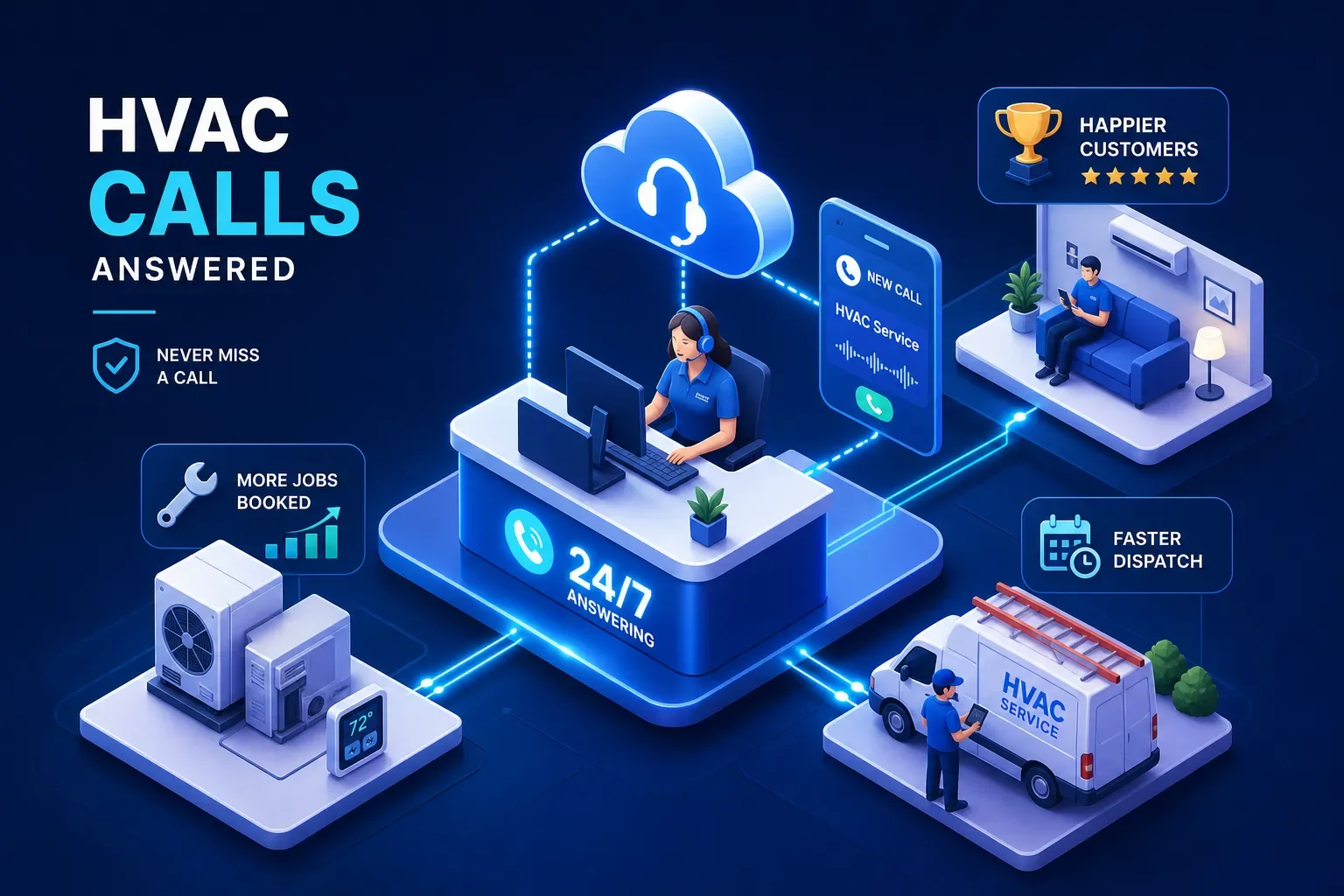
If you're searching for the best answering service for HVAC company operations, the decision starts at 11pm on a Tuesday in July. A homeowner's central AC dies. She calls your number, gets voicemail, and calls the next company on Google within 60 seconds. That job, worth several hundred dollars on the low end, closer to $900 for an emergency service call, is gone. The math adds up fast: across the industry, roughly 60, 67% of after-hours calls go unanswered. Some shops miss far more than that. If you're running eight to fifteen missed calls per month at a $500 average ticket, a realistic scenario for a mid-size residential shop, that's $4,000 to $7,500 sitting uncaptured every single month.
Choosing the right phone coverage for your shop is not a vendor comparison exercise. It's a revenue decision. This guide breaks down the three main models, what each actually costs in 2026, and how to match the right one to your shop's size and situation.
Best Answering Service for HVAC Company: Live vs. Hybrid vs. AI
Before comparing any vendors, you need three clear filters. Most HVAC owners skip this step and end up paying for a service that handles calls without actually booking jobs. That distinction matters more than almost any other variable.
Pickup rate and true availability come first. Not all "24/7" claims are equal. Some services provide full-coverage live answering around the clock. Others offer business-hours coverage with overflow routing to a voicemail or callback queue after 8pm. Peak cooling season, when call volume can spike three to five times above normal, according to vendor-reported industry figures, is exactly when the gap between real availability and marketing language becomes a billing problem or a missed-revenue problem, sometimes both.
Booking accuracy is the second filter. Taking a message is not booking a job. A booking-capable service verifies your service area, checks scheduling availability, collects job details, and gets a confirmed appointment into dispatch. HVAC-specific AI triage runs at roughly 94, 95% accuracy on emergency classification, according to vendor-published benchmarks. General live services average closer to 60, 81%, depending on how well they're trained on your specific intake questions, figures that vendors in this category publish but that haven't been independently audited. At scale, that gap translates directly to lost jobs.
The third filter is integration. A service that can't push directly into ServiceTitan, Jobber, or Housecall Pro creates a manual re-entry step for someone on your team. QuickBooks and ServiceTitan have the most reliable native pairing. Jobber and Housecall Pro typically require API or marketplace connectors. If your answering service sends job details by email and expects you to enter them into your scheduling software, it has shifted work onto you rather than removing it.
Virtual Receptionist for HVAC: What Real Availability Looks Like
A true virtual receptionist for HVAC should function as a 24/7 HVAC phone support layer, not a message-taking service with business hours. That means live or AI-powered pickup at 11pm, emergency triage that distinguishes a no-cool call from a routine tune-up request, and direct handoff to dispatch without a gap. If the service you're evaluating can't demonstrate that workflow in a live scenario, move on.
Live Answering Services: What You're Actually Paying For
Human-operator answering services are the most familiar model, and they do one thing genuinely well: a real person picks up the phone. For a panicked caller whose AC died with a newborn in the house, that matters. For high-ticket commercial accounts or older residential customers who won't engage with automated systems, a human voice builds trust faster than any script. That's real value, and it's worth acknowledging honestly.
The pricing structure is where shops run into trouble. Entry plans from services like PATLive and Ruby start around $235/month for 50 receptionist minutes. Mid-range plans run $329, $479/month covering 100 to 200 receptionist minutes. Full 24/7 specialist dispatch coverage from HVAC-focused services reaches $650, $1,500/month. None of those base prices are the real number, though. Overage billing is the hidden cost: the range most providers publish runs $1.50, $2.75 per minute, with some specialist services reaching higher, check the contract before you sign. A summer heat wave or a January cold snap can double your monthly bill without warning.
Seasonal Spikes and the Per-Minute Pricing Problem
June through August, a residential HVAC shop can field three to five times its normal call volume. A $300/month plan can balloon to $900, $1,400 during peak weeks. At the same time, hold times increase, messages get missed, and billing punishes you for your busiest period. That's the scalability problem with live services: the cost goes up exactly when your operations are already under the most pressure.
There's also the consistency issue. A service handling fifty different business types can't ask your specific HVAC qualifier questions with the same reliability as a service built exclusively for your trade. Accuracy degrades across shifts, and training depth varies significantly between agents. On-call rotation management exists at services like Always Answer and Direct Line Answers, but native integration with scheduling software is rarely built in.
Hybrid Services: Better Intake, Same Integration Gap
Services like Smith.ai, Ruby, and Abby Connect blend AI first-touch intake with human escalation for complex calls. The AI layer collects name, address, issue type, and urgency, then routes to a human agent for booking confirmation or anything that requires judgment. Smith.ai's hybrid tiers start around $292/month. Ruby starts around $235/month for 50 receptionist minutes. The appeal is real: lower cost with a human safety net.
Hybrid services generally outperform pure live services on routine intake because the AI intake layer is consistent, the person who answers at 2am asks the same questions as the one at 10am. But booking accuracy still depends on configuration depth, and the integration gap remains. Most hybrid services pass information via email or a CRM webhook rather than pushing directly into dispatch scheduling. For shops with a part-time office person who can close the loop, that's workable. For a true owner-operator already working 60-hour weeks, it's one more task that lands back on you.
AI-Native Platforms: What This Category Actually Delivers Now
AI-native answering platforms enter at $29, $59/month at the low end (Dialzara, Goodcall) and run $199, $499/month for more capable platforms built specifically for field service. The flat-rate model alone changes the math for seasonal businesses: no overage, no surprise invoice during your busiest month. HVAC-specific AI triage accuracy sits in the 94, 95% range based on vendor-published data, and a well-trained AI doesn't have bad shifts, doesn't forget your qualifier questions, and doesn't cost more during a June heat wave.
The more important distinction is what the best AI-native platforms do beyond the call. Most answering services, live or hybrid, stop when the call ends. One platform worth examining closely if you're evaluating HVAC-specific AI is Maximus. Full disclosure: it was built and battle-tested inside an actual HVAC company called Temperature Pros Orlando, which makes it either more credible or a conflict of interest depending on your perspective. What it does is concrete: it answers the 11pm emergency call, books the job directly into dispatch, follows up on the invoice that's now 47 days overdue, and has a 7am briefing ready summarizing what came in overnight, what got booked, and what needs your attention. That's a different category of tool entirely, not replacing a receptionist, but replacing the overhead of running a front office and parts of a back office without adding headcount.
The ROI figures vendors in this category publish are worth understanding, even with the caveat that most come from case studies rather than independent audits. Vendors report recovering 60, 75% of previously abandoned calls into booked appointments when AI is properly deployed. After-hours revenue increases of 30, 50% are reported when calls are captured rather than going to voicemail. For Maximus specifically, Temperature Pros Orlando recovered over $31,000 from a single dormant customer reactivation campaign and collected $12,400 in aging accounts receivable within 90 days, figures from that shop's own books. The ROI question shifts from "what does the answering service cost" to "how much revenue does the system recover."
Two Scenarios That Expose Which Model Fits Your Shop
Walk through the 11pm AC breakdown call with each model. Live service: picks up, takes a message, pages the on-call tech via text if you're lucky, or leaves a voicemail for morning. Hybrid: AI collects intake, flags as emergency, routes to a human agent who leaves a callback request in your inbox. AI-native: answers, confirms service area, books the emergency call into dispatch, texts the on-call tech, and logs the interaction so you see it in the morning briefing. The gap between those outcomes is a $400, $1,200 job, a hypothetical range based on typical emergency HVAC ticket sizes, depending on whether the homeowner calls your competitor at 12:03am.
The second scenario is the summer surge. A live or hybrid service on a $300/month plan can hit $900, $1,400 during peak weeks due to per-minute overage. An AI-native flat-rate platform absorbs the volume without a surprise invoice. When call volume spikes with a live service, hold times increase, messages get missed, and the bill grows simultaneously. An AI platform scales without degrading accuracy or adding cost. Those two problems don't exist in the same conversation when you're on flat-rate pricing.
How to Match the Best Answering Service for HVAC Company Needs to Your Budget
Under $200/month with call volume under 150 calls per month: AI-native platforms handle this efficiently and flat-rate pricing works in your favor. Budget of $200, $500/month with moderate volume and some complex commercial accounts: a hybrid service adds the human layer worth having for those relationships. Above $500/month with high emergency call volume and full 24/7 HVAC phone support needs: a specialist live dispatch service or a fully integrated AI-native platform becomes the right investment. At that spend level, the AI-native option typically provides more capability per dollar, especially when you factor in the back-office automation layer.
Questions to Ask Before Signing Any Contract
There are really only two questions that matter, and one that seals it. First, does it integrate directly with your scheduling software, or does it just send emails? Second, can it actually book a job, or does it only take a message? Third, the one that exposes how the service performs under pressure, what happens during a volume spike: does the price hold, or does the billing model punish your busiest weeks? Any service that can't answer all three clearly before you sign is probably not configured specifically for HVAC. Ask for a live demo using an actual emergency scenario, not a generic intake call.
The Bottom Line
Live answering is the most human option, but it's the least scalable and the most expensive when volume spikes. Hybrid services find a middle ground but usually leave the integration gap unsolved. AI-native platforms deliver the best accuracy, the flattest cost curve, and at the high end of the category, go well beyond answering calls into actual front-office and back-office automation.
For most HVAC shops running $1M, $5M in revenue, the best answering service for an HVAC company is the one that captures calls, books jobs, and doesn't add a per-minute surcharge during your busiest month. Start with a clear audit of your current missed-call rate and after-hours volume, map it to the model tiers above, and trial one service for 90 days with a real benchmark in place. Measure booked jobs captured after hours, not just calls answered. That number tells you what the service is actually worth.
If you want to see what a fully integrated AI office layer looks like for a real home services shop, Maximus offers a walkthrough built around your numbers, not a generic demo.