Is Ruby Receptionist Worth It for Home Services Businesses?
Many HVAC owners look into answering services after experiencing missed calls during peak season.
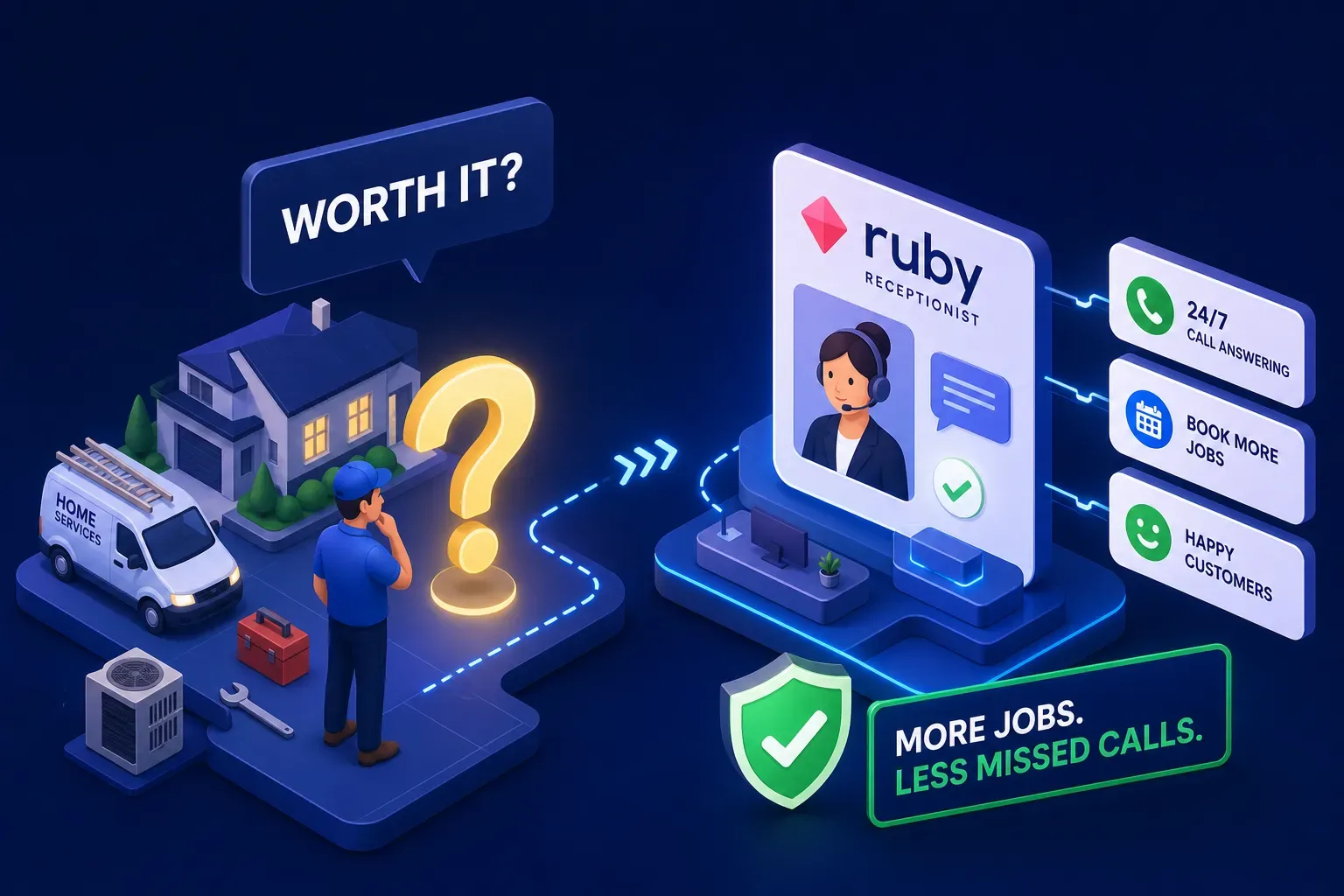
Many HVAC owners look into answering services after experiencing missed calls during peak season. Ruby Receptionist is a well-known, well-reviewed live answering service, and for some businesses, it's genuinely the right call. But home services shops have specific needs that most live receptionist services were never designed to meet.
This article gives you a straight look at what Ruby actually delivers, what it costs, and where it runs out of road for a plumbing or HVAC operation. Then we'll compare it against AI-powered alternatives, including purpose-built platforms like Maximus, an AI-powered front office and back office automation platform built specifically for home services businesses. By the end, you'll know whether Ruby fits your business or whether you're paying for a product built for someone else's problems.
What Ruby Receptionist's live answering service actually delivers
Ruby is a live answering service. Real people answer your phones, greet callers in your business name, take messages, screen calls, and warm-transfer to your team when needed. The service runs 24/7 on higher-tier plans, and Ruby's receptionists are US-based. For businesses that want a polished caller experience with a real human voice, that's the draw.
Ruby sells call-answering plans in four minute-based tiers: 50, 100, 200, and 500 receptionist minutes per month, priced at roughly $250, $395, $720, and $1,725 respectively. Entry plans cover standard answering, message-taking, and basic call handling. Scheduling and lead intake appear at the 100-minute level. CRM integrations and priority support come with the 200-minute plan. The 500-minute tier adds a dedicated account manager and detailed analytics reporting.
The integrations Ruby highlights tell the story: Clio, HubSpot, Salesforce, MyCase. This product was designed with law firms, consultants, and professional services businesses in mind. That's not a flaw, it's context. A receptionist trained to handle a personal injury intake call is a different tool than one handling a homeowner with a tripped breaker at 6pm on a Friday.
Ruby Receptionist pricing: what it actually costs a home services business
Per-minute pricing sounds simple until you hit peak season. HVAC calls in July and August tend to run longer and involve more detail than a standard message-taking interaction, callers want to know whether you service their model of unit, what an AC repair typically runs, or whether you can get there before noon. Those calls burn through your minute allotment faster than the plan assumes. Overages are billed per minute above your plan limit, and Ruby does not publicly publish its overage rates, which matters a lot when call volume is unpredictable.
At $395 per month for 100 minutes, you're paying roughly $3.95 per minute for live answering. A five-minute service call inquiry costs you nearly $20 before a single job gets booked. If only half of those calls convert into scheduled work, your acquisition cost from the answering layer alone climbs fast. For high-ticket HVAC replacements, that math can still work. For smaller diagnostic calls in the $89 to $150 range, it cuts into margin more than most owners realize when they sign up.
Ruby's Trustpilot rating sits around 4.5 out of 5, and the most common praise is exactly what you'd expect: professional receptionists, smooth call handling, and the feeling of having in-house staff without the payroll. The most common complaints center on billing transparency, support response times during service issues, and inconsistent message accuracy when things go wrong. For home services operators who need reliable, accurate after-hours coverage, that last point is the one that matters most.
After-hours calls and why generalist receptionists fall short
After-hours coverage is where home services businesses either capture revenue or lose it. Ruby's higher-tier plans include round-the-clock coverage, but the receptionists handling late calls are generalists. They can take a message and transfer a call. Depending on how your account is configured, they may not be able to confirm availability in a specific zip code, quote a diagnostic fee, or flag that your shop doesn't service commercial units. For a homeowner with a failed AC unit at 9pm in July, vague answers often lead to a callback to your competitor instead.
Booking accuracy for home services calls depends heavily on the information the receptionist has access to and how well they're trained on your business. Ruby does allow you to provide scripted instructions and call-handling guidelines. But the gap between a scripted answer and a genuinely useful one shows up fast when callers ask anything outside the script. A well-configured AI answering system with direct access to your service area, pricing, and schedule can consistently outperform a human reading from a static document.
Industry estimates put after-hours miss rates at $78,000 or more in lost annual revenue for the average contractor. When a homeowner can't reach you, they call the next number on the list. The question isn't whether Ruby is good. The question is whether an outsourced receptionist is the most accurate, cost-effective way to solve the missed-call problem for your specific type of shop.
How AI-powered answering compares for home services
AI-based answering services typically run on flat monthly pricing rather than per-minute billing. That structure removes the peak-season cost spike that hits home services businesses hardest. For high-volume shops in their busy season, the per-minute model can stop making financial sense quickly. A purpose-built platform charges based on the business it supports, not the number of minutes callers spend on the line.
A well-configured AI answering system handles calls from the same playbook every time. It doesn't vary based on which receptionist picked up, how tired they are at 2am, or whether they misread a custom script. For home services businesses, consistency in call handling directly affects the customer experience and the quality of leads that make it into the dispatch queue.
Real-time scheduling integrations
AI platforms that integrate directly with field service software like Jobber, ServiceTitan, or HCP can book calls, confirm addresses, and set expectations in a way that generalist live receptionists typically cannot match. That direct connection to your dispatch system is what separates a virtual answering service from a true front office automation platform.
Vendor-reported data from AI platforms operating in the home services space points to booking rates of 85 to 95 percent on standard HVAC and plumbing calls. Live answering services tend to be less consistent, with outcomes more dependent on callbacks and staff availability. Treat those figures as directional rather than benchmarks, they come from vendors, not independent auditors. But the directional story is clear: for repeatable intake workflows, AI wins on consistency and cost.
What a home services front office needs that Ruby doesn't offer
Ruby answers calls. It does not follow up on unpaid invoices. For a home services shop with 30- and 60-day aging accounts receivable sitting in QuickBooks, that gap costs real money. Maximus monitors outstanding invoices, flags aging accounts, and follows up automatically. According to Maximus customer data, that accounts receivable feature collected $12,400 in outstanding invoices for Temperature Pros Orlando within the platform's first 90 days. No live receptionist service is built to do this, it requires integration with your financial data, not just your phone line.
An HVAC owner who starts their day without knowing what happened overnight is flying blind. Standard live answering services, including Ruby, don't typically provide a structured daily operations briefing. Maximus delivers a 7am summary every day, what came in overnight, what was handled automatically, and what needs your attention before the first truck rolls. For owner-operators who are still doing ride-alongs and managing dispatch simultaneously, that daily briefing replaces an hour of manual email-checking and system-logging.
Ruby also doesn't natively offer the ability to pull your QuickBooks history and identify customers who haven't booked in 18 months. Running a reactivation campaign or flagging jobs that were underquoted requires integration with your financial and operational data, capabilities that aren't typical for any standard live answering service. Maximus customer data shows that a single dormant customer reactivation campaign recovered over $31,000 for Temperature Pros Orlando. That category of back-office capability sits outside what a remote receptionist company is designed to do, regardless of price point.
Here's a quick look at where the two approaches diverge on the features home services operators actually need:
-
24/7 call answering and job booking: Both Ruby and AI platforms like Maximus cover this. AI platforms often offer direct integrations with field service software like Jobber, HCP, and ServiceTitan for real-time booking, verify specific integration availability with each vendor.
-
Accounts receivable follow-up: Not a standard feature of live answering services. Maximus flags invoices past 30 and 60 days and follows up automatically.
-
Dormant customer reactivation: Not typically offered by live answering services. Maximus identifies and re-engages past customers using your QuickBooks history.
-
Daily morning briefing: Not a standard live answering service feature. Maximus delivers a 7am operations summary every day.
-
Revenue leak detection: Not a standard live answering service feature. Maximus flags underquoted jobs and mispriced work.
The honest verdict on Ruby Receptionist for home services
Ruby is a strong product for businesses where the primary need is a polished, human-sounding phone presence and general call handling. If you run a solo consulting practice, a small law office, or a boutique service business with low and predictable call volume, Ruby delivers exactly what it promises. The receptionists are professional, the product is reliable, and the onboarding is straightforward. For those use cases, the price is defensible.
For home services businesses fielding high-volume, technically specific calls in a seasonal, time-sensitive environment, Ruby Receptionist's per-minute model, generalist receptionists, and limited field service integrations start to work against you. Add what Ruby cannot do, AR chasing, morning briefings, dormant customer recovery, field service software integration, and the gap between what you're paying for and what your business actually needs becomes hard to ignore.
Maximus was built for the owner-operator who needs their front office to run without them standing in it. The platform's features were developed and validated inside a real HVAC operation, which means they reflect what an actual operator needed, not a feature list built in a vacuum. If you're evaluating Ruby Receptionist versus AI-powered alternatives and your shop is still leaving money on the table through missed calls, unpaid invoices, or dormant customers, that's worth a closer look. You can learn more about how Maximus works at askmaximus.ai.