Scaling your HVAC business from $1M to $5M revenue
If you're asking, "How do I grow my HVAC business from one million to five million in revenue?", you're already asking the right question.
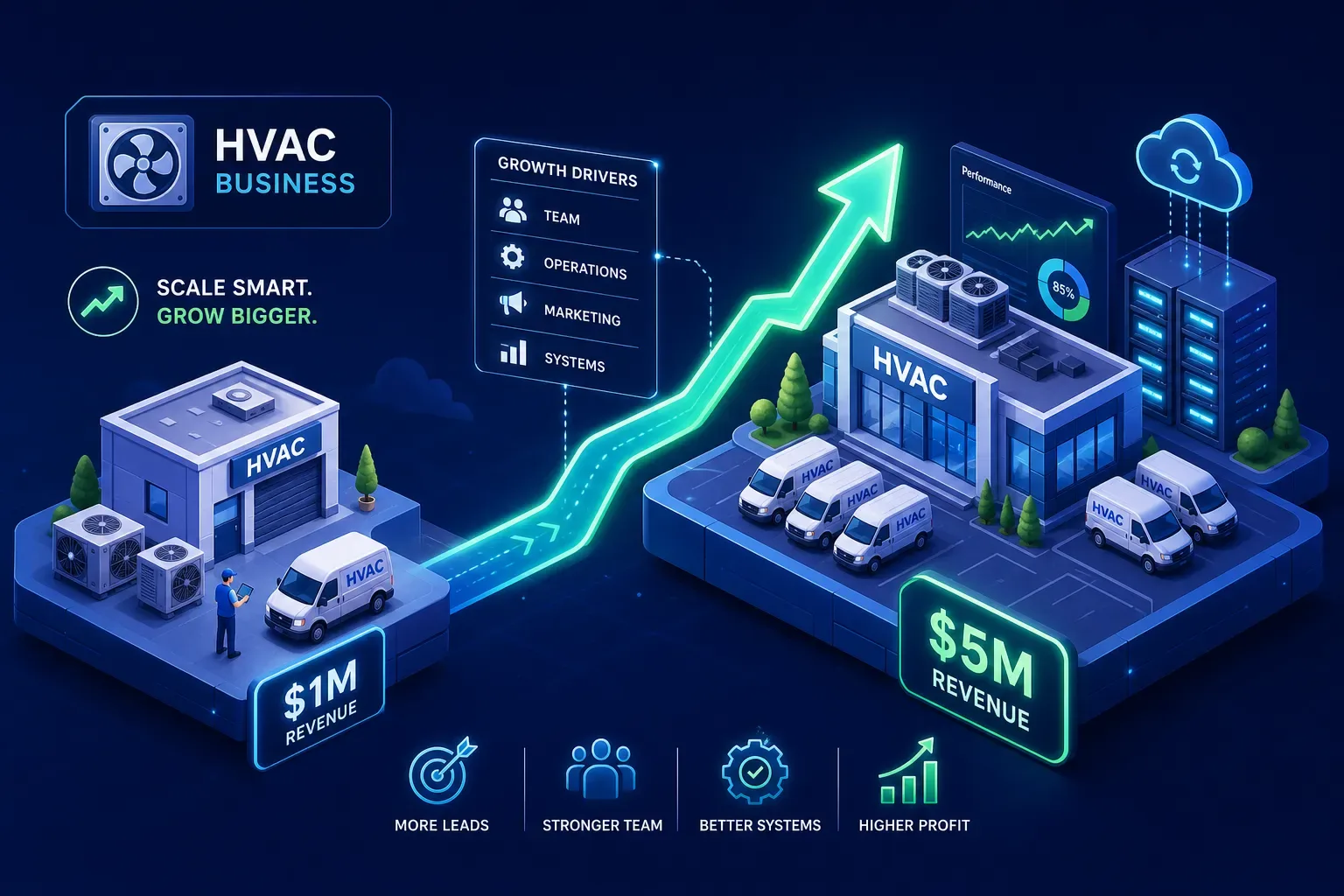
If you're asking, "How do I grow my HVAC business from one million to five million in revenue?", you're already asking the right question. Most HVAC owners who hit $1M believe the next milestone is just a matter of adding trucks and marketing harder. It isn't. The jump from $1M to $5M is almost entirely about building a business that doesn't require you in every decision, every day. That's a different problem than getting more calls.
Here's what typically happens: you reach $1M with 4, 6 techs, decent lead flow, and real revenue. You're also still answering the phone, approving every invoice, chasing unpaid balances, and riding shotgun on jobs when the schedule gets tight. That model works until it doesn't. For most shops, it breaks somewhere around $1.5M, $2M, a range many HVAC business coaches and field service consultants cite as the common operational ceiling, when the volume of decisions and tasks simply exceeds what one person can process without something important falling through the cracks.
This article gives you a concrete roadmap for how to grow your HVAC business from $1M to $5M in revenue: the financial benchmarks to track at each stage, the hiring sequence that protects your margins, the marketing mix that funds each phase of growth, and the operational systems you need to install before the growth can hold.
Why most HVAC owners stall at $1.5M, and how to grow past it
Only about 8% of HVAC companies in the United States ever scale past $2M in annual revenue. That's not a market problem. There are plenty of homeowners with aging equipment and broken systems. The bottleneck is almost always internal.
When lead volume grows without a supporting operational layer, specific things break. Calls go unanswered after hours. Invoices age past 60 days because nobody has time to follow up. Pricing decisions pile up because the owner is the only person authorized to approve them. A missed call in HVAC isn't a minor inconvenience, it's a lost job worth hundreds of dollars in average ticket revenue that went to a competitor who answered.
The compounding effect of aging accounts receivable is just as damaging. Unpaid invoices reduce the cash available to hire the next technician or fund the next marketing push. By the time many owners recognize the stall, they've been operating in survival mode for months. The fix isn't more revenue. It's plugging the leaks before you pour more in.
That's exactly where an AI-powered front office platform like Maximus earns its place. Rather than letting calls and invoices fall through the cracks, Maximus provides 24/7 call answering, invoice follow-up, and AR chasing, so the owner can stop being the office and start running the business.
The financial benchmarks that tell you where you actually stand
At $1M, a healthy HVAC operation runs 42, 54% gross margin and 7, 13% net margin, with average tickets in the $350, $650 range depending on your service mix. Those gross margin targets don't change much at $5M. What changes is that fixed overhead gets absorbed across significantly more revenue, so net margin should expand, not compress, as you scale. If your margins are shrinking as revenue grows, you have a pricing or labor efficiency problem that more revenue will not fix.
The most useful planning metric in HVAC isn't revenue. It's revenue per technician per year. For a $1M, $5M shop in 2026, a solid benchmark falls between $220K and $320K per tech annually. Below $200K, you either have too many technicians on the payroll, too few inbound calls, or a field conversion problem. At $250K per tech, you need roughly 20 technicians to run a $5M company. At $300K per tech, you can get there with 17.
Track revenue per tech every month without exception. It tells you more about the health of your operation than almost any other number, and it gives you a data-driven trigger for when to hire. A common operational rule of thumb: when your existing team is running at 85%+ capacity, you add. Not before.
The hiring sequence that protects your margins when you grow your HVAC business from $1M to $5M
The first hire that actually unlocks growth for a $1M shop is not another technician. It's your first service manager or lead tech who can run the field without you. Until that person is in place, every new technician you add increases your personal workload rather than reducing it.
Once the field runs without you, add technicians in pairs, each pair funded by the revenue the previous hire generates. This approach keeps cash flow in check: hiring ahead of demand destroys cash flow, while hiring behind demand destroys customers. The sequencing matters more than the speed.
A $5M HVAC operation typically carries this kind of headcount:
- 14, 20 field technicians
- 1, 2 sales reps focused on maintenance agreements and replacement proposals
- 1 service manager
- 4, 6 support roles covering dispatch, bookkeeping, and customer service
At $2M, you need a dedicated dispatcher or CSR so calls are answered consistently without you as the backup. At $3M, a service manager is non-negotiable. If you're still trying to personally supervise 10+ technicians and build the business at the same time, neither gets your full attention.
The marketing mix that funds each growth stage
At $1M, concentrate your marketing budget on two things: Google Business Profile (GBP) optimization and Google Local Services Ads (LSAs). LSAs produce the strongest cost-per-lead for residential HVAC and can generate calls within days of activation. This isn't the time for brand campaigns or elaborate content strategies. You need booked jobs.
A $1M shop should be spending roughly 8, 12% of revenue on marketing. A $3M shop typically drops that percentage to 5, 8% as the base grows, but the absolute dollar amount keeps climbing. For a $2M shop spending around 9, 10% of revenue, a reasonable channel allocation looks like this: 45% toward paid search and LSAs, 25% toward SEO and GBP, 15% toward CRM and call tracking, and 15% toward referrals and trade partnerships.
Add SEO investment at the $2M mark as a compounding asset. HVAC marketing for contractors that leans on SEO takes 6, 12 months to build, but it dramatically reduces your dependence on paid acquisition over time. The shops that reach $5M are almost always the ones that planted the SEO seed two years earlier and had the patience to let it grow.
Maintenance agreements are your highest-LTV revenue lever. A maintenance agreement customer can carry a long-term LTV estimated between $25,000 and $47,000 over the full relationship when you factor in recurring visits, priority service revenue, and eventual equipment replacement, though the top end of that range assumes a multi-decade customer life and includes replacement revenue. For planning purposes, many operators use a more conservative 3-year maintenance plan LTV of $2,200, $3,500 as their baseline.
Top HVAC operators convert 40, 50% of service calls into HVAC recurring maintenance contracts. The industry average is 20, 25%. That gap represents several hundred thousand dollars in lifetime value at scale. Price your plans in three tiers: basic ($150, $200/year), standard ($200, $350/year), and premium ($300, $500/year). Monthly autopay converts better than annual upfront. The tier that removes the diagnostic fee and adds a repair discount is consistently the best seller.
The operational systems you can't skip
Your booking rate, the percentage of inbound calls that convert to scheduled jobs, is one of the most important numbers in the business. As an illustrative example: a shop running at 60% booking rate is effectively leaving 40% of its lead spend unrecovered. After-hours calls in HVAC skew toward high-urgency, high-ticket work: no-cool calls in July, heat failures in January. If your phones go unanswered at night and on weekends, you're not missing nuisance calls. You're missing your best jobs.
Capturing those calls requires a real operational solution, not just good intentions. Maximus handles after-hours booking directly and integrates with field service platforms including Jobber, ServiceTitan, and HCP, so calls answered at 11pm show up as scheduled jobs in the morning. No missed opportunity, no manual follow-up, no calls routed to voicemail and never returned. That kind of HVAC business systems and SOPs infrastructure is what separates shops that scale from shops that stall.
AR management is a hidden revenue recovery tool that many operators ignore until the problem is severe. Most $1M, $3M HVAC shops have 30, 60 days of aging AR sitting uncollected. That's not a customer problem. It's a follow-up process problem. Systematic invoice follow-up at 15, 30, and 60 days, with automated reminders and personal outreach at the 60-day mark, recovers a meaningful percentage of that balance without the friction of a collections agency. Maximus flags invoices past 30 and 60 days and initiates follow-up automatically, keeping your cash flow moving without adding headcount. At Temperature Pros Orlando, this process recovered $12,400 in aging AR within 90 days of deployment.
Your 9, 12 month roadmap for how to grow your HVAC business from $1M to $5M
Q1 is about plugging leaks before you pour in more marketing spend. Audit your AR for invoices past 30 days and set up a follow-up process. Establish your revenue-per-tech baseline so you have a real number to measure against. Set up 24/7 call coverage so you stop bleeding booked jobs after hours. These are not exciting growth moves. They are the foundation that everything else sits on.
Q2 is about hiring and structuring the maintenance agreement program. If you don't have a service manager or lead tech who can run the field without you, make that hire now. Activate LSAs if they're not running. Launch a three-tier maintenance agreement structure with monthly autopay as the default offer. A reasonable target for Q2: 20, 25% growth over the prior year's equivalent period, with gross margin holding above 42%. Treat this as a directional benchmark rather than a guarantee, your specific results will depend on market conditions and execution.
Q3 is about scaling what's already working. Add technicians against confirmed demand, not projected demand. Activate SEO investment. Build out your referral and trade partnership pipeline. Start tracking customer acquisition cost by channel so you know exactly where to concentrate Q4 spend, and where to pull back.
Q4 is about preparing for the shoulder season and setting up Year 2. Run a dormant customer reactivation campaign to fill the calendar during slower months. Review your full-year KPIs: revenue per tech, booking rate, AR aging, gross and net margin. A realistic end-of-year revenue range for a shop that started at $1M and executes this playbook is $1.5M, $1.8M, presented here as an illustrative target, not a guarantee. More importantly, you should finish the year with a documented growth plan for Year 2 that doesn't require your daily presence to execute. That last part is the real milestone.
The business that grows without you
How do you grow your HVAC business from one million to five million in revenue? It's not primarily a marketing problem or a technician problem. It's a systems problem. The operational layer has to be in place before the growth layer can hold. Hire into capacity, not ahead of it. Build your office infrastructure before the volume overwhelms it. Track the numbers that actually predict health, not just the ones that look good on paper.
The financial benchmarks, staffing sequence, HVAC marketing for contractors, and AR discipline in this article are the building blocks of that operational layer. None of it is complicated. Most of it simply doesn't get done because the owner is too busy doing everything else.
The owners who reach $5M aren't necessarily better at HVAC. They're better at getting out of the day-to-day so the business can grow without them in every decision. Start there, and the revenue follows.