Speed to Lead Reviews: Best Tools for Home Services
Speed matters more than anything else in home services. The homeowner with a broken furnace at 9pm isn't comparison shopping.
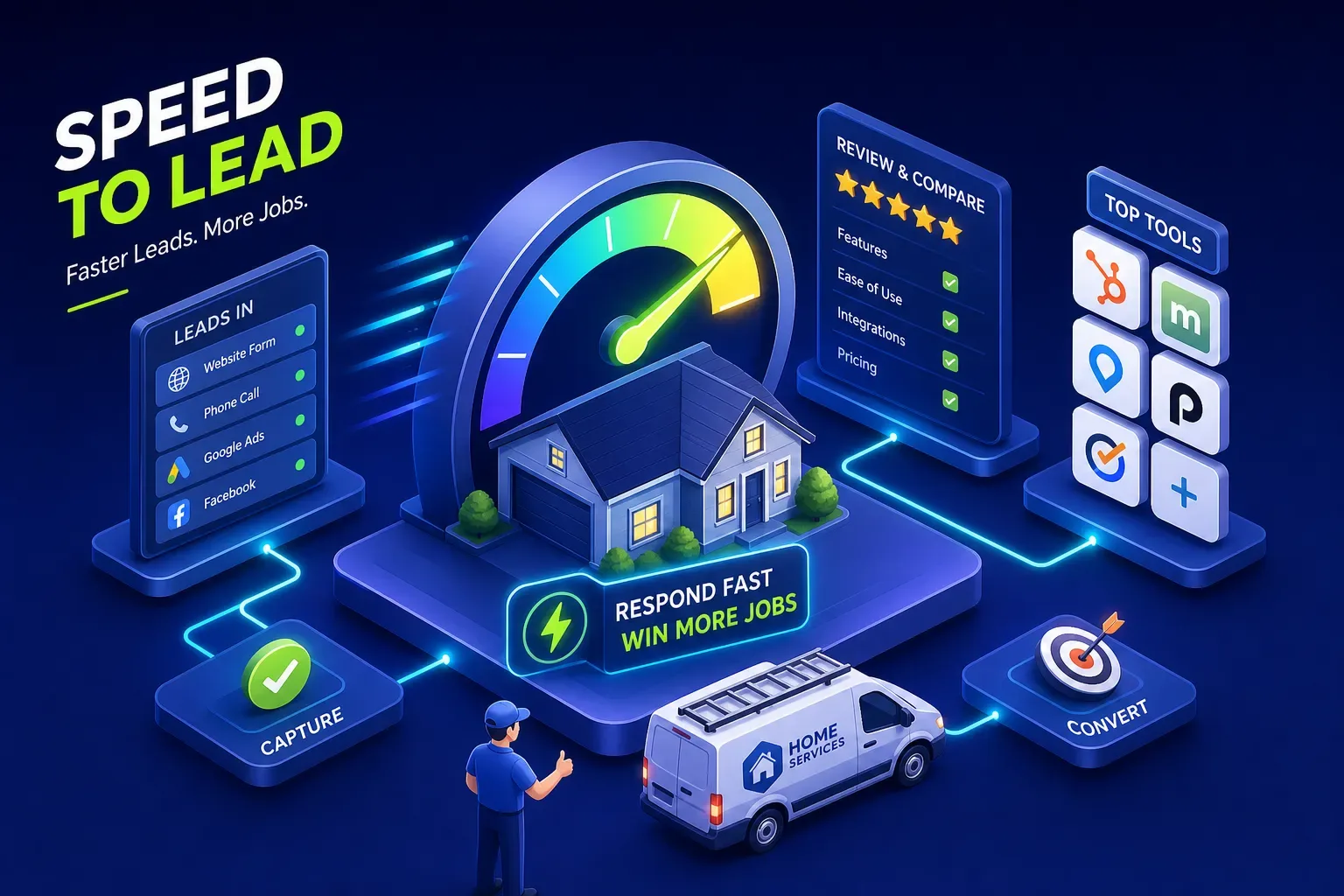
Speed matters more than anything else in home services. The homeowner with a broken furnace at 9pm isn't comparison shopping. They're calling the first number that answers, and if that number goes to voicemail, they dial the next one on the list. This is a practical roundup of speed to lead reviews for home services operators, written from inside a real HVAC company, not a marketing agency.
The research backs this up clearly: leads contacted within five minutes of first contact convert at rates 21 times higher than those reached after 30 minutes. The average HVAC shop in the United States takes about 47 minutes to respond, a benchmark documented in recent field service industry studies. That gap is where jobs are lost. Many owners don't realize it's happening because no one is measuring it.
At Temperature Pros Orlando, we use Maximus, our own AI platform, to handle exactly this problem. Full disclosure: we built Maximus, and we run it in our own shop before deploying it to any client. Every tool category covered here has been evaluated against one question: does it actually book the job, or does it just make the owner feel like they're covered?
Why Response Time Is the Real Competitive Edge in Home Services
The fastest business to respond wins. It's not a growth hack or a clever positioning strategy. It's the core mechanic of how home services revenue gets captured or lost every single day.
The 5-Minute Rule and What the Data Actually Shows
Respond within one minute and independent research has clocked a 391% lift in conversion compared to slower responses. Wait an hour and conversion odds drop by 90%. The five-minute mark is the inflection point, and most operators are running well past it without realizing it.
The average HVAC shop responds to inbound leads in about 47 minutes. That is not a competitive position. That is a revenue leak dressed up as normal operations. Most owners accept this because they've never benchmarked their own response time against what the data says it should be.
What a Missed After-Hours Call Is Actually Worth
After-hours calls are not edge cases. They are a predictable, recurring revenue event that most shops handle exactly the wrong way. To illustrate: a $400 average job value multiplied by four missed calls per week equals $83,200 per year sitting in voicemail. That assumes each missed call represents one lost job, a conservative read when you factor in repeat customers and referral chains. Published operator audits peg typical missed-call revenue losses for home services businesses between $50,000 and $78,000 annually, so the math lands in the same neighborhood regardless of the assumptions.
For a $1M to $3M HVAC shop, that is not a rounding error. That is a technician's salary walking out the door every year because nobody picked up the phone.
Speed to Lead Reviews: How Home Services Owners Rate Their Tools
The honest picture of what operators are actually using breaks into three categories: CRM automations, live answering services, and AI-powered platforms. None of them are perfect. The question is which one gets closest to solving the full problem, not just a slice of it.
CRM-Based Auto-Response and Text-Back Tools
Jobber, ServiceTitan, and Housecall Pro all have native automations that fire a text or email after a missed call, as documented in each platform's feature guides. These work for basic acknowledgment and they're worth having active. The limitation is real: they confirm the call was missed, but they don't answer questions, collect job details, or book a time slot.
GoHighLevel goes further with a sub-one-minute automation floor, per its published workflow documentation, and it's a capable marketing platform for shops willing to invest in configuration time. But these tools are a floor, not a ceiling. Owners who rely on CRM text-backs alone still lose callers who want a confirmed appointment, not a message saying someone will call them back.
Dedicated Answering Services and Live Virtual Receptionist Options
Live answering services promise a human touch. Owner reviews tell a more complicated story. The call gets answered, a message gets taken, and the follow-up still falls back on the owner or whoever is in the office the next morning.
The most common complaint in live answering service reviews isn't the quality of the conversation. It's what happens after it. No appointment confirmed. No job in the system. Just a message that needs to be returned, often by the owner at 7am when the caller has already moved on to someone else. For after-hours calls especially, this is only marginally better than voicemail.
Speed to Lead Reviews: What AI Platforms Actually Deliver
AI-powered call handling represents the next tier, and the widest gap between what vendors promise and what operators actually experience. Before committing to any platform in this category, it's worth understanding what the better-rated options do differently.
iSpeedToLead and Similar Lead-Routing Platforms
Platforms like iSpeedToLead focus primarily on lead distribution speed, routing inbound inquiries to available agents as fast as possible. Owner feedback on these tools tends to be mixed. The routing logic works, but the outcome depends entirely on who's on the receiving end. If no one picks up, the lead still dies. Complaints about iSpeedToLead in operator forums typically center on lead quality inconsistency and limited booking automation after the initial handoff.
Seller Lead and Wholesale-Oriented Services
Some speed-to-lead platforms, including several seller lead services marketed to real estate wholesalers, have found crossover use among home services businesses looking for lead generation volume. The lead quality and refund policy terms on these tools vary significantly. Seller lead services that work well in wholesale real estate don't always translate cleanly to HVAC or plumbing service calls, where the booking flow and job details matter as much as the initial contact speed.
Maximus: The AI That Answers, Books, and Follows Up Without a Staff Member
Maximus is an AI platform built specifically for home services owner-operators. It integrates directly with Jobber, Housecall Pro, and ServiceTitan, connects to QuickBooks, and handles the full inbound call workflow without requiring a human in the loop. It was built inside an actual operating HVAC company and tested on real revenue before being offered to any outside client.
What It Actually Does When a Call Comes In
A homeowner calls at 10pm. The furnace isn't heating. They're not leaving a voicemail. Maximus answers, gathers the job details, checks the schedule, and books the appointment. The owner wakes up to a morning briefing that covers exactly what came in overnight and what was handled automatically.
The difference between Maximus and a CRM text-back tool is the difference between answering the phone and sending a notification that it rang. One captures the job. The other just records that you missed it. For an after-hours emergency call, that distinction is the entire business outcome.
What Temperature Pros Orlando Achieved Using This System
These are company-reported results from a real operating HVAC business in Orlando, Florida. Maximus recovered over $31,000 from a single dormant customer reactivation campaign pulled directly from QuickBooks history. It collected $12,400 in aging accounts receivable within 90 days. On the speed-to-lead side, after-hours calls that previously went unanswered are now booked in real time, without an office staff member on duty.
The underlying system is the same one deployed to every Maximus client. These aren't projections built on industry averages. They're documented outcomes from an HVAC shop that used to miss the same calls every operator misses.
What Separates a Good Speed-to-Lead Tool from an Expensive Distraction
The market is full of platforms that solve one narrow piece of the response time problem and leave the rest untouched. Buying a tool that handles acknowledgment but not booking is just a more expensive version of the problem you already had.
Three Questions to Ask Before Committing to Any Platform
Does it actually book the job, or does it just acknowledge the call? Ask for a demo that shows the complete booking flow, not just the notification screen. There is a real difference between an AI that captures intent and schedules an appointment versus one that sends a text and waits for human follow-up.
Does it integrate with the software you already use? A speed-to-lead tool that doesn't connect to your field service management software creates a parallel workflow, more admin work, not less. And who handles setup and training? If the answer is "you," budget three to four weeks of configuration time before it runs reliably.
Red Flags That Show Up in Real User Reviews
Owner reviews surface the same warning signs repeatedly. Tools that require heavy manual configuration before they function at all are a common complaint, if the vendor's answer to every support question is a library of tutorial videos, that's a signal worth heeding. Platforms that answer calls but carry no booking logic are another: the AI picks up, collects a name and phone number, and stops. That is a more expensive version of voicemail.
The third pattern is services where the "AI" is actually a delayed human response. Call centers that market themselves as AI-powered but staff responses with overseas agents on a delay are more common than most buyers realize. They are slower than a real answering service and more expensive than a text-back automation. Ask direct questions about how responses are generated and who actually handles after-hours calls before signing anything.
How to Match the Right Tool to Where Your Business Actually Is
The best speed-to-lead tool is the one that fits your operation now. Not the most impressive one in the demo, and not the enterprise platform built for a 50-truck fleet when you're running five.
Matching Tool Complexity to Your Current Call Volume
A shop handling 20 inbound calls per week probably doesn't need a full AI call-handling platform on day one. A CRM text-back automation and a consistent follow-up process can move the needle meaningfully. At 50 calls per week with real after-hours volume, a 24/7 AI booking system pays for itself quickly because the jobs it captures outpace the monthly cost.
The math isn't complicated. If your average job value is $400 and you miss four calls per week, you're losing $1,600 per week to slow response. A tool that captures two of those jobs per week more than covers its cost. The question is not whether you can afford a better system. The question is how long you can afford to go without one.
Why Platform Depth Matters More Than the Number of Features
The operators who get the best results from speed-to-lead tools are not the ones with the most integrations. They are the ones who fully activate a smaller, tighter set of capabilities. A platform that does five things extremely well beats one that does twenty things poorly every time.
Maximus is built around this logic. It handles a defined set of tasks: 24/7 call answering, job booking, accounts receivable follow-up, dormant customer reactivation, and daily owner briefings. It doesn't try to be a marketing platform, a CRM, and a dispatch tool simultaneously. For the owner-operator running a $1M to $5M shop, that focus is the product.
The Job Goes to Whoever Responds First
That is not a tactic or a growth strategy. It is just how home services works, and the data makes the stakes clear. The five-minute window closes fast, the after-hours calls add up, and the competitor who answers at 10pm is booking jobs that should be yours.
Most tools in the market solve a fraction of that problem. They acknowledge the call, send a text, or log a message for follow-up. A real speed-to-lead solution for home services needs to answer, book, and follow up without the owner in the loop at all. Maximus was built to do exactly that, inside a real HVAC company, on real revenue, before it was offered to anyone else.
If your missed-call math is bad, these speed to lead reviews should be your next step. Start here: pull your missed call report from last week. Multiply that number by your average job value. If that number makes you uncomfortable, you already know what to do next.