The HVAC Business Exit Strategy Checklist Every Owner Needs
Most HVAC owners think about selling too late. They wait until they're exhausted, hand over three years of messy books, and walk into buyer meetings looking…
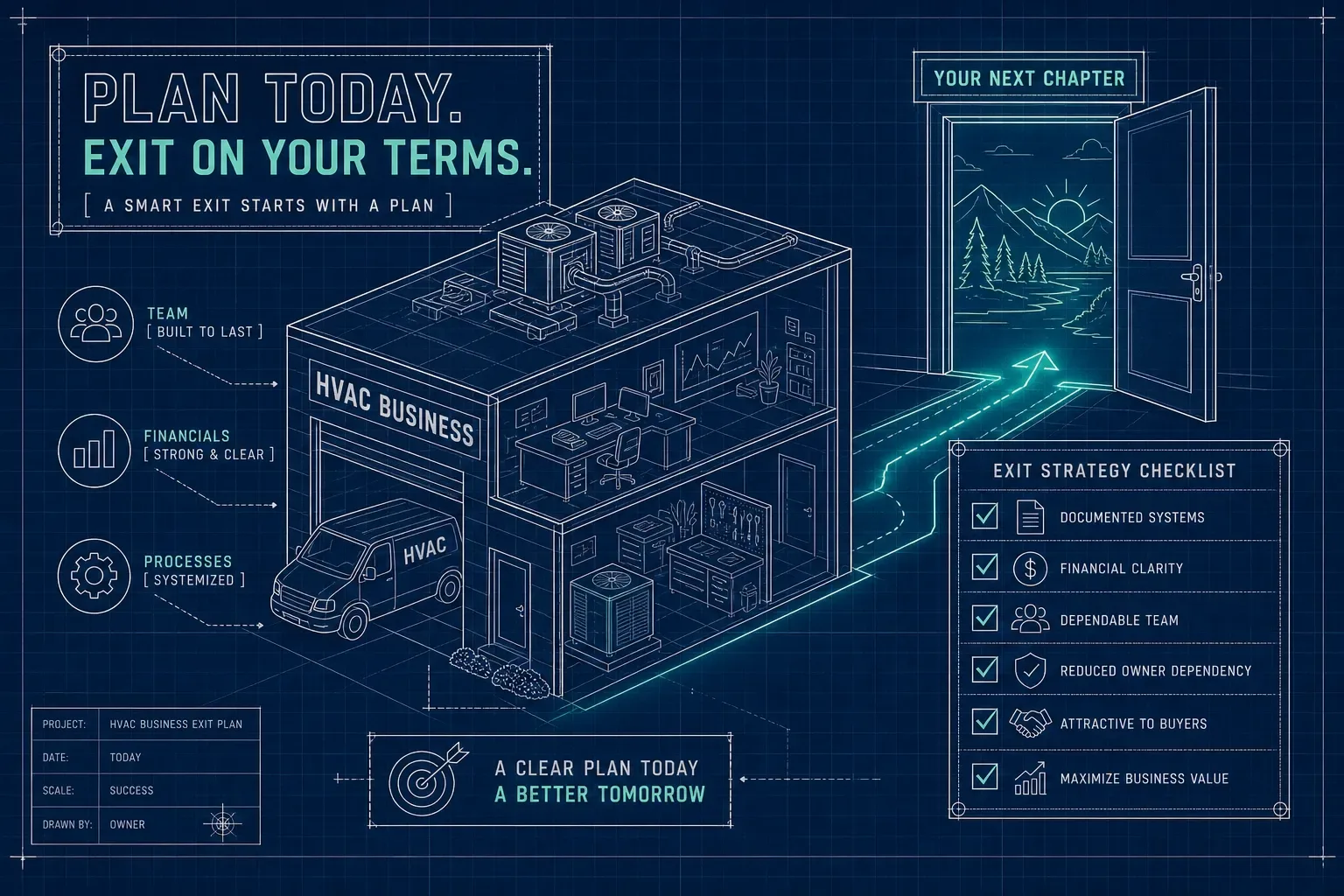
Most HVAC owners think about selling too late. They wait until they're exhausted, hand over three years of messy books, and walk into buyer meetings looking like the person the business can't function without. Then they're surprised when the offer comes in 30% below expectations. A solid HVAC business exit strategy isn't something you build in the six months before you list, it's the business you've been building for the two to five years before that. The owners who get full price didn't get lucky. They spent two to five years building a business that doesn't need them in it before they ever talked to a buyer.
This guide covers what buyers actually pay for, the exit options available to you, a five-step checklist to get your company ready, and the deal structure basics you need to understand before you sign anything. At Maximus, we went through this prep cycle firsthand at Temperature Pros Orlando, and we built the platform around exactly what buyers want to see when they're doing diligence on a home services company.
What Buyers Actually Pay for When They Look at an HVAC Company
Recurring service revenue is the single biggest premium driver in any HVAC sale. Buyers are paying for predictability. A maintenance-agreement base, where customers pay every year regardless of whether their system breaks, is the difference between a 3x and a 6x multiple. Industry benchmarks are consistent: recurring revenue can add 0.5x to 1.5x on top of your base multiple. If 30% or more of your revenue is recurring, you're in a fundamentally different conversation than a shop running purely on reactive service calls.
The second thing buyers scrutinize is owner dependence, and not in a good way. Small HVAC shops under $1M in revenue typically trade at 2.5x to 4.5x EBITDA. Professionally managed platforms with scale and systems clear 7x to 10x or more. The gap isn't purely about size, it's about transferability. When the owner answers the phones, chases invoices, and holds every customer relationship personally, buyers pay less because they're buying a job, not a business. That discount is real. It's also avoidable.
Certified technicians, low turnover, and a documented tech stack also support higher valuations, but they function as supporting drivers rather than primary levers. Recurring revenue and owner independence are what move the needle most. A business with a strong maintenance agreement base and a general manager who runs day-to-day operations will consistently command more than one with higher raw revenue and an owner who can't leave for a week without things breaking down. Get those two levers right and the rest of the premium follows.
HVAC Business Exit Strategy: Your Exit Options and What You're Trading Off
A third-party sale, either to a strategic buyer or a private equity platform, will generally produce the most cash at close. Strategic buyers want your geography and customer base. PE buyers want a platform they can bolt add-on acquisitions onto, and they'll ask for rollover equity and earnouts to keep you aligned through the transition. If maximizing your check is the priority, this path is almost always the right one. Current benchmarks for HVAC companies in the $1M to $5M revenue range put EBITDA multiples at roughly 4x to 6.5x, with stronger recurring-revenue businesses landing in the upper half of that band.
Family succession preserves the business for the next generation but rarely maximizes immediate liquidity. A management buyout gives continuity with operators who already know the business, but it almost always involves seller financing or deferred payments because the management team rarely has the capital to pay full price at close. Both paths carry real estate-planning and tax advantages worth modeling carefully. Just go in knowing you're likely trading immediate cash for other goals, whether that's legacy, continuity, or a structured transfer to heirs.
The tax math also changes depending on the path. A stock sale typically produces cleaner capital-gains treatment for the seller. An asset sale, which is more common in smaller HVAC transactions, allocates the purchase price across asset categories, and some of those categories, particularly equipment and vehicles, get taxed as ordinary income due to depreciation recapture. Your entity structure matters here too. A C-corp asset sale can trigger double taxation. An S-corp or LLC creates a different but still important tax picture. The after-tax result from an S-corp asset sale and a C-corp stock sale aren't even in the same ballpark. Get a CPA and a transaction attorney to model after-tax proceeds under each scenario before you commit to a direction. The highest gross price doesn't always produce the highest net number.
How an HVAC Business Exit Strategy Raises Your Valuation: The 5-Step Checklist (2 to 5 Years Out)
1. Systematize Operations So the Business Runs Without You
Document your dispatch process, pricing logic, service area rules, and technician assignments. Buyers want to see that a general manager, not the founding owner, could run this company on day one. If the answer to "what happens when you're not here" is chaos, you have real work to do before you talk to anyone about a sale.
2. Document Every Process That Lives in Your Head
Write SOPs for everything: how you quote a replacement system, how you handle a warranty call, how technicians close out a job in the field. Buyers conducting diligence will probe exactly these areas. Businesses with written processes close faster and at better terms because the risk profile looks lower from the buyer's seat.
3. Clean Up Your Accounts Receivable and Your Books
Aging AR over 60 days is a red flag in any diligence review. Pull your full open-invoice aging report, reconcile it to your general ledger, and attack the oldest collectible balances hard. Write off what's gone. A quality-of-earnings review runs $35,000 to $75,000 and will surface every problem a buyer's accountant will find, it's better to know early. Buyers discount businesses with messy books not because the revenue isn't real, but because they can't trust it. Get three years of clean, add-back-documented financials in place before you go to market.
4. Build Your Recurring Service Agreement Base
Start converting reactive customers to maintenance plans now. Every percentage point of recurring revenue you add over the next two to five years shows up as a higher multiple at sale. The math compounds quickly: $200,000 in recurring revenue at a 6x multiple adds $1.2M to your sale price compared to valuing that same revenue as one-off work. That is not a rounding error. That's the difference between a good exit and a great one.
5. Get the Front Office Off Your Plate
This is where most owner-operators stall. They fix their books, document their processes, and still show up to buyer meetings as the person who answers after-hours calls and personally follows up on unpaid invoices. Buyers see that and write down the valuation immediately. An AI-powered office layer like Maximus handles 24/7 call coverage, aging AR follow-up, daily operational monitoring, and dormant customer reactivation, without the owner being involved at all. When your front office operates independently, you show up to diligence looking like a platform, not a one-person shop with a logo.
Deal Structure Basics: What You'll Actually Be Signing
Most HVAC acquisitions under $5M in revenue close as asset sales. The buyer purchases specific assets, including equipment, vehicles, customer lists, and goodwill, while avoiding the entity's unknown liabilities. Stock sales are cleaner administratively but carry the company's full liability history, which is why buyers in smaller deals usually push for asset structures. Know which structure you're negotiating before you get to term sheets. How the purchase price is allocated across asset categories affects your tax bill directly, and that allocation is negotiated.
PE buyers almost always use earnouts tied to revenue or customer retention for 12 to 24 months post-close. A holdback, typically around 10% of the purchase price, sits in escrow to cover indemnification claims for a defined period. Rollover equity, where you keep a minority stake in the new entity, is standard in PE deals and can deliver a second, often larger payout if the platform scales. None of these terms are inherently bad. Each one requires a transaction attorney reviewing the specifics before you sign.
Strategic buyers generally pay more cash at close with fewer contingencies. PE buyers spread the payout across upfront cash, rollover equity, and earnouts to keep you aligned with the platform's next phase of growth. Understanding which buyer type you're talking to tells you a lot about the structure you should expect to see.
Tax and Succession Decisions That Change Your Net Proceeds
Entity structure and deal type both produce meaningfully different after-tax results. Depreciation recapture on vehicles and equipment gets taxed at ordinary income rates. Goodwill typically qualifies for capital gains treatment. The allocation of purchase price across asset categories is negotiated between buyer and seller, and how that negotiation goes changes the check you deposit at the end. This is not a conversation to have after you sign a letter of intent.
The right time to model your after-tax proceeds under a third-party sale, a management buyout with installment payments, and a family succession scenario is two to five years before you go to market. That modeling session shapes every decision that follows. It determines which exit path fits your goals, which operational improvements move the needle most on after-tax value, and what your realistic walk-away number looks like before you ever sit across from a buyer.
Start Building Your HVAC Business Exit Strategy Now, Not When You're Tired
The HVAC business exit strategy that produces full price isn't something you assemble in the six months before listing. It's built over two to five years of deliberate decisions. Clean books, documented processes, a recurring revenue base, and a front office that operates without you are the four things buyers pay a premium for, consistently, across deal sizes and buyer types. The fifth step, getting there operationally, is the hardest one and the one most owners leave too late.
Model your tax outcomes under each exit scenario. Understand your deal structure options before you're sitting across from a buyer. And if your front office still depends entirely on you to function, that's the first thing to fix. The operational layer you build now is the premium you collect at closing. Maximus exists to help home services owners build exactly that layer, starting with 24/7 call coverage, AR recovery, and the daily operational visibility that makes a business look like a platform rather than a practice.
The owners who get full price didn't get lucky. They started early and built something a buyer could run the day after they left. Start your HVAC business exit strategy now, and that can be you.