Build an HVAC Business That Buyers Pay Full Price For
How do you build an HVAC business that a buyer will actually pay full price for? Most owners never ask that question until it's too late.
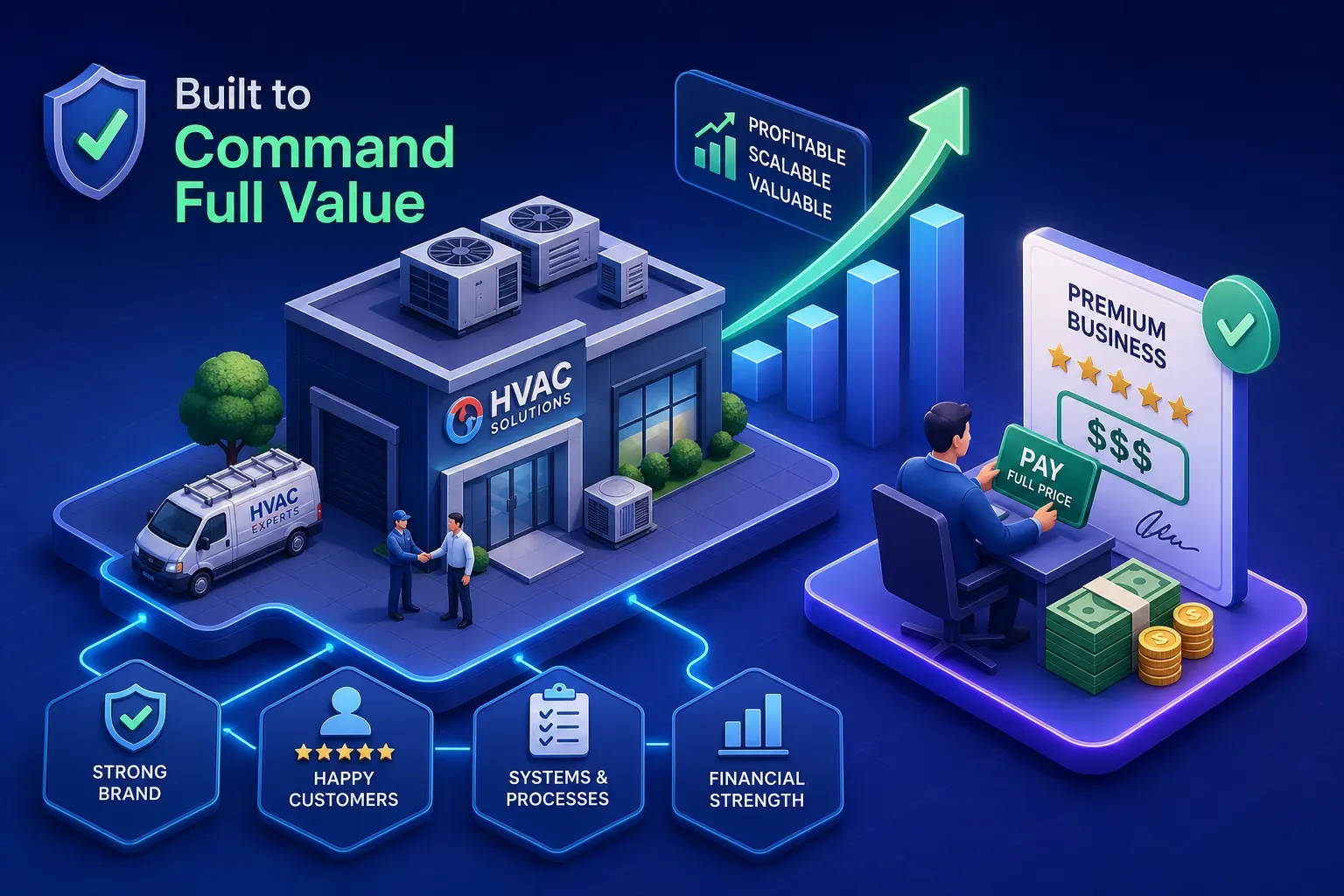
How do you build an HVAC business that a buyer will actually pay full price for? Most owners never ask that question until it's too late. They assume buyers are paying for revenue. They're not. Buyers are paying for a system that produces revenue without depending on one person. That distinction is everything when it comes to what someone will actually hand you at the closing table.
The valuation gap between those two types of businesses is not small. A typical owner-operated HVAC shop sells for 2x to 3.5x SDE. A professionally run business with recurring service revenue, documented operations, and management depth commands 5x to 8x EBITDA, sometimes higher. On a $500K SDE business, that spread translates to a difference of $1.5 million or more in total sale proceeds, once you normalize to a comparable earnings basis. That is not a rounding error. It is the result of specific, intentional preparation done two to three years before anyone contacts a broker.
This article is a working checklist for owners who want to land in the second category. At Temperature Pros Orlando, the HVAC company the Maximus team owns and operates, we have been building toward exactly this kind of buyer-ready business. Every lesson here came from running an actual shop, not from advising on them from the outside.
How to Build an HVAC Business a Buyer Will Pay Full Price For
The multiple gap between an owner-operated shop and a professionally run business comes down to one concept: transferable, repeatable cash flow. An owner-operator doing $2M in revenue is running a job. A business generating $2M with a dispatch system, documented SOPs, a service agreement base, and a team that handles operations is an asset a buyer can step into and run.
In 2026, small owner-operator HVAC businesses trade at 2x to 3.5x SDE. Businesses above $1M EBITDA with strong recurring revenue and management depth command 5x to 7.5x EBITDA at the mid-market level, with platform-quality businesses reaching 8x to 12x or higher. The jump is not gradual. It happens when specific thresholds are crossed, and the four levers that drive HVAC business valuation are: clean financials, recurring revenue, documented operations, and owner-independence. The rest of this article walks through each one.
PE firms and strategic acquirers underwrite risk, not return. Key-person dependence, install-heavy revenue, undocumented processes, and thin management all signal risk, and each one compresses the multiple. Owner-dependence alone can cost you 0.5x to 1.5x EBITDA compared to a comparable business that has systems in place. Buyers price the cost of replacing what the owner does personally, and they push that cost back onto the seller through a lower offer or through deal structure that shifts post-close risk onto you.
Your Financials Have to Be Clean Before You Go to Market
Buyers request the full financial package at the outset of due diligence. The standard request list includes three years of tax returns, monthly profit and loss statements, balance sheets, current year-to-date financials, accounts receivable and payable aging reports, bank statements, revenue broken down by service type, gross margin analysis, and payroll records. Owners who can't produce these documents promptly signal weak financial controls and an operation that isn't professionally managed. Start building this package now, not when a letter of intent arrives.
Many HVAC owners run personal expenses through the business to reduce taxable income. That is a reasonable tax strategy, and a genuine problem when it comes time to sell. Your books show lower earnings than the business actually produces, and buyers price what they see. The solution is the add-back process: normalizing owner compensation to a market rate, removing personal vehicle expenses, one-time items, and other non-recurring costs to show the true earnings power of the business. Working with a sell-side CPA or M&A advisor 12 to 18 months before a sale is strongly recommended, it is one of the highest-return investments you can make as part of your HVAC exit strategy. Clean, recasted books tell buyers the business is professionally managed, and that alone moves the multiple.
Recurring Revenue Is the Single Biggest Multiple Driver
Maintenance agreements HVAC businesses carry are the most direct lever you control for increasing your sale price. Businesses with 40% or more of revenue coming from recurring service agreements consistently command a premium of 0.5x to 1.5x EBITDA over install-heavy competitors. On a $600K EBITDA business, that is $300K to $900K in additional sale proceeds from one metric. An install-heavy HVAC shop is a solid business in a hot summer and a fragile one in a mild spring. Buyers price that volatility, and they price it against you.
Building a strong maintenance agreement base before you list requires a specific plan. Start by auditing your existing customer database for equipment age and service history. Older units, particularly those approaching or past their expected service life, are your best candidates for agreement conversion. As a practitioner rule of thumb, aim to grow your agreement count by 15 to 20 percent per year over the 18 months before you go to market. Track renewal rates and churn by quarter. Buyers will ask for this data specifically during buyer due diligence HVAC review, and a documented, growing maintenance base with a known renewal rate is what gets you into the 6x to 8x EBITDA range. An agreement count that is growing tells a fundamentally different story to a buyer than one that has sat flat for three years.
The Business Has to Run When You Are Not There
Buyers want proof that the business operates on process, not on the owner's personal judgment. The SOPs they expect to see include call intake and lead routing, dispatch, estimate approval, service ticket closeout, maintenance contract renewal, replacement sales handoff, collections policy, and technician onboarding. These do not need to be thick binders. They need to exist, be followed, and be demonstrable. A business where the owner is still the dispatcher, pricing committee, and collections department carries key-person risk that buyers discount immediately.
The operational proof layer matters as much as the documents. Buyers do not just want to hear that the business runs without you. They want to see evidence. What happens to calls at 9pm? Who flags invoices past 30 days? Who reviews overnight activity and escalates what needs attention? At Temperature Pros Orlando, we use Maximus to handle exactly this layer: 24/7 call answering and job booking, automated AR follow-up on aging invoices, and a daily 7am briefing that surfaces what happened while we were offline. When a buyer asks "what does the business look like without you in it?", owners who can point to documented systems and actual operational coverage data have a fundamentally different answer than owners who say "my team handles it." That difference shows up directly in the offer.
Understanding Deal Structure So "Full Price" Actually Means Full Price
Many HVAC owners negotiate to a headline number and then discover what the structure actually means for cash in their pocket. In PE-backed deals, cash at close is commonly 60 to 75 percent of total deal value. The remainder arrives through seller notes, earnouts tied to post-close performance, or rollover equity that pays out only if the buyer's platform exits successfully. A $10 million deal with 15 percent earnout and 15 percent rollover equity means $7 million guaranteed on closing day. That is standard deal architecture in the sell HVAC business world, and not knowing it before you negotiate puts you at a significant disadvantage.
Strategic acquirers tend to favor cleaner, cash-heavy closings. PE firms are more likely to structure continuity-oriented deals with rollover equity and earnouts designed to keep the seller aligned post-close. The practical guidance: push for higher cash at close. Be skeptical of large earnouts tied to metrics the buyer controls after closing. Understand that rollover equity is a bet on the buyer's future exit, not a payment. Work with an M&A attorney who specializes in home services transactions. The legal and advisory fees on a well-structured deal pay for themselves many times over compared to a poorly negotiated earnout that never triggers.
Your 6, 18 Month Sale Readiness Checklist
The first 90 days are foundation work. Organize three years of financials with clean, accurate books. Start tracking revenue by service type, separating recurring from non-recurring. Document your five most critical operational SOPs. Audit your maintenance agreement list for renewal rates and gaps. Begin the add-back conversation with your accountant. None of this work is glamorous, but it is what separates businesses that attract strong buyers from those that sit on the market at a discounted price.
From month four through month eighteen, the focus shifts to building demonstrable value. Grow your maintenance agreement count with intention. Verify your field service management software data is clean, accurate, and exportable. Reduce the hours you personally spend on office tasks by systematizing call coverage, AR follow-up, and daily reporting. Build at least one layer of management so someone else can run operations without you in the building. Set a concrete target: one full week away from the business with no operational crisis. Reaching that milestone is not a gut feeling, it is the clearest evidence buyers look for when deciding whether your business belongs in the higher multiple range.
- Three years of clean, recasted financials with documented add-backs
- Maintenance agreement base growing at 15%+ per year with tracked renewal rates
- Core SOPs written and demonstrably followed for dispatch, sales, collections, and onboarding
- Documented after-hours call handling and AR follow-up processes with evidence of consistent execution
- Management depth with at least one person capable of running operations independently
- Revenue breakdown by service type showing recurring percentage clearly
The Gap Is Preparation, Not Luck
Building an HVAC business that a buyer will actually pay full price for is not about timing the market or getting lucky with the right acquirer. It is the result of deliberate work done in the years before the sale. Clean books, recurring revenue, documented operations, and a business that proves it runs without its owner, those four things move the multiple more than any other factor a seller controls.
Most HVAC owners never complete this work because they are too busy running the business to build the business. The owners who sell at full price did not start preparing the year they decided to sell. They started two to three years earlier, running the business as if it were already for sale. Pick one section from this checklist and make concrete progress on it this month. The preparation compounds, and the gap between where your business is today and where it needs to be for a premium exit closes faster than most owners expect once the work actually starts.